In This Article
You invested money. Your balance grew. Now you want to withdraw — and something is blocking you. Maybe it's a "tax fee." Maybe it's "verification." Maybe it's a customer support loop that never resolves. You're starting to wonder if any of this is real.
Here's the direct answer: if a crypto investment platform is blocking your withdrawal for any reason that requires you to send more money, it is a scam. No legitimate exchange on earth requires deposit fees, pre-paid taxes, or additional verification deposits before releasing funds you've already earned.
The Short Answer
If the platform cannot release your funds without you first sending more money — for any reason — it is a scam. The balance you see is fabricated. The "customer support" prolonging the process is part of the operation. Stop sending money immediately, preserve every screenshot you have, and read the rest of this page before doing anything else.
How Fake Crypto Investment Platforms Work
Fake crypto investment platforms — sometimes called pig butchering scams when they involve a romantic or trust-building approach — are not improvised. They are software operations that mimic real exchanges with fake charts, fake balances, and fake customer support teams.
The trap works in stages:
- Platform introduction. You're introduced to the platform by someone you met online, through social media, a dating app, or sometimes a "wrong number" text. They've been building trust with you, possibly for weeks or months. See the romance scammer playbook for how this grooming works.
- Small wins. You make an initial deposit. The platform shows you impressive returns — sometimes 20–40% in days. You're encouraged to make a larger deposit to "maximize the opportunity." This is designed to get you emotionally and financially committed.
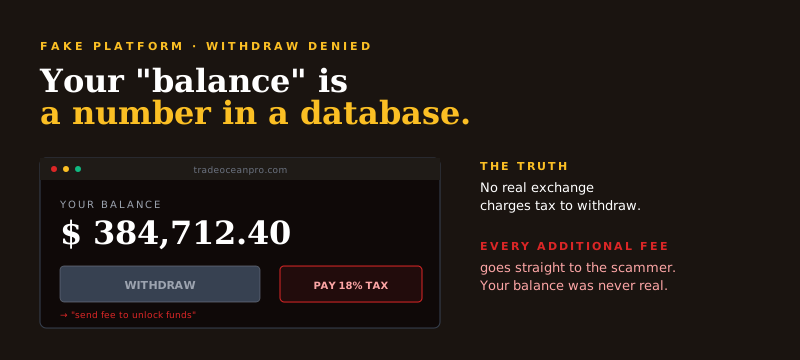
- The withdrawal block. When you try to withdraw your funds, a reason surfaces for why you can't — yet. This is where the second phase of theft begins. Every fee you pay to "unlock" your funds goes directly to the scammers.
- The endless loop. Pay the fee, a new requirement appears. This continues until you refuse to pay or run out of money. The balance was never real.
The balances displayed on these platforms have no connection to any blockchain. They are numbers in a database controlled entirely by the scammers. If you try to verify your balance on a block explorer, you will find no corresponding on-chain record.
The 6 Withdrawal Block Tactics Scammers Use
"You must pay 20% tax withholding before we can release your earnings." No exchange collects taxes on behalf of governments. This fee is fabricated and goes straight to the scammers.
"We need a refundable security deposit to verify your identity." Verification on real platforms is document-based, not deposit-based. Any platform requiring you to deposit money to prove your identity is running a scam.
"Your account needs to be upgraded to a VIP tier before large withdrawals are permitted." A fabricated account tier that requires payment. Pay it and another tier appears.
"International transfers require an insurance bond." No legitimate exchange requires insurance payments from users. This is pure fabrication designed to extract more funds.
"Your account has been flagged for routine compliance review." Designed to delay while you stay invested, hoping the situation resolves. It won't — this is a stall tactic to keep you from realizing the scam.
"You must refer three new investors before withdrawals are enabled." Turns you into an unwitting recruiter for the scam and delays your realization while involving others.
Every payment made to "unlock" a withdrawal is a new theft. The original funds are already gone. Each fee payment is not bringing you closer to recovery — it is increasing your total loss. The moment a platform asks you to pay anything to receive your own money, stop completely.
Red Flags You're on a Fake Platform
- The platform was introduced to you by someone you met online, not through your own research
- The website domain is very new (check with WHOIS) despite claims of years of operation
- Returns are suspiciously consistent — real markets are volatile, fake platforms show unrealistic steady gains
- Customer support communicates only via Telegram, WhatsApp, or email — not through verifiable official channels
- The platform is not registered with FINRA, the SEC, CFTC, or any equivalent regulator in its claimed jurisdiction
- Your balance cannot be verified on a public block explorer
- Withdrawal attempts generate new requirements rather than processing
- The same person who introduced the platform is also your "customer support" contact
- There are no verifiable reviews on independent platforms like Trustpilot, Reddit, or BitcoinTalk
- The platform name closely resembles a legitimate exchange (e.g., "Coinbase Pro Markets" vs. the real Coinbase Pro)
How to Verify If a Platform Is Real
Before assuming the worst, here's how to do a quick legitimacy check on any crypto platform:
- Check regulatory registration. Real US-facing exchanges are registered with FinCEN as Money Services Businesses. Check the FINRA BrokerCheck and the CFTC's registration database. No registration is a major red flag. See our knowledge base on how to tell if a crypto exchange is legitimate.
- Verify on-chain. Deposit a small amount and try to find that specific transaction on a block explorer like Etherscan or Blockchain.info. If you can't find your deposit as an actual on-chain transaction, the platform is not holding real crypto.
- Search the platform name + "scam" or "review" on Google, Reddit, and Trustpilot. Fake platforms often have warning threads from previous victims.
- Check the domain age. Use WHOIS (whois.domaintools.com) to check when the website was registered. A platform claiming to be established since 2018 but with a domain registered last month is fraudulent.
- Test a small withdrawal first. Before making any significant investment, request a small withdrawal to verify the platform actually processes them. Scam platforms often allow small early withdrawals to build trust before blocking larger ones.
What to Do Right Now
If you believe you are on a fake platform, here is the exact sequence of actions to take immediately:
- Stop all payments immediately. Do not pay any fee, tax, insurance, or upgrade cost. Every payment from this point is a new loss with zero chance of recovery.
- Screenshot everything. Your account balance, every transaction record, every communication with the platform and the person who introduced it to you. Do this before they can lock you out. Our guide on gathering transaction evidence has the full checklist.
- Do not confront the scammer yet. Alerting them that you've identified the scam can cause them to destroy records, move funds, or disappear entirely. Gather evidence first.
- Contact your bank if you funded via bank transfer. Wire recalls have a narrow window — sometimes as little as 24 hours. Call your bank immediately if any funding came from a bank wire or ACH transfer.
- File reports. File at IC3.gov, the FTC at ReportFraud.ftc.gov, and your state attorney general. Use our step-by-step FBI reporting guide.
- Get a blockchain forensic trace. If you sent cryptocurrency, an on-chain trace can identify exactly where your funds went — which exchanges received them and which accounts hold them. This is the foundation of any recovery effort.
After you identify a fake platform and start searching for help, you will likely be contacted by "recovery services" claiming they can retrieve your funds. Many of these are secondary scams run by the same criminal networks. Before engaging any recovery service, read our guide on how to tell a legitimate recovery service from a scam.
Can You Get Your Money Back?
The honest answer depends on several factors. See our complete breakdown at can you get crypto back after being scammed, but here's the summary for this specific situation:
If you funded via credit card: Contact your card issuer immediately about a chargeback. Your success rate depends on how recently the transaction occurred and whether it was classified as a goods/services purchase. Read our full guide on crypto chargebacks through your bank.
If you funded via bank wire: Wire recalls are possible within a narrow window. Contact your bank immediately. The longer you wait, the lower the probability.
If you sent cryptocurrency directly: On-chain forensics can trace where your funds went. If they landed on a regulated exchange that has not yet moved them out, there may be grounds for an exchange-level freeze request or civil legal action. Recovery is more likely the sooner you act — see realistic recovery timelines for what to expect.
If funds have passed through multiple wallets or mixers: Recovery becomes harder but tracing is still possible. The on-chain evidence is still there — it just requires more sophisticated analysis. See how forensic investigators trace stolen crypto for what this process looks like.
Frequently Asked Questions
Why can't I withdraw from my crypto investment platform?
If the platform is blocking your withdrawal and asking for fees, taxes, verification deposits, or giving vague technical excuses — it is almost certainly a scam. Legitimate exchanges do not require you to pay anything before processing withdrawals. The "can't withdraw" mechanism is the core trap: they show you a large balance, then block access until you send more money, which they also keep.
My crypto platform says I need to pay a tax fee to withdraw — is that real?
No. This is one of the most common withdrawal scam tactics. Legitimate platforms do not collect taxes on behalf of governments. No real exchange requires you to pre-pay tax withholding before releasing funds. The "tax fee" is fabricated — stop sending money immediately.
Is the balance I see on a fake crypto platform real?
No. Fake platforms display fabricated balances. The numbers on screen are not connected to real blockchain transactions. If you cannot find your deposits traceable on a public block explorer, the platform's stated balance has no relation to real cryptocurrency.
Can I get my money back from a fake crypto investment platform?
Sometimes — but speed matters enormously. If funds came through a bank wire or credit card, contact your bank immediately. If you sent cryptocurrency directly, a blockchain forensic trace can identify where funds went and may support civil litigation or exchange-level intervention.
What should I do right now if I think my crypto platform is a scam?
Stop sending money immediately. Screenshot everything — account balance, every communication, every transaction. Report to IC3.gov and the FTC. Contact your bank if any funding came from your bank account. Then get a blockchain forensic trace started — the on-chain evidence is time-sensitive.
Think You're on a Fake Platform? Get a Forensic Trace Started
We trace on-chain fund flows to identify where your deposits actually went — which exchanges received them and what recovery options exist. Free consultation, honest assessment of your case.