In This Article
- What IC3 is and who reviews your complaint
- Why most crypto scam complaints go nowhere
- What to gather before you file
- Step-by-step: filing your IC3 complaint
- What to write in the narrative section
- What happens after you file
- Other agencies to report to simultaneously
- How a forensic report changes the outcome
- Frequently asked questions
The IC3 — the FBI's Internet Crime Complaint Center — received over 880,000 complaints in 2023 and documented more than $12.5 billion in losses. Cryptocurrency fraud was the top reported loss category. The FBI cannot individually investigate each complaint. What it can do is identify patterns, build cases, and direct field offices toward the most actionable fraud networks.
Whether your complaint contributes to that process — or disappears into the queue — depends almost entirely on the quality and specificity of what you submit. This guide explains exactly what to include. If you want broader context first, see our full guide on how to report a crypto scam to the FBI.
What IC3 Is and Who Reviews Your Complaint
IC3 is an intake and analysis center, not a direct investigation unit. Complaints are reviewed by FBI analysts who use them to identify fraud patterns, aggregate related cases, and route matters to field offices or task forces for investigation. Your individual complaint is most likely to matter when it connects to existing patterns — wallet addresses already associated with known fraud networks, platform names appearing in multiple complaints, or recurring operational signatures.
This means filing a vague complaint ("I was scammed out of $50,000 in Bitcoin by someone I met online") contributes little. Filing a specific complaint with wallet addresses, transaction hashes, exchange records, and a clear narrative materially increases the odds your complaint connects to an active case pattern — or creates a new one.
Why Most Crypto Scam Complaints Go Nowhere
The most common reasons IC3 crypto complaints fail to trigger action:
- No on-chain data. Complaints that mention crypto fraud but include no wallet addresses or transaction IDs give analysts nothing to work with. The blockchain trace is where actionable intelligence lives.
- Narrative without timeline. "I sent money over several months" is not actionable. "I sent 0.5 BTC on March 3, 0.8 BTC on March 19, and 1.2 BTC on April 2" gives investigators a dated record to corroborate on-chain.
- Scammer details without contact info. The persona name alone is worthless. Platform usernames, profile URLs, phone numbers, and email addresses are what connect your case to other complaints about the same operator.
- No documentation of where you bought the crypto. The exchange you used to purchase crypto has KYC records and transaction logs. Law enforcement needs to know where to send legal process.
- Filing too late. Funds move quickly. The sooner a complaint is filed with specific on-chain data, the higher the chance that exchange accounts still hold the funds and a freeze is possible. See our guide on the first 72 hours after theft.
What to Gather Before You File
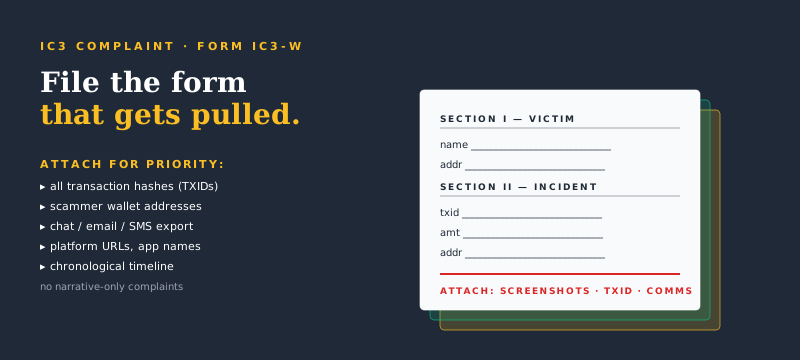
Collect everything in the list below before opening the IC3 complaint form. Having it in front of you makes the filing significantly more complete:
- Every cryptocurrency wallet address you sent funds to
- Every transaction hash (TXID) — found in your sending wallet's transaction history or on the blockchain explorer
- Date, amount, and cryptocurrency type for every transfer
- The name of the exchange or wallet you used to send the funds
- Your own account details at the exchange (account email, not password) — law enforcement may need to contact the exchange about your account
- Screenshots of all communications with the scammer (messages, emails, profile photos)
- Every platform where contact occurred (dating app, WhatsApp, Telegram, LinkedIn, etc.) and the scammer's profile details on each
- Phone numbers, email addresses, or social media handles used by the scammer
- Any website URLs the scammer directed you to (fake trading platforms, investment sites)
- A written chronological summary of what happened — dates, amounts, platform, narrative used
For help gathering transaction evidence, see our knowledge base guide on gathering transaction evidence after a crypto theft.
Step-by-Step: Filing Your IC3 Complaint
Go to IC3.gov
Navigate to ic3.gov. Click "File a Complaint." You'll be asked to create an account or file as a guest. Creating an account allows you to access and update your complaint later — recommended.
Select Complaint Category
Select the category that best matches your situation. For crypto scams, the most relevant categories are: "Investment Fraud" (for pig butchering/fake trading platforms), "Romance Scam / Confidence Fraud" (for relationship-based scams), or "Cryptocurrency Fraud" as a general category. If your scam involved a fake trading platform, choose Investment Fraud — the FBI's CCTF team specifically targets these.
Enter Subject / Suspect Information
Fill in every field you have data for. Platform username, email, phone number, profile URL, name used. More detail here = more potential for your case to match other complaints about the same actor.
Enter Financial Loss Details
List every transaction: date, amount in USD, cryptocurrency type, and destination address. The form may limit fields — use the narrative section to include overflow transaction details if needed. Total loss in USD matters for prioritization thresholds.
Write the Narrative — This Is the Most Important Section
The free-text narrative is where you can provide context that makes your complaint actionable. Guidance for this section is in the next section of this article.
Upload Supporting Documentation
Attach screenshots of communications, transaction records, and any wallet addresses or TXIDs you have. File size limits may apply — prioritize transaction evidence and scammer contact details over chat screenshots if you have to choose.
Submit and Record Your Complaint Number
Save your IC3 complaint number. You'll need it if you follow up, if an agent contacts you, or if you need to reference the complaint in civil litigation or with other agencies.
What to Write in the Narrative Section
The narrative section is your best opportunity to make your complaint actionable. A strong IC3 narrative for a crypto scam includes:
- How contact was initiated — platform, date, method (unsolicited message, wrong number text, dating app match)
- The relationship or scenario developed — brief description of the cover story used (investment coach, romantic partner, business opportunity)
- How crypto was introduced — first financial request, framing used, urgency narrative
- Complete transaction record in chronological order — date, amount, cryptocurrency, destination wallet address, TXID for each transfer
- The exchange you used to purchase or send the crypto
- All wallet addresses you sent funds to, including any intermediate wallets if known
- Any website URLs the scammer directed you to
- How the scam ended — did contact stop, were you asked for more money, did someone contact you claiming to be a recovery service
"On [date], I was contacted via [platform] by an individual using the name [name] / username [username]. Over [time period], they [brief description of what happened]. I transferred the following cryptocurrency to the following addresses: [list transactions]. I purchased this crypto via [exchange name], account registered to [your email]. The scammer's contact details were: [list]. Total loss: $[amount]."
What Happens After You File
Understanding what to realistically expect after submission prevents frustration:
- You will receive a confirmation email with your complaint number. Save it.
- Analysts will review your complaint. High-specificity complaints with on-chain data get more attention. Vague complaints may be filed and used only for aggregate pattern statistics.
- You may not hear anything. Most complainants never receive individual follow-up. This does not mean your complaint was ignored — it may be aggregated into a larger case you'll never see.
- If your complaint connects to an active investigation, an FBI agent may contact you for additional information. This is more likely with larger losses ($100k+) or when your wallet addresses match known fraud networks.
- If funds are still in a known exchange account, law enforcement may be able to request a freeze — but this requires both actionable on-chain data and a relatively fast response time. This is why filing quickly matters.
Other Agencies to Report to Simultaneously
IC3 should not be your only report. File with all applicable agencies — each contributes to different enforcement channels:
FTC (Federal Trade Commission)
Feeds the Consumer Sentinel database used by 3,000+ law enforcement agencies. Important for fraud pattern detection and consumer protection enforcement.
ReportFraud.ftc.govState Attorney General
State-level consumer protection. Varies in crypto enforcement capacity but important for building a legal record and potentially triggering state-level action.
Your state AG's consumer protection pageCFTC
Commodity Futures Trading Commission has jurisdiction over crypto derivatives and commodity-linked fraud. Relevant for fake trading platform scams.
whistleblower.gov / smartcheck.govThe Exchange Directly
Submit a fraud report to the exchange where funds were received. Exchange fraud teams can sometimes freeze accounts faster than law enforcement. Include transaction hashes.
Each exchange's support/fraud reporting portalHow a Forensic Report Changes the Outcome
The single most impactful thing you can add to an IC3 complaint is a blockchain forensic report from a qualified investigator. Here's why:
An IC3 complaint with wallet addresses gives law enforcement the starting point. A forensic report gives them the complete fund flow — every wallet the funds touched, exchange attribution, mixer interactions, and a documented chain of evidence that transforms a complaint into a ready-to-subpoena case.
FBI agents and prosecutors work with limited bandwidth. A case that comes with a documented fund flow already traced to a specific exchange account requires less work to prosecute than one that requires the agent to start the blockchain analysis themselves. That difference affects which cases get prioritized.
Additionally, a forensic report can be submitted alongside your IC3 complaint as supporting documentation, and can be used in parallel civil litigation if law enforcement timelines don't fit your situation. See our guide on law enforcement vs civil lawsuit for crypto fraud for a comparison of your options.
Frequently Asked Questions
What is the IC3 and who reviews complaints?
IC3 is the FBI's Internet Crime Complaint Center — an intake and analysis center, not a direct investigation unit. Complaints are reviewed by FBI analysts who use them to identify patterns, build cases, and refer matters to field offices. Individual complaints rarely trigger standalone investigations, but they feed pattern detection that drives major enforcement actions.
What information should I include in an IC3 complaint for a crypto scam?
Include all wallet addresses you sent funds to, transaction hashes (TXIDs) for every transfer, dates and amounts, the exchange you used, screenshots of communications, all contact details for the scammer, and a clear chronological narrative. The more specific and documented, the more actionable.
Will the FBI contact me after I file an IC3 complaint?
Not necessarily. IC3 complaints are used for pattern analysis and case building, not as direct service requests. The FBI may contact you if your complaint connects to an active investigation or if it meets thresholds for standalone investigation. Most complainants don't receive individual follow-up — but filing is still important.
What other agencies should I report to besides the FBI?
In addition to IC3: the FTC at ReportFraud.ftc.gov, your state attorney general's consumer protection division, the CFTC if the scam involved commodity trading or crypto derivatives, and directly to the exchange the scammer used. Each contributes to different enforcement channels.
Get a Forensic Report That Supports Your IC3 Filing
A documented fund flow trace makes your complaint actionable. We trace wallet-to-wallet flows, identify exchanges, and produce reports that give law enforcement something to subpoena. Free consultation — honest about what your case looks like.