In This Article
The question every crypto fraud victim asks, and rarely gets a straight answer to: does filing a report with the FBI actually do anything? The cynical answer is no — too many complaints, too few agents, too much crypto. The naive answer is yes — law enforcement will investigate and you'll get your money back. The honest answer is more nuanced than either.
This article gives you that honest answer, explains what actually happens when a complaint is filed, and tells you what factors determine whether your report matters. For the mechanics of filing, see our step-by-step IC3 complaint guide. For the basics of reporting, see how to report a crypto scam to the FBI.
The Honest Answer
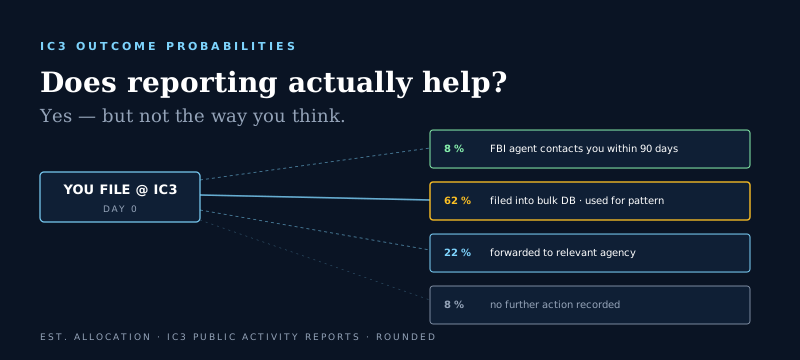
Yes, reporting helps — but almost never in the way victims hope, and only if the report contains enough specific information to be actionable. Most individual complaints don't trigger standalone investigations. What they do is build the pattern data that drives large enforcement actions, create legal records that support civil remedies, and — when properly documented — give field agents something concrete to act on. The gap between "I filed a report" and "the FBI called me" is almost always wide, and almost always explained by the quality of the complaint rather than the FBI's indifference.
What Actually Happens to Your Complaint
When you file at IC3.gov, your complaint enters a review pipeline run by FBI analysts. Here's the realistic sequence:
- Intake and triage. Analysts review complaints for actionability — do they contain on-chain data, identifiable contact information, and a loss amount that meets internal prioritization thresholds?
- Pattern matching. Your wallet addresses, platform names, and suspect details are compared against existing case data. If your scammer's wallet appears in other complaints or is linked to a known fraud network, your case connects to something larger and becomes more actionable.
- Aggregate case building. Complaints that don't individually meet investigation thresholds may collectively trigger action. A dozen complaints about the same fake trading platform, wallet cluster, or Telegram account builds a case that a single complaint couldn't.
- Field office referral. Complaints that meet investigation thresholds are referred to FBI field offices or specialized units like the Cryptocurrency Task Force. This is where actual subpoenas to exchanges happen.
- No follow-up in most cases. The majority of complainants never hear back. This doesn't mean their complaint was discarded — it means it was aggregated into patterns or didn't individually meet standalone investigation criteria.
When FBI Reporting Works
Works Well When
- Loss is $100,000 or more
- You have wallet addresses + TXIDs
- Funds are still on exchange
- Report filed within 72 hours
- Your case matches known patterns
- You have a forensic report
- Multiple victims, same operator
Works Poorly When
- Loss under $10,000
- No on-chain data provided
- Funds already moved to privacy coins
- Filed weeks or months later
- Complaint is narrative only
- International scammer, non-cooperative jurisdiction
- No corroborating evidence
When It Doesn't
FBI reporting is least effective when:
The funds are already gone through mixers or privacy coins. Once crypto passes through a professional mixing service or is converted to Monero, the on-chain trail degrades significantly. Law enforcement has fewer actionable leads, and the case becomes much harder to prosecute even when the perpetrator is identified.
The operator is in a non-cooperative jurisdiction. Many organized crypto fraud operations run from countries that don't participate in MLAT agreements or that have limited cooperation with US law enforcement. Even a perfect blockchain trace leading to an identified individual in one of these jurisdictions may not result in prosecution.
The loss amount doesn't meet practical investigation thresholds. Federal agents have finite bandwidth. While there's no official minimum, practical reality suggests standalone federal investigations are more common for losses above $100,000. Smaller losses matter for aggregate patterns but rarely receive individual investigative resources.
The complaint contains no on-chain data. A narrative complaint without wallet addresses or transaction hashes gives analysts almost nothing to work with. Pattern detection requires data — specifically, the kind of data that lives on the blockchain.
What Factors Affect Your Individual Case
What Reporting Accomplishes Even Without Prosecution
Even when FBI reporting doesn't result in prosecution or fund recovery, it accomplishes several things that matter:
- Creates a legal record. A filed IC3 complaint is a document that can be referenced in civil litigation. It establishes that you reported the fraud to authorities, which is often a prerequisite for certain civil remedies and for working with attorneys on asset recovery cases.
- Contributes to enforcement against repeat operators. Organized fraud operations run the same playbooks against many victims. Your complaint adds to the pattern data that eventually builds the case that takes the operation down — even if you never hear about the outcome.
- May enable exchange cooperation. Some exchanges will cooperate with account holds or information requests when presented with an IC3 complaint number and transaction evidence, even before law enforcement formally subpoenas them. The complaint demonstrates the legitimacy of your report.
- Establishes priority for civil attorneys. If you pursue civil recovery through an attorney, an FBI complaint demonstrates you've exhausted initial law enforcement channels and provides a documented timeline of the fraud.
The FBI's 2023 cryptocurrency fraud enforcement actions — which disrupted multiple pig butchering networks, resulted in asset seizures of hundreds of millions of dollars, and identified criminal networks operating from Southeast Asia — were built on patterns aggregated from thousands of individual IC3 complaints. Your complaint may never result in a call from an agent. It may contribute to an enforcement action that protects thousands of future victims. Both outcomes matter.
How a Forensic Report Changes the Outcome
The single variable that most consistently improves outcomes in crypto fraud cases is the quality of blockchain forensic documentation attached to the report. Here's the practical difference:
Without a forensic report: Law enforcement receives a narrative complaint with some wallet addresses. To act on it, an agent needs to: obtain blockchain analysis access, run the trace, interpret the results, identify exchange attribution, build the documentation for a subpoena, and write the legal process. This takes time and analyst capacity that may not be available at the individual case level.
With a forensic report: Law enforcement receives a complete, documented fund flow — wallet-by-wallet trace, exchange attribution, timeline, and a structured evidence report ready to attach to legal process. The subpoena to the exchange is already identified; the agent just has to execute it. Cases that come with forensic documentation are significantly more likely to receive active attention because the investigative work is already done.
This is why private blockchain investigation isn't an alternative to FBI reporting — it's what makes FBI reporting effective. See how forensic investigators trace stolen crypto and realistic recovery timelines for what the full process looks like.
After reporting a crypto scam, victims are frequently targeted by fake recovery services that claim to work with the FBI or to have access to law enforcement databases. The FBI does not partner with private recovery companies. Anyone who contacts you unsolicited claiming they found your case through FBI records or can guarantee recovery is running a secondary scam. See our guide on spotting fake crypto recovery services.
Your Action Plan
Based on everything above, here's the highest-value sequence of actions after a crypto fraud loss:
- Preserve all evidence immediately. Screenshots of every communication, all transaction records, all wallet addresses. Do not delete anything. See our guide on gathering transaction evidence.
- File an IC3 complaint within 72 hours with all available on-chain data — wallet addresses, TXIDs, amounts, dates. Use our IC3 filing guide to maximize complaint quality.
- Report to the exchange where funds were received simultaneously. Request account freeze based on fraud evidence. Include your IC3 complaint number and transaction hashes.
- File with FTC at ReportFraud.ftc.gov and your state attorney general's consumer protection division.
- Get a private blockchain forensic trace started. This produces the documented fund flow that makes all of the above more actionable — and opens civil recovery options that don't depend on federal prosecution timelines.
Frequently Asked Questions
Does reporting a crypto scam to the FBI actually do anything?
Yes — but almost never in the way victims expect. Individual complaints rarely trigger standalone investigations. What they do is build pattern data that drives enforcement actions, create legal records that support civil remedies, and — when properly documented — give field agents something concrete to act on. The impact of your report is almost entirely determined by the quality of information you provide.
How long does it take the FBI to investigate a crypto scam?
Federal investigations are measured in months to years, not days. This is one reason victims pursuing fund recovery work with private blockchain forensic investigators in parallel — civil remedies and exchange subpoenas can move significantly faster than federal prosecution timelines.
What dollar amount does the FBI investigate crypto fraud at?
There's no official published threshold, but standalone federal investigations are most common at losses of $100,000 or more. Smaller cases contribute to aggregate patterns and may be part of multi-victim enforcement actions. Victims with smaller losses may need to pursue civil remedies in parallel rather than waiting for federal action.
What's the most effective thing I can do to get my crypto back?
The most effective combination: immediate IC3 complaint with all on-chain data, simultaneous report to the exchange where funds were received, and a private blockchain forensic trace to document the fund flow. The forensic trace is often the critical piece — it tells law enforcement and civil attorneys exactly where the money went and provides the documentation needed to issue formal legal process to exchanges.
Get a Forensic Report That Makes Your FBI Report Actionable
We produce documented fund flow traces that give law enforcement and civil attorneys the specific evidence needed to act. Free consultation — honest about what your case looks like and what recovery options realistically exist.