Crypto Litigation Support for Civil Disputes
I'm Zack Coffing, an independent blockchain forensic investigator. When a business dispute, a fraud claim, or an insolvency turns on where crypto went, I trace the funds, tie every step to the public ledger, and tell counsel which exchange accounts to subpoena.
What I do for litigators
A civil case involving crypto often comes down to one factual question: where did the money go? I answer it from the chain, in a form you can serve, file, and put in front of a judge, an arbitrator, or a jury.
- Pre-suit tracing. Test the theory before you file. Did the funds reach an exchange, a wallet tied to the defendant by records, or somewhere else?
- Discovery targeting. The exchange deposit addresses and transactions to subpoena, and the records to ask for.
- Tracing through commingled wallets with a named method, applied the same way from start to finish.
- Transfer values priced at the time of each transfer from a named price source, so the damages work starts from figures that hold up.
- Expert reports and testimony. I write the report, sign it, and testify to it. See expert witness services and what a blockchain forensic expert witness does.
Disputes I work on
- Partnership and co-founder disputesCompany or jointly held crypto moved to wallets one side controls. The trace shows which wallets received it and when.
- Investor claimsMoney sent to a fund manager, project, or promoter. The trace shows whether it stayed in the project's wallets or moved to exchanges and other addresses.
- Fraud and misappropriationCrypto taken under false pretenses or without authority. The trace follows it from the plaintiff's wallet to where it landed.
- BankruptcyTransfers out of the debtor's wallets before the petition, dated by block timestamp against the lookback periods in 11 U.S.C. § 548.
- ReceivershipsWhich wallets hold estate crypto, where it went before the appointment, and which exchanges the receiver can serve.
- Contract and payment disputesWhether a payment was sent, to which address, in what amount, and when. One transaction hash can settle it.
How tracing and discovery work together
On-chain tracing and exchange subpoenas feed each other. I plan the trace so each round of discovery extends it.
- 1. Trace from what you have
- Known addresses, transaction hashes, or a produced statement. I follow the funds until they reach exchange deposit addresses or the trail stops.
- 2. Subpoena the endpoints
- I list each exchange, deposit address, and transaction, so the subpoena asks for the right account. The returned records tie that account to a verified holder, which the chain alone can't do.
- 3. Trace the returns
- Exchange records show withdrawal addresses and other deposits. Those become new starting points, and the trace extends from there.
- 4. Report what is proven
- The report separates what the chain shows, what the records show, and what I infer from both, so each conclusion carries its source.
That is why timing matters. A trace finished after the discovery cut-off can only point at accounts you no longer have time to subpoena.
What the work product looks like
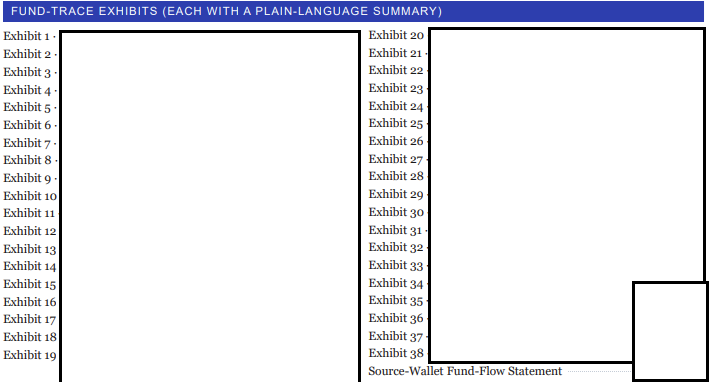
A civil report has to hold up against a motion to exclude and a hostile cross-examination. I build it as numbered exhibits, one trace per exhibit, each with a plain-language summary. This is the redacted exhibit index from a recent matter that ran to 38 exhibits across Ethereum, Bitcoin, Solana, XRP, Cardano, and Polkadot wallets.
Each report also includes:
- The tracing method used for commingled funds, such as first-in-first-out, and why it fits the question.
- Facts, inferences, and opinions kept apart, so the reader can see which is which.
- A source for every attribution: exchange records, a party's own statements, or another stated basis.
- A data cut-off by date or block height, with the tools named.
- Scope and limits: what was traced, where each trail stopped, and why.
That list follows the checklist I'd want counsel to run on any crypto forensic report, including one served by the other side.
What I need from you
- The claims and the question. The complaint or a short summary, and the specific fact you need established.
- Every address and transaction hash in the record, from pleadings, produced documents, or your client's own wallets.
- Exchange productions and bank records showing money moving between bank accounts and exchanges.
- The relevant dates: contract dates, the petition date in a bankruptcy, the appointment date in a receivership, and the transfer windows in dispute.
- Any protective order covering the materials, and the case schedule, including the discovery cut-off and expert disclosure deadline.
If the other side has already served a tracing report, include it. Testing it can be part of the scope.
What I don't do
- No recovery promises. I trace and document. Freezes, judgments, and turnover orders run through counsel and the court.
- No identity claims from chain data alone. A wallet gets a name in my report only when a record supports it.
- No conclusions about fraud or intent. Whether a transfer was fraudulent is a legal question. I testify to the transfers.
- Crypto only. Bank tracing, business valuation, and lost-profits analysis belong with a forensic accountant or an economist.
- No contingency fees. My fee is hourly and doesn't depend on who wins.
How an engagement works
Conflict check and free 30-minute case review
I run a conflict check first. Then you walk me through the claims and the record, and I tell you whether the chain can answer your question.
Written scope and hour estimate
The questions I'll answer, the data I need, and an estimate of hours, before any billable work starts.
Tracing and discovery support
The trace, the subpoena targets, and help scoping the records request. Returned records go back into the trace.
Report and exhibits
A signed report with numbered exhibits for your expert disclosure.
Deposition, hearing, or trial
Testimony on the report, with preparation alongside counsel.
Fees are hourly and never contingent on the outcome.
Book a Free 30-Minute Case Review
Frequently asked questions
When should I bring in a crypto tracing expert in a civil case?
Before discovery closes, and ideally before you serve exchange subpoenas. The trace tells you which exchanges and accounts to subpoena, and the records that come back extend the trace. A late start leaves less time for that second round.
Can blockchain tracing identify the defendant?
Not by itself. The chain shows how funds moved between addresses. Exchange records obtained by subpoena tie a deposit address to a verified account holder, and my report lists the deposits to request.
How do you trace crypto that was mixed with other funds?
I name a tracing method, such as first-in-first-out, explain why it fits the question, and apply it the same way throughout. If a different method would change the result, the report says so, so you learn it before the hearing.
Can you trace crypto for a bankruptcy trustee or receiver?
Yes. I trace from the debtor's or the estate's records, date each transfer by its block timestamp, and identify the exchanges where funds landed. Freezing or recovering the assets is for the trustee, the receiver, and the court.
Do you work for plaintiffs, defendants, or trustees?
All three, and for receivers too. The findings are the same whoever retains me, and my hourly fee does not depend on how the case comes out.
How much does crypto litigation support cost?
I bill hourly. The first 30-minute case review is free, and you get a written scope and hour estimate before any billable work starts. The total depends on how many wallets, chains, and transactions the question involves.

Zack Coffing
Founder of Wallet Witness. Independent blockchain forensic investigator, in crypto since 2017, with 20+ cases investigated. I also co-founded an NFT marketplace startup that raised $1.8 million. Full background.