In This Article
- What to gather before you file anything
- How to file with the FBI (IC3)
- The FBI's crypto task force — VAXU and NCET explained
- How to file with the FTC
- Other agencies worth reporting to
- Realistic timeline — what to expect at week 1, month 1, month 3
- Common mistakes that get reports buried
- What actually happens after you report
- The FBI isn't responding — now what?
- How a forensic report changes everything
If you've just been scammed out of cryptocurrency, the first thing most people do is search for how to report it. That instinct is right — but most victims file a report with almost no supporting evidence, hear nothing back, and conclude that reporting is useless.
It's not useless. But a bare complaint with no transaction data, no wallet addresses, and no documentation gets filed and sits. A report with a full evidence package gets flagged, cross-referenced, and in some cases actioned. The difference is what you bring to the report — and most victims don't know what that should look like.
This guide walks you through exactly what to gather, where to file, and what to realistically expect from each agency.
Before you file anything — stop all contact with the scammer and do not send any more money. Any service that contacts you promising to recover your funds for an upfront fee is almost certainly a recovery scam targeting you a second time.
Your IC3 narrative gets prioritized when you can name the attack pattern. If you bought a token you can't sell, see Honeypot Scam: Tracing the Operator When You Can't Sell. If you bought into a "launch" that pumped then collapsed, see Token Bundling Scam: How Coordinated Bundles Fake a Launch. If your funds were USDT-on-Tron sent to an "investment" platform, see Pig Butchering Scams in 2026 — the FBI's largest single fraud category in the US.
What to Gather Before You File Anything
This is the step most victims skip — and it's the most important one. A detailed, evidence-backed report has a fundamentally different outcome than a vague complaint. Here's exactly what you need to collect before you open a single reporting form:
- Transaction hashes — the unique ID for every transfer you made to the scammer. Find these in your exchange withdrawal history or wallet transaction history. They look like a long string of letters and numbers.
- Wallet addresses — the address(es) you sent funds to. Copy these exactly.
- Dates and amounts — every transfer, every date, every amount in both crypto and USD equivalent at the time.
- Screenshots of all communication — every message, email, WhatsApp, Telegram, or DM. Include timestamps. Don't delete anything.
- Websites and platforms involved — URLs of any fake trading platforms, investment dashboards, or websites the scammer directed you to.
- Scammer contact information — phone numbers, email addresses, social media profiles, usernames.
- How you were first contacted — dating app, social media, cold call, text message. This helps pattern-match to known operations.
- Any identity information provided — names, photos, companies, job titles the scammer used. Even if fabricated, this is useful intelligence.
The more of this you have documented in one place before filing, the stronger your report. If you're missing some of it — file anyway, but note what's missing.
Step 1: File with the FBI via IC3
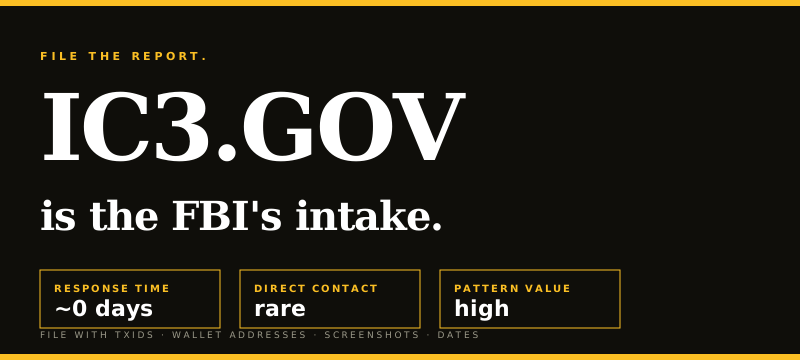
IC3 — the Internet Crime Complaint Center — is the FBI's official intake system for internet-based fraud, including cryptocurrency scams. It's where your report needs to go first.
FBI Internet Crime Complaint Center
IC3 accepts complaints from anyone who believes they've been a victim of internet crime. Your complaint is reviewed by FBI analysts and cross-referenced against other reports. High-value cases and patterns that match active investigations receive priority follow-up.
How to file effectively at IC3
Go to ic3.gov and click "File a Complaint"
You'll create an account or file as a guest. Use your real contact information — if an agent follows up, you want them to reach you.
Select the correct crime type
Choose "Cryptocurrency Fraud" or "Investment Fraud" depending on the scam type. Pig butchering is investment fraud. Wallet hacks or direct theft is cryptocurrency fraud. If both apply, select the one that better describes how the money was taken.
Fill in every field you can — be specific
The more detail the better. Paste transaction hashes directly into the description field. List wallet addresses. Name the platforms used. Describe how contact was initiated. Agents reading this need specifics, not summaries.
Attach supporting documentation
IC3 allows file attachments. Upload your screenshots, any forensic documentation you have, and a timeline of events if you've written one. Attachments make your complaint stand out from the thousands of bare text submissions.
Save your complaint reference number
IC3 gives you a complaint ID when you submit. Keep this — you'll need it if you're filing with other agencies or working with an attorney, and it allows IC3 to link follow-up information to your original report.
The FBI's Crypto Task Force — VAXU, NCET, and Who Actually Investigates Your Case
One of the most common questions victims have is whether the FBI has a dedicated cryptocurrency unit and whether they can contact it directly. The short answer: yes, the unit exists — but no, you can't contact it directly, and that's by design.
FBI Virtual Asset Exploitation Unit (VAXU)
VAXU sits within the FBI's Cyber Division and is the bureau's specialized cryptocurrency unit. Its mandate covers cryptocurrency-enabled crimes — fraud, ransomware, sanctions evasion, money laundering, and dark market operations. VAXU operates as a specialized resource that supports field offices, not a public-facing intake unit. Cases reach VAXU through internal FBI prioritization processes, not through direct victim outreach.
National Cryptocurrency Enforcement Team (NCET)
NCET is a unit within the U.S. Department of Justice — separate from the FBI but coordinating with it — that prosecutes major cryptocurrency cases. NCET attorneys work alongside FBI, IRS-CI, Secret Service, and DEA investigators on the largest crypto fraud, money laundering, and sanctions cases. Like VAXU, NCET is not a victim intake mechanism. They prosecute cases that have already been built.
IRS Criminal Investigation (IRS-CI) Cyber Crimes Unit
IRS-CI has emerged as one of the most effective federal crypto investigation units, particularly for money laundering, sanctions, and tax-related cases. IRS-CI agents have led several of the largest crypto seizures in U.S. history. While they are not a victim intake unit either, IC3 reports are regularly forwarded to IRS-CI for cases involving large losses or suspected money laundering.
U.S. Secret Service Cyber Fraud Task Forces
The Secret Service runs Cyber Fraud Task Forces in major U.S. cities, with cryptocurrency a growing focus area. They handle financial crimes broadly, including high-loss crypto investment fraud and business email compromise schemes that converted to cryptocurrency. Local Secret Service field offices accept direct reports from victims of significant financial fraud.
You cannot contact VAXU, NCET, or IRS-CI Cyber directly as a victim. The intake channel is IC3, supplemented by direct outreach to your local FBI or Secret Service field office for high-value cases ($100K+). The dedicated crypto units pull cases from the IC3 queue based on priority — which is exactly why a thorough, evidence-backed IC3 filing matters so much. It is what determines whether your case crosses their desk.
Step 2: File with the FTC
The Federal Trade Commission handles consumer fraud at a broad level and shares data with law enforcement agencies nationwide. Filing here is quick and adds your case to a national fraud database that helps identify organized operations.
Federal Trade Commission — Report Fraud
The FTC doesn't investigate individual cases, but it uses fraud reports to identify patterns, build cases against large operations, and share intelligence with the FBI and state attorneys general. Your report contributes to investigations you'll never directly hear about — including the one that might take down the operation that scammed you.
Other Agencies Worth Reporting To
Depending on the type of scam, additional agencies may have jurisdiction — and filing with multiple agencies increases the total intelligence value of your report.
CFTC — Commodity Futures Trading Commission
File here if the scam involved fake futures trading, forex trading, or any commodity-linked investment platform. The CFTC has jurisdiction over crypto derivatives and frequently pursues civil enforcement actions. They also offer monetary awards for tips that lead to enforcement actions — worth noting if your case involves a large operation.
SEC — Securities and Exchange Commission
Relevant if the scam involved a fake investment opportunity that promised returns — classified as a security under U.S. law. Many crypto fraud operations qualify. Like the CFTC, the SEC has a whistleblower program with potential financial awards for information that leads to a successful enforcement action.
Your State Attorney General
Most state AGs have a consumer protection division that accepts fraud complaints. Some states — California, New York, Florida — are particularly active in crypto fraud enforcement. Filing at the state level adds another layer of visibility and may trigger action independent of federal agencies. Search "[your state] attorney general report fraud" to find the correct form.
Your Local FBI Field Office
If your loss is significant — generally $100,000 or more — it's worth calling your local FBI field office directly in addition to filing at IC3. Large individual losses sometimes receive direct attention, especially if you have strong documentation. Find your local office at fbi.gov/contact-us/field-offices.
Realistic Timeline — What to Expect at Week 1, Month 1, Month 3
One of the hardest parts of being a crypto fraud victim is the silence after filing. Here's what's actually happening behind the scenes, and what you should realistically expect.
Day 1 — Filing
You receive an IC3 confirmation email with a complaint reference number. Your complaint enters the queue for analyst review. No investigation has started yet.
Week 1 — Triage and Categorization
IC3 analysts categorize your complaint by scam type, loss amount, and identifiers (wallet addresses, phone numbers, email addresses, platform names). Your data is automatically cross-referenced against existing complaints. Most victims receive no further communication at this stage — that's normal.
Weeks 2–4 — Pattern Matching and Routing
Complaints matching active investigations or known criminal infrastructure are routed to the relevant FBI field office, VAXU, or partner agency (IRS-CI, Secret Service). Complaints that don't match active patterns enter the bulk database for future cross-referencing. If your case fits an open investigation, this is when it would be flagged.
Month 1 — Possible Field Office Contact
If your case matched an active investigation, you may receive contact from a field office agent in this window. This is rare for individual cases — typically reserved for losses over $100K or cases tied to ongoing operations. No contact at month 1 does not mean your case was ignored. It usually means it's still in the bulk database awaiting future cross-referencing.
Month 3 — Window for Civil Action Closes
By month 3, the realistic likelihood of direct FBI follow-up has declined significantly for cases that didn't match active patterns. This is the window where most victims should be evaluating civil litigation, exchange disclosure requests, or international LE pathways in parallel. Federal action and civil action are not mutually exclusive — pursue both.
Year 1+ — Long-Tail Outcomes
Some IC3 reports contribute to indictments and asset seizures that occur 12–36 months after filing — often as part of larger operations involving hundreds of victims. Victims of seizures may be notified through DOJ remission programs to receive a portion of recovered funds. This is the realistic best-case outcome for a federal-only path.
Common Mistakes That Get Reports Buried
Most victims file IC3 reports that get categorized as data points rather than actionable leads. The difference between the two is mostly avoidable. Here are the mistakes I see most often when reviewing victim filings:
- Filing without transaction hashes. A report that doesn't include TXIDs is functionally a narrative complaint. Without on-chain identifiers, IC3 cannot cross-reference your case against existing investigations. Every transfer to the scammer has a TXID — get it from your exchange withdrawal history or wallet history.
- Approximate dates and amounts. "About $50K in March" is far less useful than "$48,200 USD on 2026-03-12 at 14:33 UTC." Pattern-matching depends on precision. Vague timing makes correlation across cases nearly impossible.
- Not attaching screenshots or supporting docs. IC3 allows file attachments. Most victims don't use them. Screenshots of communications, fake platform interfaces, and forensic findings make a report stand out from the bulk text submissions.
- Filing only at IC3. File at IC3, FTC, your state AG, and (when relevant) CFTC and SEC. Multi-agency filings increase the chance one of them surfaces your case to the right investigator.
- Waiting weeks before filing. The longer you wait, the more time the scammer has to move funds through additional laundering steps. File the day you realize you've been scammed — even if your evidence package is incomplete. You can supplement later.
- Engaging a "recovery service" before filing. Recovery scam operators frequently target people who have just been defrauded. Report to the FBI before paying anyone who claims they can help. Most legitimate forensic investigators charge after providing a free initial assessment, not before.
- Not following up if you find new information. If you later identify a wallet address, transaction hash, or scammer identity that wasn't in your original report, contact IC3 to supplement. Use your original complaint reference number.
- Confusing "no response" with "no action." The vast majority of useful federal action happens without direct victim communication. Silence is the default state of the system, not a sign your report failed.
What Actually Happens After You Report
This is where honest expectations matter. Most IC3 reports do not result in a phone call from an FBI agent. That's not because your report was ignored — it's because IC3 receives hundreds of thousands of complaints per year and operates as an intelligence aggregation system, not a one-to-one case intake system.
Here's what actually happens with your report:
- It gets reviewed and categorized by IC3 analysts
- It's cross-referenced against other complaints involving the same wallet addresses, phone numbers, platforms, or methods
- If it matches an active pattern, it gets forwarded to the relevant FBI field office or task force
- If it's part of a large enough pattern, it contributes to a case that may result in indictments years later — often without individual victims being directly notified
The honest reality: your individual report is a data point, not a case trigger. The reports that generate direct action are either very large losses with strong documentation, or they match a pattern that investigators are already actively working.
The FBI Isn't Responding — Now What?
This is the reality most victims face. You filed at IC3. You filed at the FTC. Weeks pass. Nothing. No email confirmation beyond the complaint ID. No call. You start to wonder if anything is happening at all.
This doesn't mean your options are exhausted. Federal law enforcement is one path — and often a slow one. Here are the others:
- Civil litigation. You don't need the FBI to file a civil lawsuit. If a forensic investigation identifies the exchange where stolen funds landed, an attorney can pursue civil claims — including subpoenas for account holder identity — independently of any criminal proceeding. Some of the largest crypto fraud recoveries have been through civil courts, not criminal prosecution. See law enforcement vs civil lawsuit for a comparison of both paths.
- Exchange disclosure requests. Major exchanges like Binance, Coinbase, and Kraken have compliance teams that respond to law enforcement requests — and increasingly to documented civil matters. A forensic report identifying a specific deposit address is often enough to trigger a voluntary disclosure or freeze.
- International law enforcement. If you're outside the US, your national cybercrime unit may be the more direct path. Europol, Action Fraud (UK), and equivalent agencies in other jurisdictions work these cases actively. The FBI also has international partnerships — IC3 reports do feed into those channels.
If someone contacts you after you've filed a report — claiming to be from the FBI, IC3, or a recovery agency — and asks for payment to process your case or release your funds, it is a scam. The FBI does not charge fees to investigate crimes. This is one of the most common follow-on scams targeting people who have already reported fraud.
How a Forensic Report Changes Everything
The single biggest difference between a report that generates action and one that doesn't is supporting documentation — specifically, a professional blockchain forensic report.
Here's why it matters:
- It gives investigators a starting point. A bare complaint says "I was scammed." A forensic report says "the funds moved from this wallet to this exchange deposit address, here are 14 intermediate hops documented with transaction IDs, and the receiving exchange is Binance." One of these requires investigation to begin. The other begins the investigation.
- It identifies a subpoena target. Exchange deposit addresses mean there's KYC data attached. Law enforcement can subpoena that identity without building a case from scratch. Start by gathering your transaction evidence before filing.
- It makes civil litigation viable. Attorneys can file civil claims based on forensic findings — asset freezes, TROs, and recovery judgments have all been obtained using blockchain evidence as the foundation.
- It separates you from the noise. IC3 receives hundreds of thousands of complaints. The ones that come with a professional forensic report attached are a tiny minority — and they stand out.
Wallet Witness offers a free initial consultation to review your case and tell you what a forensic investigation would find — before any payment. If your case has a traceable trail worth pursuing, we'll tell you. If it doesn't, we'll tell you that too. Book your free consultation →
A Report Without Evidence Is Just a Complaint.
A blockchain forensic report transforms your IC3 filing from a data point into an actionable lead — with a named exchange, a deposit address, and a documented chain of custody. That's what moves cases forward.