In This Article
If you've lost Bitcoin or cryptocurrency to a scam, this is probably one of the first questions you searched. The answer matters, because it determines whether there's anything left to fight for.
The short answer is yes. But the complete answer is more subtle. Here's what's actually possible, explained by someone who does this for a living.
The Short Answer
Yes, stolen Bitcoin can almost always be traced. The blockchain is a permanent, public record of every transaction ever made. A forensic investigator can follow your funds across wallets, exchanges, and chains. The question isn't usually can it be traced, it's where does the trail lead and what can you do with that information.
Tracing and recovery aren't the same thing. Tracing tells you where the money went and who controlled it. Recovery is a separate step that depends on law enforcement action, civil litigation, or exchange cooperation, and it's never guaranteed. But without the trace, recovery is impossible. The trace is always step one. See can stolen crypto be recovered for a realistic breakdown of what comes next.
Why Bitcoin Is Traceable by Design
Bitcoin was built on a public blockchain, a ledger where every single transaction is recorded permanently and visible to anyone. That's not a flaw; it's a core feature. Every Bitcoin transfer has a transaction ID, a sender address, a receiver address, a timestamp, and an amount. None of that can be altered or deleted.
This is different from cash. Cash is anonymous by nature, once it changes hands, the trail ends. Bitcoin does the opposite: it creates a permanent, auditable record of every movement. Forensic investigators use that record to reconstruct exactly what happened to your funds, step by step, from the moment they left your wallet.
Other major cryptocurrencies work similarly. Ethereum, USDT, Solana, and BNB Chain all maintain public transaction records. Even stablecoins like USDT-TRC20, commonly used in fraud operations because they're easy to move quickly, leave a complete on-chain trail.
Privacy coins like Monero (XMR) are a genuine exception, they use cryptographic techniques to obscure transaction data. If your funds were converted to Monero, the trail may go cold at that conversion point. This is worth knowing upfront.
How Investigators Actually Trace Stolen Crypto
Blockchain forensics isn't guesswork. It's a systematic methodology that combines on-chain data analysis with off-chain intelligence. Here's what the process actually looks like:
Transaction Graph Analysis
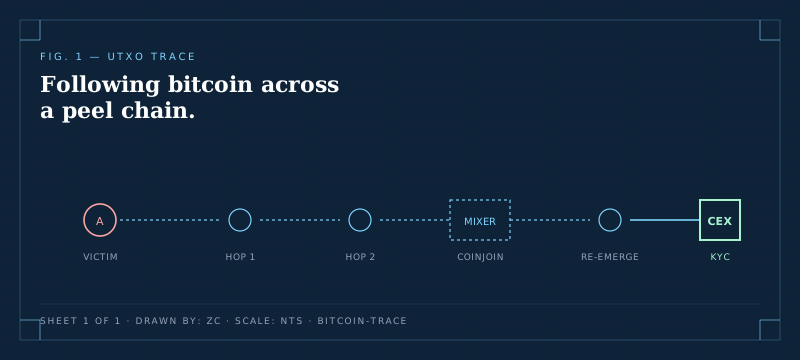
Starting from your transaction, we map every later movement of those funds, where they went, how they were split, how they were consolidated, and where they ended up. This creates a visual graph of the full money flow. Even funds split across dozens of wallets can be tracked when the methodology is systematic.
Wallet Clustering
Scammers rarely use just one wallet, they use dozens or hundreds. Wallet clustering is the process of identifying wallets that are controlled by the same entity based on behavioral patterns, input co-spending, timing analysis, and other heuristics. This reduces a sprawling network of wallets down to a set of actors.
Exchange Deposit Identification
The most valuable finding in most cases. When stolen funds reach a centralized exchange, Binance, Coinbase, Kraken, OKX, the exchange holds KYC (Know Your Customer) data on the account that received the deposit. Identifying the exchange deposit address gives law enforcement a legal pathway to subpoena that identity information.
Off-Chain Intelligence Correlation
On-chain data alone rarely identifies a person by name. Combining blockchain findings with off-chain sources, social media accounts, IP addresses from exchange records, domain registration data, communication metadata, closes the gap between a wallet address and a real identity.
Forensic Report Preparation
Findings are documented in a written forensic report that includes every transaction ID, wallet address, methodology step, and conclusion. This report is what you bring to law enforcement, an attorney, or a civil court. Without it, on-chain evidence is hard to act on, with it, it becomes the foundation of a legal case.
What Happens When Scammers Try to Cover Their Tracks
Experienced crypto fraudsters know the blockchain is traceable. They use obfuscation techniques to complicate the trail. Here's what those look like, and the honest assessment of how effective they actually are:
- Wallet fan-out: Splitting funds across many wallets immediately after receiving them. Looks complex but is usually traceable, the funds have to reconsolidate somewhere.
- Chain bridging: Moving funds from one blockchain to another via a bridge. Traceable bridges leave on-chain records on both sides.
- DEX swaps: Swapping between tokens using decentralized exchanges. Fully traceable, all DEX activity is on-chain.
- Bitcoin mixers / CoinJoin: Services designed to break the transaction trail by mixing funds with other users. Harder to trace but not impossible. Probabilistic analysis and heuristics can often identify likely outputs.
- Tornado Cash (ETH): A smart contract mixer for Ethereum. OFAC-sanctioned. Challenging but traceable to some degree depending on timing and usage patterns.
- Monero conversion: Converting to a privacy coin is the most effective obfuscation. If the trail ends at a Monero conversion, the path forward depends on exchange-side records rather than on-chain data.
Most crypto scammers, including large pig butchering operations, don't use sophisticated obfuscation. They move fast and rely on volume, not technical complexity. In the majority of cases I've investigated, funds were traceable to a centralized exchange deposit within a few hops.
What Tracing Can Realistically Achieve
This is the part most people want to skip to, and it's where honest expectations matter most.
Exchange Deposit Address
Identifies the exchange and account that received your funds. Gives law enforcement a subpoena target with KYC data attached.
Entity Attribution
Links wallet clusters to known entities, exchanges, OTC desks, or before identified fraud operations, adding credibility to a legal filing.
Law Enforcement Package
A documented forensic report that FBI, Secret Service, or international agencies can actually use as a starting point for investigation.
Civil Litigation Evidence
On-chain evidence that supports a civil complaint, asset freeze motion, or TRO, especially valuable in federal court cases.
What tracing does not guarantee: getting your money back. Recovery depends on what happens after the trace, whether law enforcement acts, whether the exchange cooperates, whether the suspect is in a jurisdiction with mutual legal assistance treaties. Those factors are outside any investigator's control.
What I can tell you is this: without a forensic trace, every recovery path is harder. With one, you have something concrete to pursue. That's the value of the work. Read more about what happens inside a forensic investigation and realistic recovery timelines.
What Determines Whether a Case Is Traceable
Not every case produces the same results. Here are the factors that most affect traceability:
- Time since the fraud occurred. The blockchain record is permanent, funds don't disappear. But exchange-side data can age out, and acting quickly increases the odds that funds are still sitting at the exchange deposit address.
- The obfuscation methods used. Most cases involve basic wallet hopping. Advanced mixing or Monero conversion creates harder problems.
- The blockchain involved. BTC, ETH, USDT, SOL, and BNB are all highly traceable. Privacy coins are the exception.
- Quality of your starting evidence. A transaction hash and sending address gives us a clean starting point. The more you have documented from the scam itself, the faster and more complete the trace.
- Whether funds reached a KYC exchange. If the money landed at Binance, Coinbase, or any regulated exchange, there's an identity attached to that deposit. That's the target.
What to Do If You've Been Scammed
If you've recently lost Bitcoin or cryptocurrency to a scam, here's what matters most right now:
- Don't send any more money. Any service promising to recover your funds for a fee is almost certainly a recovery scam, the second hit after the first.
- Gather your transaction records. Find the transaction hash(es), the wallet address you sent to, and any screenshots or communication from the scammer.
- Start the forensic trace as soon as possible. Time doesn't change the on-chain record, but it can affect peripheral data and the status of funds at exchanges.
- File reports with IC3 (FBI), FTC, and your local authorities. A forensic report dramatically improves the chances that these reports lead somewhere.
Wallet Witness offers a free initial consultation to review your case and give you an honest assessment of what a trace would find, before any payment is discussed. Book your free consultation →
Your Funds Left a Trail. Let's Follow It.
Every Bitcoin transaction is permanently recorded on the blockchain. A forensic investigator can follow that trail from your wallet to wherever it ended up, and turn those findings into something you can take to law enforcement or an attorney.