In This Guide
What Rule 26(a)(2)(B) Requires
Federal Rule of Civil Procedure 26(a)(2)(B) governs the written report that a retained expert must produce before testifying. The rule exists to prevent trial by ambush: opposing counsel is entitled to know every opinion the expert intends to offer, and every piece of data that underlies those opinions, well before depositions begin.
The rule applies to any witness who is retained or specially employed to provide expert testimony in the case, or whose duties as an employee regularly involve giving expert testimony. An independent blockchain forensic investigator hired specifically for the case falls squarely within this definition. Fact witnesses with incidental expertise do not.
The consequences of a deficient or late report are severe. Under Rule 37(c)(1), failure to comply bars the expert from using the undisclosed information to supply evidence on a motion, at a hearing, or at trial — unless the failure was substantially justified or harmless. Courts have excluded expert testimony entirely for reports that were fundamentally incomplete.
How Crypto Reports Differ From Other Expert Reports
Blockchain forensic expert reports share the same formal requirements as any other Rule 26 report, but the subject matter creates several practical differences that attorneys should understand before engaging an expert.
The underlying data is public and verifiable. Every transaction the expert analyzes exists permanently on a public blockchain. Opposing counsel can independently run the same address queries. This cuts both ways: it makes the expert's work harder to fabricate, but it also means every factual claim in the report is directly checkable.
Methodology must be made explicit. Blockchain forensic analysis relies on techniques like wallet clustering (common-input-ownership heuristics), address attribution (linking wallets to named entities), and fund flow tracing. Courts evaluating admissibility under Daubert will ask whether these methods have been peer-reviewed, what their known error rates are, and whether they are generally accepted in the field. A report that simply presents conclusions without walking through the analytical steps will face serious admissibility challenges.
Tool disclosure matters. Most forensic investigators use commercial analytics platforms such as Chainalysis Reactor, TRM Labs, or Elliptic Navigator alongside open-source tools and proprietary scripts. The report should identify which tools were used for which conclusions, and describe the tool's methodology where it drives a material opinion.
Exhibit complexity is high. A transaction graph tracing $2 million through fifteen wallets across three blockchains, with DEX swaps and a bridge transaction in the middle, is genuinely complex. The report should include annotated exhibits that make the chain of custody comprehensible to a judge and jury, not just a data scientist.
The Six Required Elements, Applied to Crypto Cases
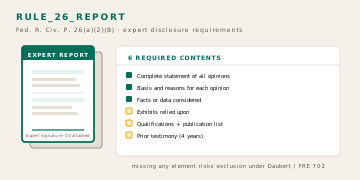
Rule 26(a)(2)(B) specifies six elements. Here is what each means in the blockchain forensics context.
| Element | What It Means for Crypto Reports |
|---|---|
| 1. Complete statement of all opinions | Every opinion the expert intends to offer at trial must appear, including opinions about address attribution, fund flow conclusions, mixer identification, and any opinions about industry practices or standards. |
| 2. Basis and reasons for each opinion | The methodological steps: which heuristics were applied, what thresholds triggered a cluster expansion, what exchange attribution data was used, how mixer involvement was determined. Not just the conclusion. |
| 3. Facts or data considered | Every address analyzed, every block range queried, every third-party attribution dataset consulted. This is the complete data universe — not just what supported the final opinion. |
| 4. Exhibits to be used as summaries | Transaction flow diagrams, annotated blockchain explorer screenshots, cluster maps, timeline charts. These become trial exhibits. Prepare them at report-quality resolution. |
| 5. Qualifications and publication list | Certifications (CAMS, CFE, blockchain analytics vendor certifications), prior expert engagements, published research, and the CV. Courts assess whether the expert is qualified in the specific subfield. |
| 6. Prior testimony list (4 years) and compensation | Every case where the expert testified by deposition or at trial in the prior four years, plus the current compensation arrangement. Missing this element alone can support exclusion motions. |
Element 3 — “facts or data considered” — is the most frequently litigated in blockchain cases. Courts have held that it means everything the expert looked at, including data that cut against the conclusions. A blockchain forensic report that only discloses the favorable addresses invites a successful motion to exclude on incompleteness grounds.
Blockchain Exhibits and Transaction Graphs
The exhibits section of a Rule 26 report in a crypto case is often more important than the narrative. Juries and judges are not blockchain native. The exhibits must translate on-chain data into a form that is comprehensible to someone encountering these concepts for the first time.
Transaction Flow Diagrams
A transaction flow diagram shows the movement of funds from the source wallet (or wallets) through intermediate addresses to a final destination or known exchange. The best diagrams show the amount at each hop, the timestamp, the chain (if multi-chain), and any known entity labels (exchange, mixer, smart contract) at each node.
These diagrams are generated by analytics platforms like Chainalysis Reactor but should be annotated and curated for the report — not simply screenshot-dumped. Each node should be labeled in plain language. The overall flow should be narrated in the accompanying text so the exhibit and the report mutually reinforce each other.
Address Cluster Maps
When the expert uses wallet clustering to conclude that a set of addresses belongs to a single controlling entity, the cluster map should show which addresses are in the cluster and why (common-input-ownership, behavioral pattern, or direct attribution). The expert should state the confidence level and acknowledge addresses that were uncertain and excluded.
Blockchain Explorer Screenshots
For individual high-value transactions, annotated explorer screenshots (Etherscan, Solana Explorer, Blockchair, etc.) make the data concrete. These should show the transaction hash, timestamp, amount, sender, and receiver, with key fields highlighted and explained in the caption.
Common Grounds for Deficiency Challenges
Opposing counsel in cryptocurrency cases have developed a predictable set of attack patterns for Rule 26 reports. Knowing them in advance lets you plug the gaps before they become exclusion motions.
Methodological Black Box
The most common and most successful challenge is the “black box” argument: the expert ran data through a proprietary tool and presented the output as a conclusion, without explaining the underlying methodology. Chainalysis, TRM Labs, and Elliptic are all commercial products whose internal algorithms are not publicly disclosed. A report that says “Chainalysis identified the destination as [Exchange X]” without explaining how attribution databases are built, validated, and updated will struggle under Daubert scrutiny.
The fix is to include a methodology section that describes, at a sufficient level of generality, how clustering and attribution work — citing academic literature and peer-reviewed research on the underlying heuristics, and noting the tool as one source of data cross-validated by the expert's independent analysis.
Data Cherry-Picking
If the expert analyzed 200 wallets but the report only discusses the 40 that supported the tracing conclusion, opposing counsel will argue that the expert excluded exculpatory data. The report should acknowledge the full scope of what was analyzed and explain why certain addresses were excluded from the conclusion (e.g., insufficient transaction volume, insufficient linking evidence, or identified as unrelated parties).
Scope Creep at Deposition
When an expert offers opinions at deposition that go beyond the written report, opposing counsel has grounds for a motion to strike the additional opinions and, in some circuits, to seek fees for wasted deposition time. The report should include a catch-all section on “additional opinions that may be offered in rebuttal” or at minimum a statement that the expert reserves the right to supplement upon review of the opposing expert's report.
Missing Prior Testimony or Publications
A surprisingly common deficiency is an incomplete prior testimony list. Courts have excluded experts for omitting cases where they testified adversely to the current theory. Ensure the expert's list is complete and accurate before service.
In jurisdictions applying the Kumho Tire extension of Daubert, the gatekeeping obligation applies to all expert testimony, not just scientific testimony. Blockchain forensic analysis is technical, not purely scientific. Attorneys should be prepared to brief Kumho and its progeny when opposing admissibility challenges in the Ninth, Second, and Fifth Circuits, where Daubert motions in technical-expert crypto cases are increasingly common.
Disclosure Timeline and Deadlines
Rule 26(a)(2)(D) requires expert disclosures at least 90 days before trial (or 30 days before trial for rebuttal experts) unless the court orders otherwise. As a practical matter, the scheduling order in your case will set specific deadlines that govern.
For blockchain forensic reports, the attorney should work backwards from the disclosure deadline to set an internal delivery date with the expert. Give the expert the data they need at least six to eight weeks before the disclosure deadline on a complex case, or four weeks before the deadline on a focused affidavit-style engagement.
| Stage | Typical Time Required | What to Deliver |
|---|---|---|
| Intake & scope | 3–5 days | Wallet addresses, transaction hashes, exchange account records, known entities |
| Data collection & analysis | 1–3 weeks | Attorney reviews preliminary findings call |
| Draft report | 1–2 weeks | Attorney reviews for completeness, flags gaps |
| Exhibit preparation | 3–5 days | Transaction graphs, cluster maps, annotated screenshots |
| Final report + signature | 2–3 days | Signed report, exhibit package, CV, prior testimony list |
Attorney-Expert Communications and Work Product
The 2010 amendments to Rule 26 significantly strengthened protections for attorney-expert communications. Under Rule 26(b)(4)(C), the following are protected from discovery:
- Drafts of any expert report, regardless of form
- Communications between an attorney and the expert, except those that: (i) relate to compensation; (ii) identify facts or data the attorney provided that the expert considered; or (iii) identify assumptions the attorney provided and the expert relied upon
This means an attorney can review a draft report, suggest organizational changes, identify unclear passages, and ask the expert to address additional data points — all without those communications being discoverable. What the attorney cannot do is alter the substance of the opinions or instruct the expert to exclude data the expert considered. Doing so could constitute improper influence and create impeachment material.
The practical upshot: get involved in the expert's report early. Review an outline before the full draft. Discuss with the expert what the weaknesses are and how to address them in the narrative. Do not wait until the final week before the disclosure deadline.
Supplementation Obligations
Rule 26(e) requires a party to supplement expert disclosures if the party learns that the information disclosed is incomplete or incorrect in some material respect. In blockchain cases, this arises most often when:
- New wallet addresses are identified after the initial disclosure, expanding or contracting the cluster
- The opposing party produces exchange account records showing identity of a wallet holder the expert had only attributed probabilistically
- A blockchain event (fork, bridge exploit, protocol update) changes the interpretation of a transaction
- The opposing expert's report reveals data the expert had not considered
Supplementation should be filed promptly when material new information emerges. Courts have found prejudice where a party waited until the eve of trial to file a supplement that materially expanded the expert's opinions.