In This Article
- What a blockchain forensic expert witness actually does
- When attorneys engage one
- Qualifications and credentials to evaluate
- The engagement structure
- Deliverables: declaration, deposition, trial
- Daubert and admissibility considerations
- Cost ranges and retainer structure
- Cross-examination preparation
- Frequently asked questions
Crypto shows up in litigation now across nearly every kind of docket I see, divorce, bankruptcy, fraud, contract disputes, corporate theft, federal investigations. The expert who interprets on-chain evidence for the court is the blockchain forensic expert witness. I wrote this for attorneys who are deciding whether to retain one, what to look for, and how the engagement actually plays out in a real case file.
If your case is going to lean on cryptocurrency transactions as evidence, to prove a fraudulent transfer, expose a hidden marital asset, attribute a wallet to a defendant, or rebut an opposing expert, this is the structured walkthrough of how that work fits into the file.
What a Blockchain Forensic Expert Witness Actually Does
A blockchain forensic expert witness performs three interlocking functions for the court:
- Analytical work. The expert traces cryptocurrency transactions across one or more blockchains using commercial analytics platforms (Chainalysis Reactor, TRM Labs, Elliptic Investigator), open-source tools, and proprietary methodology. The output is a structured set of findings: transaction graphs, wallet clusters, entity attributions, exchange identifications, and timeline reconstructions.
- Reporting. The expert prepares a written report or declaration that documents the methodology, findings, and conclusions in a form that satisfies Federal Rule of Civil Procedure 26(a)(2)(B) or its state-court equivalent. The report cites the on-chain data, identifies the analytical tools used, and distinguishes between deterministic findings and probabilistic inferences.
- Testimony. The expert is available for deposition and trial testimony. Direct examination walks the trier of fact through the methodology and findings. Cross-examination is the moment where qualifications, methodology, and conclusions are tested. The deliverable for the attorney is a witness who can articulate technical findings clearly under hostile questioning.
The terms "blockchain forensic expert", "crypto forensic expert", "cryptocurrency expert witness", and "digital asset forensic expert" are used interchangeably in court filings and engagement letters. The real work is the same. Choose the phrasing that matches the case caption and the court's working vocabulary.
When Attorneys Engage a Blockchain Forensic Expert Witness
The case categories where a forensic expert most frequently adds value:
Civil fraud and breach of fiduciary duty
The plaintiff alleges defendant misappropriated funds and converted them to cryptocurrency, or that crypto was used to conceal proceeds. The expert traces the funds from the alleged conversion event through the defendant's wallets to current locations, supporting both the underlying fraud claim and any prejudgment remedy applications. Blockchain forensic evidence in federal civil litigation covers the procedural mechanics of this category.
Divorce and family law
One spouse moved marital funds into cryptocurrency before or during the proceeding and is undervaluing or omitting the asset on financial disclosures. The expert produces a tracing report identifying wallet activity, current holdings, and the most likely valuation date. See hidden crypto assets in divorce for the full family-law treatment.
Bankruptcy
The trustee identifies undisclosed cryptocurrency on the petition or in pre-petition transfers. The expert traces movements that may support avoidance actions under 11 U.S.C. § 547 or § 548 and identifies turnover targets under § 542. See bankruptcy crypto asset tracing for trustee-specific workflow.
Contract disputes
A payment was made or alleged to have been made in cryptocurrency, and the timing, amount, sender, or recipient is disputed. The expert reconstructs the on-chain record and confirms or rebuts the disputed facts.
Civil RICO and conspiracy
Cryptocurrency wallet clustering establishes the financial linkage between multiple defendants. The expert provides clustering analysis and entity attribution as the financial-architecture exhibit in the racketeering claim.
Criminal defense and prosecution support
Defense counsel may engage a forensic expert to rebut a government expert's testimony, challenge wallet attribution, or articulate the limits of probabilistic clustering. Prosecutors may engage a private forensic firm to supplement federal agency capacity.
Insurance and recovery actions
The insured filed a claim for cryptocurrency theft. The carrier's adjuster or coverage counsel needs an independent forensic record establishing the loss, the mechanism, and any partial-recovery prospects.
Qualifications and Credentials to Evaluate
The blockchain forensic expert market has expanded rapidly. A lot of self-styled "investigators" have no demonstrable qualification beyond a Twitter following. The qualifications that actually matter when you're putting someone in front of a judge:
Demonstrable tooling experience
The expert should have documented experience with at least one major commercial analytics platform — Chainalysis Reactor, TRM Labs, or Elliptic Investigator. These are the platforms that produce the entity attributions courts will weigh. See crypto forensics tools and techniques for an overview.
Methodology articulation
A qualified expert can describe their tracing methodology in a way that's reproducible, peer-reviewable, and resistant to a Daubert challenge. If the expert can't explain how they distinguish a deterministic finding from a probabilistic inference, the testimony won't survive cross-examination.
Prior expert engagement history
Ask for prior cases where the expert prepared a report, sat for deposition, or testified at trial. Ask whether any prior report has been the subject of a Daubert motion and the outcome. New experts can be excellent — but their first deposition shouldn't be in your case.
Communication ability
The expert will be cross-examined in front of a judge or jury that doesn't know what a Merkle tree is. The ability to translate technical findings into plain English without losing accuracy is the single most important practical skill. Interview the expert in person or by video before retaining.
Useful supporting credentials
- CipherTrace Certified Examiner (CTCE)
- Chainalysis Reactor Certification
- TRM Labs Certified Investigator
- Certified Cryptocurrency Investigator (CCI)
- CFE (Certified Fraud Examiner) with crypto specialization
- CAMS (Certified Anti-Money Laundering Specialist)
Credentials are useful supporting evidence of training but don't substitute for actual case experience and methodology rigor.
The Engagement Structure
A typical attorney-led engagement of a blockchain forensic expert witness proceeds in stages:
Initial conflict check and scope conversation
The attorney describes the case terms. The expert checks for any prior engagement adverse to the proposed retention. If the expert has before worked for or against any party, that's disclosed before any privileged information passes.
The scope conversation covers: case caption, jurisdiction, the type of work needed (declaration only, full report, deposition, trial), known timeline pressures (discovery cutoff, expert disclosure deadline), and the universe of evidence the expert will need to review.
Engagement letter and retainer
The engagement letter establishes scope, hourly rate, retainer amount, deliverable format, and reservation of the expert's right to decline opinions not supported by the evidence. Most experts work on a retainer model with hourly draw-down and replenishment.
The engagement letter should make clear that the expert's compensation is for time and analysis, not for any particular opinion or outcome — this is a requirement of admissibility under FRE 702.
Evidence intake and preservation
The attorney provides starting-point evidence: client wallet addresses, transaction hashes, exchange records, communications with counterparties, prior investigative reports. The expert documents the chain of custody for each piece of evidence and preserves a working copy.
Investigation and analysis
The expert performs the core forensic work — transaction tracing, wallet clustering, entity attribution, timeline reconstruction. Most engagements include at least one interim status communication so the attorney can adjust strategy as findings develop.
If the analysis reveals a finding that doesn't support the engaging party's position, the expert reports this candidly. A credible expert is one who states the limits of their conclusions clearly.
Draft report review
The expert circulates a draft report to engaging counsel. Counsel may suggest organizational changes, clarification, or formatting that supports the case theme — but can't direct the expert's real opinions. The line between appropriate counsel feedback and inappropriate ghostwriting is one every experienced expert knows.
Disclosure and depostion preparation
The final report is served under FRCP 26(a)(2)(B). The expert and engaging counsel prepare for deposition: anticipated lines of questioning, exhibits, methodology defense, and the expert's prior testimony record.
Trial testimony
If the case proceeds to trial, the expert testifies. Direct examination establishes qualifications, walks through methodology, and presents conclusions. Cross-examination is the test of the methodology and the expert's credibility. Re-direct may rebuild any ground lost.
Deliverables: Declaration, Deposition, Trial
| Deliverable | What It Contains | When Used |
|---|---|---|
| Forensic Affidavit | Sworn statement of facts and findings, used to support a motion or application | Prejudgment remedy, ex parte applications, freezing orders |
| Expert Declaration | Sworn statement attaching report and exhibits, identifying the expert and methodology | Summary judgment, dispositive motion practice |
| Rule 26 Expert Report | Full written report meeting FRCP 26(a)(2)(B) requirements: opinions, basis, exhibits, qualifications, prior testimony, compensation | Federal civil litigation, expert disclosure |
| Deposition Testimony | Sworn testimony under examination by opposing counsel, recorded for use at trial | Civil discovery, preservation testimony |
| Trial Testimony | Live testimony before judge or jury, with direct, cross, and re-direct | Bench or jury trial |
| Demonstrative Exhibits | Annotated transaction graphs, timeline charts, wallet-cluster diagrams | Trial presentation, mediation, settlement |
Daubert and Admissibility Considerations
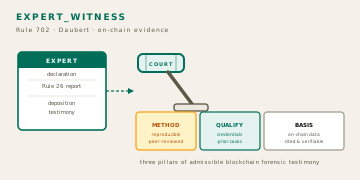
Federal Rule of Evidence 702 and the Daubert trilogy govern admissibility of expert testimony in federal court. Most states have adopted equivalent or near-equivalent standards. The threshold elements:
- Qualification. The expert is qualified by knowledge, skill, experience, training, or education.
- Reliability. The methodology is testable, has been subject to peer review, has a known error rate, is generally accepted in the relevant field.
- Relevance. The testimony will assist the trier of fact in understanding the evidence.
- Sufficient basis. The opinion is based on sufficient facts or data.
Blockchain forensic methodology generally satisfies the reliability prong because:
- Underlying on-chain data is publicly verifiable and reproducible by any examiner with the same starting inputs.
- Commercial analytics platforms publish methodology white papers and have been the subject of academic peer review.
- The error rate for deterministic findings (transaction inclusion in a block) is effectively zero. Probabilistic findings (clustering heuristics) carry documented confidence intervals.
- The methodology has been generally accepted within the forensic community since approximately 2015 and has been used in federal prosecutions including the Silk Road, BTC-e, and many OFAC actions.
Most successful Daubert challenges to blockchain forensic testimony don't attack the methodology — they attack the specific expert's articulation, the chain of custody for victim-provided evidence, or the conflation of probabilistic inference with deterministic finding. Engage an expert who clearly distinguishes "wallet X paid wallet Y at block height N" (deterministic) from "wallet Y is likely controlled by entity Z with 85% confidence based on heuristic H" (probabilistic). The latter is admissible if the heuristic and confidence are stated; it is vulnerable if it is presented as a fact.
Cost Ranges and Retainer Structure
Pricing varies with the expert's experience, the complexity of the case, the deliverable scope, and any urgency. The following ranges reflect current market rates for U.S. engagements and should be treated as directional, not authoritative.
| Engagement Type | Typical Cost Range | Notes |
|---|---|---|
| Hourly rate | $300 to $600 | Most senior experts. Some niche specialists charge more. |
| Forensic affidavit (single-issue) | $2,500 to $5,000 | Sworn statement supporting motion practice |
| Full Rule 26 expert report | $8,000 to $25,000+ | Depends on transaction complexity, multi-chain scope |
| Deposition day rate | $3,000 to $6,000 | Often half-day minimum charged to opposing counsel |
| Trial testimony day rate | $4,000 to $8,000 | Plus travel and prep time billed at hourly rate |
| Initial retainer | $3,000 to $10,000 | Held in trust, hourly draw-down, replenishment as needed |
For a detailed breakdown of cost mechanics including retainer terms, fee shifting, and budget planning, see crypto expert witness cost and engagement process.
Cross-Examination Preparation
Opposing counsel will probe the expert on five reliable axes. Prepare for each before deposition:
- Qualifications. Education, certifications, prior testimony, exclusions and admissions in prior cases.
- Methodology specificity. What heuristic was applied at each clustering step? What is the documented error rate?
- Tool reliance. Did the expert independently verify the analytics platform's output, or rely on it? What did the expert do beyond running a Reactor query?
- Chain of custody. How did the expert receive evidence from the client? Was anything modified? Are working files preserved?
- Compensation. Total fees billed, whether compensation is contingent (it must not be), prior engagements with the same retaining counsel.
An expert who has rehearsed clean answers to all five axes will hold up. An expert who is surprised by any of these questions in deposition is a problem.
Frequently Asked Questions
Considering Retaining a Blockchain Forensic Expert?
Wallet Witness accepts attorney engagements for declaration, full report, deposition, and trial work. Initial scope conversations are confidential and at no charge. Tell us about the case and we will assess fit and timeline within 24 hours.
Schedule a Confidential Consultation