In This Article
Cryptocurrency holdings appear on a growing percentage of bankruptcy schedules and, in a meaningful number of cases, fail to appear at all. For Chapter 7 and Chapter 13 trustees, the question is no longer whether crypto matters — it is how to identify it, value it, and recover it as property of the estate.
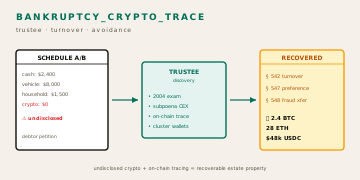
This article is a practical workflow for trustees, debtor and creditor counsel, and forensic professionals supporting bankruptcy estates. It covers the signals that suggest concealment, the discovery tools available, the forensic tracing process, and the recovery mechanisms under sections 542, 547, 548, and 727.
Why Bankruptcy Crypto Tracing Matters in 2026
Three reasons crypto now matters in nearly every consumer and small-business bankruptcy:
- Adoption is wide. A material share of U.S. adults hold cryptocurrency. The base rate of crypto on consumer bankruptcy schedules is no longer negligible.
- Concealment is asymmetric. Self-custody crypto generates no statement and is not reported by any third party. The schedules are the disclosure point. If the debtor omits, no automatic system catches it.
- Pre-petition transfers are recoverable. Many debtors transfer crypto to family members, spouses, or business associates in the months before filing. These transfers are reachable under the avoidance powers in sections 547 and 548 if the trustee identifies them.
In trustee panel anecdotal data, the median undisclosed crypto recovery in cases that did pursue forensic tracing has consistently exceeded the cost of the forensic engagement. The cases where tracing was not pursued represent uncaptured estate property that creditors did not receive. The systematic underuse of forensic tracing in routine consumer bankruptcies is a real problem.
Signals of Undisclosed Cryptocurrency
The signals to look for during the trustee's initial review and the section 341 meeting:
Tax-return signals
- Form 1040 digital-asset question answered "yes" in any prior year
- Form 8949 entries reflecting cryptocurrency dispositions
- Schedule 1 line items for crypto-related income
- Form 1099-B or 1099-MISC from a crypto exchange
Bank statement signals
- Wire transfers or ACH transactions to Coinbase, Kraken, Gemini, Crypto.com, Cash App
- Credit card charges for hardware wallets (Trezor, Ledger, GridPlus)
- PayPal or Venmo transactions categorized as crypto purchases
- Large cash withdrawals during the look-back period without clear use
Schedule signals
- Sophistication of debtor's other holdings inconsistent with zero crypto disclosure
- Industry employment that commonly includes crypto compensation (tech, finance, gaming, content creation)
- Prior years showing crypto activity but current schedules showing none
341 meeting signals
- Hesitation, qualifying language, or referrals to counsel when asked about digital assets
- "It's not worth anything anymore" without supporting basis
- Claims of lost seed phrases or hardware-wallet failure without timeline
Trustee Tools for Crypto Discovery
Rule 2004 examination
The Rule 2004 examination is the trustee's broadest discovery tool. A targeted 2004 examination on crypto-specific topics — every wallet ever controlled, every exchange account ever opened, every transfer to or from a digital-asset platform during the look-back period — produces admissions or, equally usefully, false statements that support denial of discharge.
Subpoena to identified exchanges
Once an exchange is identified (from bank statements, tax returns, or 2004 testimony), a trustee subpoena to the exchange will produce account statements, deposit and withdrawal history, KYC documentation, and IP logs. See subpoenaing a crypto exchange for the procedural mechanics.
On-chain forensic tracing
Once exchange withdrawal addresses are known, a forensic investigator traces the funds through the blockchain to current locations. This is the step that surfaces self-custody holdings the debtor did not disclose.
Document subpoenas to third parties
Family members, business associates, and identified transferees can be served with subpoenas to produce communications and records relevant to alleged transfers.
Section 521 disclosure compulsion
The debtor's section 521 duty of cooperation extends to providing all information necessary for the trustee to administer the estate, including wallet addresses, seed phrases, and access credentials. Failure to comply supports denial of discharge under section 727.
The Forensic Tracing Workflow
Document review and trigger identification
The forensic investigator reviews bank statements, tax returns, the petition and schedules, the SOFA, and 341 meeting transcript. The output is a list of trigger events — transfers, exchange accounts, addresses — that warrant follow-up.
Subpoena coordination
The investigator and trustee coordinate the subpoena targets and the records to request. Exchange records are the foundation of most tracing work because they bridge fiat-on-ramp records to wallet addresses the trustee can then trace on-chain.
Outflow tracing from exchange withdrawals
Every cryptocurrency withdrawal from each subpoenaed exchange account is traced through the blockchain to the receiving address. Each receiving address is the entry point into the debtor's self-custody footprint.
Wallet clustering
Standard heuristics group additional wallets with the initial receiving addresses based on common-input ownership and behavioral patterns. The cluster expands until the investigator has mapped the debtor's likely full wallet footprint.
Pre-petition transfer identification
The investigator catalogs every cryptocurrency transfer made by the debtor during the section 547 (90 days for non-insiders, one year for insiders) and section 548 (two years) look-back periods. Recipient wallets are identified and, where possible, attributed to specific entities.
Current-balance valuation
The current value of each identified holding is calculated for inclusion in the estate. The valuation report supports turnover demands and avoidance complaints.
Forensic report
The findings are compiled into a sworn forensic report suitable for use as an exhibit in turnover proceedings, avoidance complaints, or denial-of-discharge actions. See blockchain forensic expert witness for the deliverable structure.
Avoidance Actions and Recovery
The forensic record supports three primary recovery mechanisms:
Section 547 preference actions
Cryptocurrency transferred to a creditor during the 90-day look-back (or one year for insiders) on account of an antecedent debt may be avoided as a preference. The forensic record establishes the transfer date, amount, recipient, and that the transfer was on account of antecedent debt.
Section 548 fraudulent transfer actions
Cryptocurrency transferred during the two-year look-back with actual intent to hinder, delay, or defraud creditors — or for less than reasonably equivalent value while insolvent — is avoidable. Cross-references to similar concepts in family-law tracing apply: see hidden crypto assets in divorce.
State-law fraudulent transfer (UVTA / UFTA) via section 544
The trustee, standing in the shoes of an unsecured creditor, can extend the reach using the state Uniform Voidable Transactions Act (or Uniform Fraudulent Transfer Act) look-back, which is typically four years and sometimes longer.
Turnover Under Section 542
For cryptocurrency held by the debtor or by a custodian as of the petition date, section 542 authorizes the trustee to compel turnover. In practice this looks like:
- Direct turnover from debtor. The trustee demands the debtor transfer the cryptocurrency to a trustee-controlled wallet, or surrender the seed phrase and any hardware wallets. Refusal supports contempt and denial of discharge.
- Custodian turnover. Where cryptocurrency is held by a centralized exchange identified through subpoena, the trustee directs the exchange to transfer the holdings to a trustee wallet.
- Section 542(e) information turnover. The trustee can compel turnover of records and information necessary to access cryptocurrency, including wallet addresses, transaction histories, and (subject to litigation in specific cases) seed phrases or private keys.
Bankruptcy courts have ordered debtors to disclose seed phrases and surrender wallets, but enforcement requires the debtor's cooperation in a way that traditional asset turnover does not. If the debtor claims to have lost the seed or destroyed the wallet, the trustee's leverage shifts to denial of discharge under section 727 and referral for federal criminal prosecution under 18 U.S.C. section 152 (concealment of assets in bankruptcy).
Cost, Timing, and Administrative Expense
Typical cost ranges:
- Initial assessment: Free to $500. Identifies whether traceable evidence exists.
- Standard forensic investigation: $4,000 to $15,000. Standard case with one or two chains, identification of undisclosed wallets, look-back transfer analysis.
- Complex multi-chain investigation: $15,000 to $40,000. Cross-chain bridging, mixing analysis, multi-period look-back.
- Expert testimony at evidentiary hearing: $4,000 to $8,000 per day plus prep time.
Forensic costs are routinely allowed as administrative expenses paid from the recovered estate property. For trustees, the cost-benefit calculation is generally straightforward: if a 2004 examination or document review surfaces credible signals of undisclosed crypto, the forensic investigation typically pays for itself many times over.
For broader investigation cost context, see how much does a crypto investigation cost and crypto expert witness cost.
Frequently Asked Questions
Trustee or Counsel With a Crypto-Adjacent Estate?
Wallet Witness works with bankruptcy trustees and counsel on undisclosed-asset investigations and avoidance support. Initial scope conversations are free and confidential.
Schedule a Confidential Consultation