In This Article
Pricing opacity is one of the biggest trust problems in the blockchain forensics and crypto recovery industry. Most firms either hide their rates entirely or use language so vague it tells you nothing — "custom pricing," "case-dependent fees," "contact us for a quote." That opacity benefits the provider, not the victim.
This post does something different. It explains, as transparently as possible, what actually drives the cost of a cryptocurrency scam investigation, what you should expect to pay at different service levels, and — critically — which pricing patterns are red flags for outright fraud.
Investigation costs vary by case complexity, investigator experience, and what the case requires. The ranges in this article reflect the legitimate market as of 2026. Any quote significantly outside these ranges — especially significantly below them — warrants scrutiny.
Why Pricing Opacity Is a Problem
When a victim has just lost a significant sum of money to fraud, they are in a uniquely vulnerable position. They're distressed, motivated to act quickly, and may not be thinking clearly about cost-benefit analysis. That vulnerability is exactly what pricing opacity exploits.
Vague pricing allows bad actors to quote whatever they think a desperate victim will pay. It prevents victims from comparing options intelligently. And it enables recovery scammers — fraudsters who pretend to be investigators — to present their fee demands without any market reference point for the victim to evaluate them against.
Legitimate investigators should be able to explain their pricing structure. If they can't or won't, that's a signal worth taking seriously.
What Drives the Cost of a Crypto Scam Investigation
Investigation pricing is not arbitrary. It's driven by a set of concrete factors that any honest investigator can explain to you. Here's what actually goes into the cost:
Transaction Volume and Complexity
A case involving a single on-chain transfer to an identifiable exchange deposit address is far simpler than a case where funds were split across 40 wallets, bridged across three chains, passed through a mixing service, and consolidated through multiple OTC transactions. Investigator time scales with complexity. A simple case might require 5–10 hours of analysis. A complex multi-chain laundering trail can require 40–80+ hours.
Number of Blockchains Involved
Cross-chain cases require analysis tools and expertise for each chain the funds touched — Bitcoin, Ethereum, Tron, Solana, BNB Chain, and others each have different analytical methods, data availability, and tooling. A case that stays on a single chain is structurally simpler than one that crosses multiple chains through bridges or swaps.
Report Type and Intended Use
A basic tracing summary for personal reference is less work than a full forensic report prepared for law enforcement submission or civil litigation. Legal-grade reports require meticulous documentation of methodology, reproducible findings, chain of custody records, and formatting standards for evidentiary use. Expert witness reports — which may need to survive cross-examination — are the most demanding output.
Time Since the Fraud Occurred
Older cases don't necessarily cost more to trace — the blockchain is permanent. But they may require more extensive research to reconstruct context, and some peripheral data sources (exchange records, platform caches, communication metadata) become less available over time. Cases that require historical reconstruction are often more time-intensive than recent ones.
Loss Amount and Case Scope
Larger loss amounts often correspond to more complex fraud operations — more transactions, longer laundering chains, more sophisticated obfuscation. The scope of what the investigation needs to cover scales accordingly. This is also why many legitimate investigators set minimum case thresholds: smaller losses often don't economically justify the investigative investment for either party.
Investigator Experience and Tooling
Experienced blockchain forensic investigators with professional-grade analysis tools, established methodologies, and a track record of law enforcement collaboration command higher rates than less experienced practitioners. This premium is generally worth paying — a forensic report that doesn't survive legal scrutiny is worthless regardless of what it cost to produce.
What Different Price Ranges Actually Get You
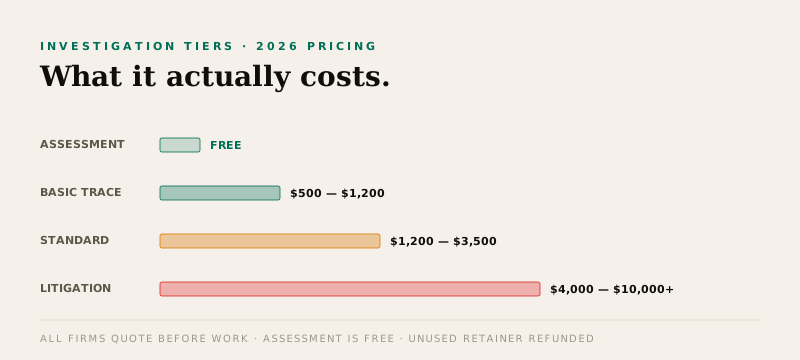
Here is a transparent breakdown of the legitimate market tiers for blockchain forensic investigation as of 2026.
Initial Trace & Summary Report
Covers single-chain tracing for straightforward cases, a written summary of findings, identification of receiving wallets and any obvious exchange deposits. Suitable for smaller cases or as a viability assessment before commissioning deeper work. Typically does not include full legal-grade documentation or methodology write-up.
- Single chain, limited hops
- Summary-level findings
- Not optimized for legal proceedings
Full Forensic Investigation & Report
Comprehensive multi-hop tracing, wallet clustering, exchange deposit identification, and a full written forensic report with documented methodology. Suitable for law enforcement submission, civil litigation, and regulatory complaints. This is the standard range for a complete investigation on cases in the $100K–$500K loss range.
- Full transaction graph analysis
- Wallet clustering and entity attribution
- Exchange deposit identification
- Legal-grade forensic report
Complex Multi-Chain Investigation
Cases involving significant cross-chain movement, high-volume transactions, multiple victims, or OTC desk involvement. Pricing at this level reflects the additional time and depth required for complex, multi-layered fund flows. Expert witness services are scoped and quoted separately.
- Multi-chain, high-volume tracing
- Complex wallet clustering and attribution
- OTC desk and bridge tracing
- Full documented forensic report
How the Retainer Model Works
Most legitimate blockchain forensic investigators work on a retainer model rather than a flat fee or contingency arrangement. Here's why, and what it means for you as a client.
A retainer is an upfront payment that secures the investigator's time and formally opens the case. It is not a full payment for the completed investigation — it is a deposit against the hours required. At the conclusion of the engagement, the retainer is applied against the total fees. If the work completed is less than the retainer, the remaining balance is refunded. If the investigation requires more time than the retainer covers, additional billing occurs.
This structure is standard in professional services — attorneys, accountants, and consultants all use retainers. It is not a red flag. What matters is whether the retainer terms are clearly documented in writing, whether the hourly rate is disclosed, and whether the investigator can give you a realistic estimate of total hours before you pay.
Contingency pricing — where an investigator takes a percentage of recovered funds — sounds appealing but is ethically complicated and often a scam signal in this industry. Legitimate forensic investigators are investigators, not recovery guarantors. They cannot and should not price their work based on an outcome they cannot control.
"We only charge if we recover your money" sounds ideal — but it is almost universally a signal that the "investigator" is either a scammer or someone who will produce a meaningless report while claiming they "tried." No forensic investigator can guarantee recovery. If they're pricing based on it, ask hard questions.
Pricing Red Flags That Signal a Scam
This is the section that matters most for anyone who has recently been defrauded. The recovery scam industry targets crypto fraud victims specifically — and pricing tactics are one of the clearest ways to identify them.
- Upfront fee demanded before any consultation or case review — legitimate investigators assess your case before asking for money
- Guaranteed recovery for a fee — no one can guarantee blockchain-based recovery; anyone who does is lying
- Vague pricing with no written scope of work — "it depends" is not an acceptable answer when you ask what you're paying for
- Fee required to "release" your funds — this is the original scam continuing, not a recovery service
- Unsolicited contact offering recovery — legitimate investigators don't cold-call or DM scam victims on social media
- Percentage-of-recovery pricing from an unverifiable source — without a track record, this is just a cash grab
- Pressure to pay quickly before "the window closes" — urgency tactics are a manipulation technique, not a legitimate business constraint
- Payment requested in cryptocurrency only — legitimate professional services accept standard payment methods
Is a Forensic Investigation Worth the Cost?
This depends on three things: the size of your loss, the quality of your starting evidence, and what you plan to do with the findings.
For a victim who lost $200,000 and has transaction hashes pointing to a known exchange, a $3,000–$5,000 forensic investigation that produces an exchange deposit address and a law enforcement submission package is almost certainly worth it. That report is the foundation of every legitimate recovery path available — civil litigation, law enforcement referral, exchange disclosure. Without it, those paths are either closed or much harder to pursue.
For a victim who lost $8,000 in a small phishing attack with no clear on-chain trail, the math is different. The investigation cost may approach or exceed the realistic recovery potential. A good investigator will tell you this honestly during the free consultation rather than take your money.
The honest framing: a forensic investigation is not a recovery mechanism — it is an evidence-building mechanism. It gives you the best possible foundation for recovery through other channels. Whether those channels produce results depends on factors outside the investigator's control: law enforcement action, exchange cooperation, jurisdictional reach, and timing. The investigation improves the odds. It doesn't guarantee the outcome.
Wallet Witness offers a free initial consultation to assess your case and give you an honest evaluation of what investigation can realistically find — before any payment is discussed. Book your free consultation →