Quick check: is this recovery service a scam?
Run them against these four signals. 3 or more = scam, walk away.
- Did they contact you first? Telegram DM, email, Reddit reply. Yes = scam.
- Are they guaranteeing recovery? No legit investigator can. Yes = scam.
- Upfront fee before any review? Real firms do free initial assessments. Yes = scam.
- Asking for your seed phrase, private keys, or wallet access? Always = scam.
In This Article
- The recovery scam, the second hit
- How recovery scammers find victims
- Legitimate vs scam, side by side
- The 10 red flags of a crypto recovery scam
- How to verify a legitimate investigator
- What a legitimate forensic investigator actually looks like
- What to do if you've already been targeted by a recovery scam
After a crypto scam, victims sit in a uniquely dangerous position. They've already been defrauded once. They're desperate for a solution. They're actively searching for help. That combination makes them the perfect target for a second wave of fraud: the recovery scam.
The crypto recovery scam industry is enormous. Some estimates suggest more money is stolen through fake recovery services than through the original scams that preceded them. These operations are sophisticated, convincing, and built specifically to exploit the emotional state of someone who's already been hit.
This guide gives you the full picture of how recovery scams work, the specific signals that separate them from real services, and exactly how to verify whether an investigator you're considering is real.
The Recovery Scam: The Second Hit
The recovery scam runs on a simple premise. Find people who've already been scammed. Offer to recover their funds. Collect fees. Disappear. The victim, already traumatized by the original fraud, is psychologically primed to take the bait. They desperately want to believe recovery is possible and that someone can help.
What makes recovery scams especially nasty is that they often know exactly what happened to the victim. Some recovery scammers are actually running the original fraud, or are affiliated with the same criminal network, and use the victim's transaction details to seem credible. Others just scrape public complaint boards, Facebook groups, and social media where victims discuss what happened. Either way, they show up armed with specifics that make them sound legit.
The playbook is consistent: establish credibility, create urgency, collect an upfront fee, either disappear or demand more fees, and ultimately take more money from someone who can't afford to lose it.
How Recovery Scammers Find Victims
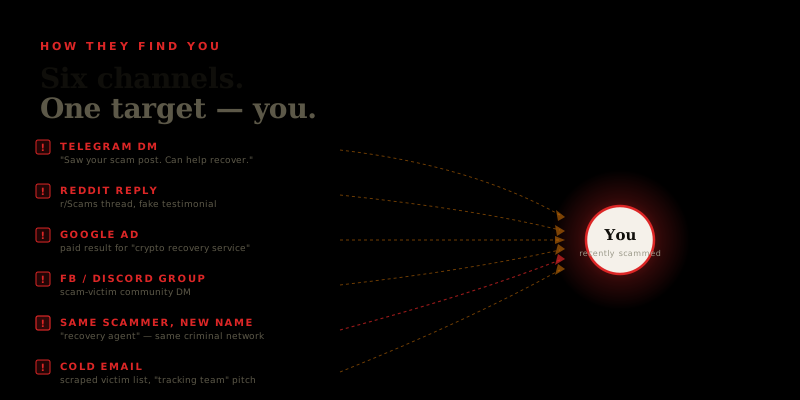
If you've been scammed and you're wondering how these people find you, here are the primary vectors:
- Same platform, same scammer: The original scammer or affiliated parties contact you again, now posing as a "recovery specialist" who "knows how these scams work."
- Public complaint boards: Sites like ScamAdviser, Trustpilot, Reddit's r/Scams, and similar forums are monitored by scammers for fresh victims. If you post your story publicly, expect outreach.
- Facebook and social media groups: Groups for scam victims are frequently infiltrated by recovery scammers who comment on posts or send private messages to people who share their experiences.
- Google search ads: Some recovery scam operations buy paid search ads for terms like "recover stolen cryptocurrency" or "crypto scam recovery help", so the first result you see when searching for legitimate help is a scammer.
- Referrals from other scammers: Criminal networks sell victim lists. If you were scammed through one operation, your contact details may be sold to recovery scammers as a "hot lead."
Unsolicited contact offering to recover your stolen cryptocurrency is one of the strongest signals of a scam. Legitimate forensic investigators don't cold-call, DM, or email victims they haven't been referred to. If someone reached out to you, especially soon after you were scammed, treat them as a scammer by default until proven otherwise.
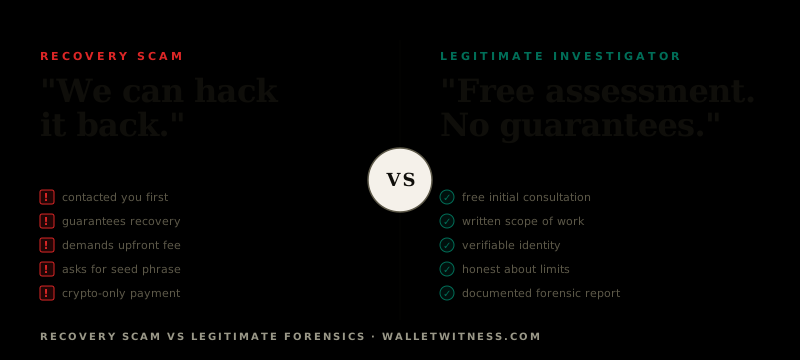
Legitimate vs Scam: Side by Side
- Free initial consultation before any payment
- Clear, written scope of work provided upfront
- Transparent hourly rate or fixed fee structure
- Honest about what investigation can and can't achieve
- Never guarantees recovery of funds
- Never asks for private keys or seed phrases
- Verifiable identity, professional history, and references
- Accepts standard payment methods (bank transfer, card)
- Delivers a written forensic report with documented methodology
- Doesn't cold-call or solicit victims unsolicited
- Unused retainer balance refunded
- Demands upfront fee before assessing the case
- Vague scope, promises results, not deliverables
- Opaque pricing with no written agreement
- Claims guaranteed or near-certain recovery
- Promises to "reverse the transaction" or "hack back" funds
- Asks for wallet access, private keys, or seed phrases
- No verifiable identity, anonymous, or impersonates real firms
- Demands payment in cryptocurrency only
- Produces no meaningful report or evidence
- Contacted you first, often within days of original scam
- Multiple escalating fee demands before disappearing
The 10 Red Flags of a Crypto Recovery Scam
🚩 1. They Contacted You First
Legitimate investigators work by referral and inbound inquiry. If someone reached out to you offering recovery services, especially through social media, messaging apps, or unsolicited email, the probability that they're a scammer is very high. The original scam and the recovery scam are often run by the same people or affiliated networks.
🚩 2. They Guarantee Recovery
No one can guarantee cryptocurrency recovery. The outcome depends on law enforcement action, exchange cooperation, jurisdictional factors, and whether funds are still accessible, none of which any investigator controls. A guarantee is either a lie to extract fees, or a signal that you're dealing with someone who doesn't understand what they're talking about. Either way, walk away.
🚩 3. Upfront Fee Required Before Any Work
Recovery scammers monetize through upfront fees before delivering nothing. Legitimate investigators conduct a free initial consultation to assess whether a case is worth pursuing, before any money changes hands. Demanding payment before even reviewing your case details is a defining characteristic of a scam.
🚩 4. They Claim to Be Able to "Hack Back" Your Funds
The blockchain doesn't have a hack-back mechanism. Confirmed transactions can't be reversed by any technical means. Claims to the contrary, that a team can "access the scammer's wallet" or "force a reversal", are either lies or deep technical ignorance. In either case, it's fraud.
🚩 5. They Ask for Your Private Keys, Seed Phrase, or Wallet Access
Your private key or seed phrase gives complete control of your wallet to anyone who has it. No legitimate investigator needs this, blockchain tracing works from public transaction data, not from wallet access. Any request for your private keys or seed phrase is an attempt to steal whatever remains in your wallet.
🚩 6. Payment Demanded in Cryptocurrency Only
Legitimate professional services accept traceable payment methods, bank transfer, credit card, wire. A requirement to pay in cryptocurrency only is a signal that the recipient wants to be untraceable. It is also consistent with the fee-collection structure of recovery scams.
🚩 7. Escalating Fees After Initial Payment
A common recovery scam structure: collect an initial fee, claim progress, then demand additional fees to "unlock" the next stage, insurance fees, government compliance fees, platform release fees. These escalating demands have no legitimate basis. Once the first fee is paid, the scammer knows the victim will pay again.
🚩 8. No Verifiable Identity or Professional Track Record
Legitimate forensic investigators have professional profiles, verifiable names, reference clients (where confidentiality permits), and ideally professional certifications or institutional affiliations. Anonymous services, websites created in the last few weeks, and investigators who refuse to provide verifiable credentials should be treated with extreme skepticism.
🚩 9. Fabricated Reviews and Testimonials
Recovery scam websites commonly feature elaborate fake testimonials, complete with photos, full names, and detailed recovery stories. Look for reviews on independent platforms (Google Business, Trustpilot, BBB) rather than only on the investigator's own website. Even then, be aware that reviews can be fabricated. Cross-reference with discussions on Reddit, scam forums, and consumer complaint boards.
🚩 10. Urgency Pressure
"The window to recover your funds closes in 48 hours." "We need your payment now to freeze the scammer's account." Urgency is a manipulation tactic designed to prevent you from thinking clearly or doing due diligence. Legitimate forensic investigation has no such time pressure, the blockchain is permanent and the investigator's schedule isn't an emergency manufactured to rush you into payment.
How to Verify a Legitimate Investigator
Before engaging any cryptocurrency recovery or forensic investigation service, take these steps:
Search Their Name and Company Independently
Search the investigator's name, company name, and website URL on Google combined with "scam," "review," and "complaint." Check Reddit (r/Scams, r/CryptoScams), the Better Business Bureau, and scam-reporting forums. A clean search isn't conclusive, but negative results are significant.
Ask for a Written Scope of Work Before Payment
A legitimate investigator should be able to provide a written engagement letter or scope of work document that specifies what the investigation will cover, what deliverables you will receive, the fee structure, and refund terms. If they won't provide this, don't pay.
Verify Their Identity
Ask for the investigator's full legal name, LinkedIn profile, and any relevant professional certifications (CAMS, CFE, blockchain forensics training credentials). Run a reverse image search on their photo. Check whether their LinkedIn profile has genuine history and connections. Anonymous investigators should be rejected regardless of how credible they sound.
Ask for References
Ask whether the investigator can provide references from past clients, understanding that many investigations are confidential and full references may not be available. A flat refusal with no explanation is a yellow flag. A legitimate investigator will usually be able to point to publicly visible cases, law enforcement collaborations, or attorney clients who can speak to the quality of their work.
Ask What Payment Methods Are Accepted
Legitimate professional services accept bank transfers and standard payment methods. If the only payment option is cryptocurrency or a payment app with no buyer protection, treat that as a significant red flag.
What a Legitimate Forensic Investigator Actually Looks Like
Given all the fraud in this space, it's worth spelling out what a real blockchain forensic investigator actually provides.
A legitimate investigator starts with a free consultation, no payment required to assess whether your case is worth pursuing. During that consultation, they'll ask about your transaction details, give you an honest assessment of what the on-chain evidence is likely to show, and explain what the investigation process would involve and what it would cost.
If you proceed, you'll receive a written engagement agreement that specifies the scope of work, the fee structure (usually a retainer against billable hours), and what happens to unused retainer funds. The investigation produces a written forensic report with documented methodology, not just conclusions, but the step-by-step analysis that supports them. This report is what law enforcement and attorneys need to take action.
Throughout the investigation, a legitimate investigator keeps you informed of findings as they develop. At the conclusion, they explain what the evidence shows, what your options are, and what each option realistically involves. They don't promise outcomes they can't deliver. They don't disappear with your money. And they will never, under any circumstances, ask for your private keys or seed phrase.
Wallet Witness is an independent blockchain forensic investigation practice. We offer a free initial consultation, provide written scope of work before any payment, deliver fully documented forensic reports, and never guarantee recovery. If you want to verify who we're, read about us or reach out directly. We'll answer any questions you have before you decide anything.
What to Do If You've Already Been Targeted by a Recovery Scam
If you paid a recovery scammer, you've experienced what the industry calls a "double victimization", being defrauded twice in connection with the same underlying theft. Here's what to do:
- Stop all payments immediately. Any additional fee demands are further theft. Nothing they say will change That your money is gone.
- Report the recovery scam to IC3 separately from the original scam. File a new report at ic3.gov that specifically identifies the recovery scammer, their website, wallet addresses, contact information. These reports help law enforcement track this specific fraud layer.
- Report to the FTC at reportfraud.ftc.gov.
- If you paid by credit or debit card, contact your card issuer immediately to dispute the charge as fraud.
- Document the recovery scam the same way you documented the original scam, screenshots, transaction IDs, all communication. This second fraud is independently reportable and actionable.
- Be aware you may be targeted a third time, there are "re-recovery" scammers who specifically target people who have already been hit by recovery scams. The same skepticism applies to anyone who contacts you offering to recover your recovery scam losses.
Frequently Asked Questions
How can I tell if a crypto recovery service is legitimate or a scam?
Check four signals first: (1) Did they contact you, or did you find them? Unsolicited contact is the strongest scam signal. (2) Are they asking for an upfront fee before reviewing your case? Legitimate firms offer free initial assessments. (3) Are they guaranteeing recovery? No legit investigator can. (4) Are they asking for your private keys or seed phrase? Real forensic work uses public chain data, never wallet access. Three or more "yes" answers means it is a scam, walk away.
Should I trust a crypto recovery service that contacted me on Telegram?
No. Unsolicited contact via Telegram, Discord, Instagram DM, email, or forum reply is the single most consistent red flag of a recovery scam. Real blockchain forensic investigators don't cold-DM victims. Many recovery scams are run by the same criminal networks that ran the original scam, they buy victim contact lists and reach out within days of the first theft.
Are crypto recovery services real?
Legitimate blockchain forensic investigation services are real, but pure "recovery" services that promise to get your money back are largely fake. The honest version of this work is forensic tracing, producing documented evidence that law enforcement, civil attorneys, or exchange compliance teams can act on. Recovery itself happens through those legal/exchange channels, not through anything the investigator does directly. Anyone promising direct fund recovery is misrepresenting the work.
Why do crypto recovery scammers ask for my private keys?
To steal whatever remains in your wallet. Your private key or seed phrase gives complete control of your funds to anyone who has it. No legitimate investigator needs this, blockchain tracing works exclusively from public on-chain data. Any request for private keys, seed phrases, recovery phrases, or wallet credentials is an attempt at a second theft. Never share these with anyone, ever.
How much should a real crypto forensic investigation cost?
Initial case assessments from legitimate firms are free. Full investigations usually range from $500–$1,200 for simple single-chain traces, $1,200–$3,500 for multi-hop standard cases, and $4,000–$10,000+ for litigation-grade reports with expert witness preparation. The fee structure is transparent, agreed in writing before work begins, and unused retainer is refunded. See our full cost breakdown.
Can a recovery service really "hack back" my stolen crypto?
No. Confirmed blockchain transactions can't be reversed by any technical means. The blockchain is a permanent ledger, there's no admin override, no "reversal" function, and no way to "hack into" the scammer's wallet to retrieve funds. Anyone claiming hack-back capability is either deceiving you or has no idea how blockchains work. Either way it is fraud. Real recovery happens through legal action against identified parties.
I already paid a recovery scammer. What should I do?
Stop all further payments immediately, any escalating fee demand is more theft. Report the recovery scam separately to IC3.gov (file as a new complaint identifying the recovery scammer specifically) and to ReportFraud.ftc.gov. If you paid by credit or debit card, contact your card issuer to dispute the charge as fraud. Document everything: screenshots, wallet addresses, communications. Be aware: "re-recovery" scammers target people who have already been hit by recovery scams. Apply the same skepticism.
How do legitimate blockchain forensic investigators charge for their work?
Most charge by retainer against billable hours, with the retainer paid only after a free initial assessment and a written engagement letter that specifies scope, deliverables, and refund terms. Some offer fixed-fee tracing for simple cases. Payment methods are standard, bank transfer, wire, ACH, or major credit card. Cryptocurrency-only payment with no other option is a red flag. Unused retainer is always refunded.
Want to verify a real forensic investigator?
Free initial consultation. We will scope your case, give you written terms before any payment, and tell you honestly what forensic analysis can and can't do. No guarantees, no upfront fees, no DMs.
Start a Free Case Review