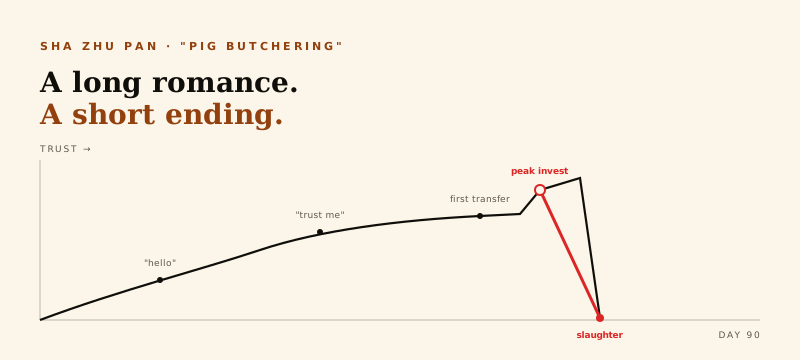
Pig butchering ("Sha Zhu Pan" / 杀猪盘) is industrial-scale investment fraud run from compounds in Cambodia, Myanmar, and Laos. In 2025, Americans alone reported $7.228 billion in losses across 61,559 IC3 complaints — up 25% from 2024. Globally, academic estimates put cumulative losses above $75 billion since 2020, with some 2025 projections reaching $140 billion.
The "investor" you've been chatting with is one of an estimated 200,000+ trafficked workers held in scam compounds. The "exchange" is a fake interface. The money flow is overwhelmingly USDT (84% of pig butchering volume) on Ethereum first, then Tron for cash-out. Western on-ramps: Coinbase, Crypto.com, Kraken. Asian off-ramps: Binance, HTX, OKX. The dominant DEX laundering venue is Tokenlon, where independent analysis found 57-60% of swap volume tied to scam-network addresses.
Recovery is possible but rare and time-sensitive. The DOJ's Scam Center Strike Force has recovered $580M+ in digital assets since November 2025, including a record $14B Bitcoin seizure tied to Cambodia's Prince Group. Tether has frozen $4.4B+ across 2,300+ cases globally. If you've been hit, the first 7 days matter more than the next 7 months combined.
For the law-enforcement side of the laundering pipeline, see Tron USDT Tracing for Law Enforcement — the T3 Financial Crime Unit, Tether freeze process, and Tronscan workflow that detectives use against the same scam compounds. For evidence-package preparation, see Stolen USDT Recovery: Inside Tether's $4.4B Freeze Network.
In This Article
- Why I'm writing this one differently
- By the numbers: pig butchering in 2025-2026
- Sha Zhu Pan: what the term actually reveals
- The industrial operation: compounds, trafficking, and organized crime
- The behavioral playbook: what I actually see in cases
- Where the money actually goes on-chain
- The 2025-2026 enforcement crackdown
- What recovery actually looks like
- What to do right now if you've been scammed
- Frequently asked questions
Why I'm Writing This One Differently
Most pig butchering articles online read like they were written by someone who Googled the term and rephrased an FBI press release. That's because most of them were.
I work pig butchering cases. I trace the funds through Tokenlon, Tron USDT swaps, and the ladder of cash-out exchanges. I file the affidavits that go to law enforcement. I see the patterns repeat across dozens of victims because the same compounds are running the same scripts.
This article is going to be longer than most of what you'll find on the topic. If you just need the action checklist, jump to What to do right now if you've been scammed. If you want to understand what actually happened to your money, where it is now, and what your real options are — keep reading.
What you'll find here that's different from the typical writeup: 2025-2026 enforcement data (most articles still cite 2021 FBI numbers), the on-chain laundering specifics (Tokenlon, USDT-Tron, the Western-to-Asian exchange route), the trafficking and compound infrastructure that makes the scam scale, and the recent recovery cases that are actually changing the math on what's possible.
By the Numbers: Pig Butchering in 2025-2026
The scale of pig butchering is genuinely difficult to comprehend. Here's where the most recent data comes out as of mid-2026:
The official US numbers
The FBI's 2025 Internet Crime Report (released early 2026) provides the most authoritative U.S. figures:
- $7.228 billion reported lost to crypto investment fraud (the FBI category that captures most pig butchering activity)
- 61,559 complaints — a 48% jump from 2024
- $11.36 billion in total crypto-related fraud losses, making cryptocurrency the single largest transaction medium used in cybercrime
- $8.6 billion in total investment scam losses (pig butchering is the dominant subcategory, alongside other crypto investment frauds)
- $20.877 billion in total internet-enabled crime losses across all categories — a 26% YoY increase
For context: the 2024 figures were $9.3B in total crypto fraud and $5.8B in investment fraud. Pig butchering specifically grew somewhere in the 25-40% range YoY depending on how you measure.
The independent estimates
Official numbers capture only reported losses. The actual scale is much larger:
- $75 billion — cumulative pig butchering losses traced through early 2024, per a University of Texas academic study
- $140 billion — some 2025 projections for global pig butchering losses
- $94.6 billion — total inflows to pig butchering networks traced 2020-2024 in independent on-chain analysis
- $27.8 billion — average annual outflow to suspicious Asian exchange accounts (2021-2023)
- $17 billion — Chainalysis's estimate of total 2025 crypto scam losses across all categories, with $14B confirmed on-chain
- $10 billion+ — Americans lost specifically to SE Asia-based scam operations in 2024 (66% increase over prior year per Chainalysis)
The numbers that should stop you
Two stats from the FBI's Operation Level Up — an initiative specifically targeted at notifying pig butchering victims who don't yet know they're being scammed:
- 8,103 victims notified by the FBI that they were currently being scammed
- 77% of those victims didn't know. They were still mid-scam, still emotionally invested, still planning their next deposit
- $511 million in projected savings from those notifications
That 77% number tells you everything you need to know about how good the scam is. The vast majority of currently-active victims do not realize what's happening until someone outside the scam tells them.
Average individual loss has also exploded. Per Chainalysis's 2025 Crypto Crime Report, the average crypto scam payment went from $782 in 2024 to $2,764 in 2025 — a 253% increase. The scam isn't just spreading; the per-victim extraction is getting bigger.
Sha Zhu Pan: What the Term Actually Reveals
The Mandarin term for pig butchering is Sha Zhu Pan (杀猪盘) — literally "killing pig plate." The metaphor is grim and accurate. The pig is you. The fattening is the weeks of relationship-building. The slaughter is when the script flips and the deposits are gone.
The Mandarin origin matters because it tells you who designed the scam. Pig butchering didn't evolve organically in some American basement. It was developed as a refined fraud playbook by Chinese organized crime networks operating out of Southeast Asia, originally targeting Chinese-speaking diasporas in the late 2010s. Around 2020-2021 the playbook was translated — literally and operationally — for English, Korean, Japanese, and European targets. Today the same scripts run across more than a dozen languages.
What distinguishes Sha Zhu Pan from older romance and investment scams is the investment hook timed to a manufactured emotional baseline. Older romance scams ended with "send me money so I can fly to see you." Pig butchering ends with "I just made $40K this week, you should let me show you" — which feels less manipulative because the scammer doesn't directly ask for money. The victim asks how to participate.
That single shift — making the victim ask — is why the scam scales the way it does. It bypasses the "I would never fall for that" instinct because the victim isn't being asked for anything. They're being shown an opportunity.
The Industrial Operation: Compounds, Trafficking, and Organized Crime
This is the part most coverage gets wrong, and it's why prevention advice based on "watch out for romance scammers" misses the actual picture.
The person on the other end of the chat is not in a bedroom in Eastern Europe. They're on a 12-hour shift at a desk in an industrial scam compound — in many cases against their will.
Where the compounds are
The major centers as of 2026:
- Cambodia: Sihanoukville (the de facto capital of online fraud), Bavet, Poipet, and Phnom Penh. Cambodian authorities found roughly 2,000 foreign workers from 11 countries in just four Sihanoukville compounds during 2024-2025 inspections.
- Myanmar: KK Park in Myawaddy on the Thai border (one of the largest, holding ~2,000 trafficked scammers), plus other compounds along the Karen State border. A February 2025 joint operation by China, Thailand, and Myanmar freed approximately 1,200 workers from KK Park alone.
- Laos: Bokeo Province, particularly the Golden Triangle Special Economic Zone.
- UAE: A growing footprint in Dubai-area free zones for higher-end operations.
- The Philippines: POGOs (Philippine Offshore Gaming Operators) infrastructure has been repurposed in some cases.
The UN Office on Drugs and Crime estimates over 200,000 trafficking victims are currently held in SE Asia scam compounds. Myanmar's military government has stated that "special operations" over the past two years repatriated 70,000+ foreigners who had been forced into online fraud work.
How a compound is structured
A typical compound runs like a corporate sales floor with prison features:
- "Hosts" or "Models" — the front-line workers running the conversations. 50-200 per compound, working 12-hour shifts. Many are trafficking victims lured by fake job ads ("data entry job in Thailand, $1,500/month") and then held against their will once their phones are confiscated.
- Translators and scriptwriters — adapt scripts for English, Korean, Japanese, Mandarin, Vietnamese, Thai, Indonesian, and increasingly European-language targets.
- "Trainers" — usually Chinese-speaking middle managers who coach hosts on closing techniques and review chat logs.
- The crypto layer — a separate team manages wallets, monitors deposits, and runs outflow laundering. This team is typically not the same people the victim talks to.
- Compound bosses — Chinese or Chinese-Cambodian organized crime networks. The largest have ties back to triad-affiliated structures.
This is not metaphorical. There is documented video footage of hosts being beaten for missing quotas. There are rescued victims who escaped through windows. The U.S. State Department has classified the compounds as a major human trafficking concern. Indonesian and Filipino embassies have repatriated thousands of citizens trafficked into these operations.
The Prince Group: a case study in scale
On October 14, 2025, the U.S. Treasury (in coordination with the U.K.'s Foreign Commonwealth and Development Office) designated the Prince Group as a transnational criminal organization and sanctioned 146 associated persons. The Prince Group, run by Chinese-Cambodian businessman Chen Zhi, operated multiple compounds across Cambodia and laundered the proceeds through legitimate-looking real estate, hotels, and financial vehicles.
The same action included the largest Bitcoin seizure in U.S. history: approximately $14 billion in BTC. That single seizure represents more than the annual GDP of dozens of countries.
If you ever wondered why a single pig butchering operation could look like a corporate empire — it's because, financially, it is one.
BREAKING: US Government Seized $14B BTC Tied to LuBian and Chen Zhi's Pig Butchering Operation
— Arkham (@arkham) October 14, 2025
The US Government has submitted today a filing for the forfeiture of 127,271 $BTC ($14.2 BILLION) connected to Chen Zhi, chairman of Prince Group, who allegedly ran large-scale pig butchering...
Chen Zhi himself, transported to China
Sanctions are paper. Forfeiture orders are paper. The thing that actually changes the math for compound operators is when one of them physically gets put on a plane — and that's what happened on January 8, 2026.
Chen Zhi, the man who built Prince Group into what Arkham Intelligence has called a $40 billion scam empire, was transferred from Cambodia to China that day to face criminal investigation. He'd been under Chinese investigation since 2020, but for years it sat there because the political layer in Phnom Penh kept him out of reach. The transfer is the first time the founder of a top-tier compound operation has been physically handed over to a state that intends to prosecute him for it. For everyone else running similar operations, this is the data point from 2026 that mattered most.
BILLIONAIRE SCAM EMPIRE FOUNDER CHEN ZHI TRANSFERRED TO CHINA
— Arkham (@arkham) January 8, 2026
Chen Zhi, the 'pig butchering' scammer who ran 'Prince Group', has been transported to China. Prince Group was a $40 Billion scam empire that has been under Chinese criminal investigation since 2020.
Then his lieutenant followed him
Three months later, on March 31, 2026, Cambodia revoked the citizenship of Li Xiong — known internally as “Boss Xi” (西总) — by royal decree, then deported him to China the next day. CCTV identified Li Xiong as a core member of the Chen Zhi network. He's the second top-tier compound figure handed to Beijing inside a single quarter.
What this tells you: the protection layer in Phnom Penh that kept these operations untouchable for years is, finally, breaking down. The political cost of being publicly tied to compound operators got too high once the U.S. seized $14 billion and the OFAC list started naming Cambodian senators. The ones who can still leave are doing it. The ones who can't are being shipped.
Video: Li Xiong, aka “Boss Xi,” arriving in China after being deported from Cambodia. Citizenship revoked, charges pending. He's the second major figure handed to Beijing after Chen Zhi in January.
— Jacob in Cambodia 🇺🇸 🇰🇭 (@jacobincambodia) April 1, 2026
What raids on compound floors are turning up in 2026
One detail from a March 2026 raid in Phnom Penh that I think is the most under-reported story of the year: police hit the 30th floor of a luxury building, arrested 65 people including eight suspected Chinese ringleaders, and seized AI-generated pig butchering scripts in more than 20 European languages, along with costumes and fake IDs. The compound was running a translation-and-localization assembly line. The hosts didn't need to speak the victim's language; the LLM was translating between the script's Mandarin master copy and the victim's German, Polish, French, Italian. Same script, same psychological pressure points, twenty-plus localizations, no human translator bottleneck.
AI-generated pig butchering scripts in more than 20 European languages. Costumes and fake IDs. All found on the 30th floor of a luxury building in Phnom Penh.
— Jacob in Cambodia 🇺🇸 🇰🇭 (@jacobincambodia) March 22, 2026
Police raided the scam center and arrested 65 people, eight of them suspected Chinese ringleaders.
This is the 2026 version of the scam: industrial in 2022, AI-augmented in 2026. If you're trying to keep up with how compound operations are evolving, generative AI is the single biggest force multiplier they've gotten in five years. The compounds don't need fewer hosts — they need hosts who can run more parallel conversations in more languages, and they're getting it.
The Cambodian senator: state-level complicity
Pig butchering doesn't exist without local political protection. In 2025, OFAC sanctioned Cambodian Senator Kok An and 28 others for operating scam centers across the country. Kok An's Crown Resorts hospitality group owned casinos and buildings in Poipet, Sihanoukville, and Bavet that had been converted into scam compounds. A subsequent November 2025 action sanctioned Cambodian businessman Rithy Raksmei and additional infrastructure (Trans Asia, Troth Star) used to develop these compounds.
Hun To, identified as a director of Huione Pay (the Cambodia-based laundering network discussed below), is the cousin of Cambodian Prime Minister Hun Manet. The compound infrastructure operates with at least the tolerance, and in some cases the active protection, of Cambodian political elites.
Huione Group: the laundering layer
In October 2025, the U.S. Treasury's FinCEN issued a Section 311 final rule severing Huione Group from the U.S. financial system — a designation typically reserved for the most serious money laundering concerns. FinCEN found Huione laundered at least $4 billion in illicit proceeds between August 2021 and January 2025, including:
- Pig butchering scam proceeds from SE Asian compound operators
- Cyber heist proceeds from North Korea's DPRK-linked hacking groups
- General money laundering for transnational organized crime
Huione Pay's significance to the pig butchering industry is hard to overstate. It functioned as the Cambodia-based clearing layer where compound operators converted on-chain crypto proceeds into local fiat or moved them through chains of accounts with weak KYC.
Funnull Technology: the scam infrastructure layer
In May 2025, OFAC sanctioned Funnull Technology Inc., a Philippines-based hosting company that provided web infrastructure (domains, IP addresses, hosting) for the fake exchange websites pig butchering operators direct victims to. Funnull's role mattered because it was the technical backbone that let compound operators spin up new fake-platform domains within hours of one being reported.
The pig butchering industry isn't just compounds. It's a stack: traffickers feed compounds, compound operators run the scams, Funnull-style hosting services provide the tech, Tokenlon-style "DEXs" launder the on-chain proceeds, Huione-style platforms convert to fiat, and exchanges in Seychelles and Hong Kong cash out. Each layer can be sanctioned, but the industry as a whole adapts.
The Behavioral Playbook: What I Actually See in Cases
If you read this section and recognize five or more behaviors from a current conversation, you're being targeted. These aren't coincidences — they're the script. Compound trainers drill hosts on each of these patterns.
How they communicate
Communication tells
- Daily "good morning / good night" messages. Without fail, every single day. The consistency is itself the manipulation — it builds emotional reliability faster than almost anything else.
- Always available, even at odd hours. A "Singapore investor" who's instantly responsive at 3am Singapore time is on a Cambodia compound's night shift.
- Photos but rarely video. Selfies, gym pics, food photos, scenery, voice notes — all common. Live video calls are deflected. Excuses include "my camera is broken" or 5-second "look at the view!" clips that don't show their face. Most hosts physically cannot do video because they aren't who they claim. Some advanced compounds have started using deepfake video, which is its own emerging problem.
- Polite even when accused. Confront them with "I think you're a scammer" and they don't get defensive — they get hurt. They send a long, wounded message about how they thought you trusted them. This isn't sociopathy; it's training. Hosts are scripted on accusation responses.
- Voice memos but the voice changes. Some operations use shifts on the same persona, meaning different humans speak as the same character. Subtle voice variation across messages is a tell most victims miss until pointed out.
How they build the persona
Persona tells
- Profile photos look professionally staged because they often are. Compounds maintain libraries of stolen photos from Korean, Taiwanese, and Japanese influencers. The "host" has 200+ photos of the same person to draw from in different settings.
- Their "business" is unverifiable. A clothing line in Hong Kong, a wine import company in Singapore, a real estate fund in Vancouver, a finance job in Dubai. Every detail sounds plausible but nothing checks out on LinkedIn or in trade registries.
- They casually mention expensive things. A Hermès bag, a weekend in the Maldives, the Tesla they just got. The implicit message: "I'm in a different financial league than you."
- They talk about goals, dreams, and "thinking bigger." Closing-script language. They're priming the frame that your current financial situation is a failure of imagination.
- They ask about your finances early. Savings accounts, retirement balances, home equity, investments. This is target sizing. The compound's crypto team needs to know the maximum extraction ceiling before committing a host's hours.
How they introduce the investment
Investment-introduction tells
- Crypto comes up between week 2 and week 6, almost never on day one. The wait is deliberate. By the time it surfaces, you've had 50+ conversations and feel a real connection.
- They don't pitch — they share. "My uncle taught me this." "My friend showed me this strategy." "I made $40K last month, look." They never directly suggest you invest. They wait for you to ask.
- The platform name is a custom-branded interface. Not Coinbase, not Binance — a website you've never heard of with names like "ABS Trading," "GlobalFXPro," "Vanrock Capital," or names that sound like real exchanges but aren't ("Coinbase Pro Premium," "Binance VIP Trading" — these don't exist).
- They walk you through the funding flow. "Buy USDT on Coinbase, then send it to this address on the platform." This routing makes the deposit feel legitimate because Coinbase IS legitimate, even though the destination isn't.
- Wire transfers are an alternate funding path. Sometimes the platform offers a wire option to a U.S. or Hong Kong bank account. Those accounts are usually money mules — international students who sold their account, or trafficked individuals whose IDs were used to open accounts they'll never see.
- They show you their "trades" with impressive returns. The platform pulls real BTC/ETH price data but shows fictional account balances. Their account "moves with yours" because they control both.
How they accelerate the deposits
Acceleration tells
- The first withdrawal works. Always. A few hundred or a few thousand dollars. This is the most psychologically critical moment in the scam. Once you've successfully pulled money out, your skepticism collapses. You stop fact-checking.
- They mention a "limited time" investment opportunity. "There's a new token launch tomorrow — you have to be in by midnight." The deadline IS the manipulation. It bypasses your research time and family-consultation time.
- Belittling for not investing enough. The emotional arsenal kicks in. "You have to spend money to make money." "I thought we were building something together." "If you can't even commit to this, what does that say about us?" The romance frame becomes the leverage.
- They offer to "match" your deposit or lend you money. "I'll put in half." Their account balance goes up — but they control the platform, so the "matched" funds are fictional.
- Manufactured platform losses. The platform shows you've taken a big loss and need to "make up the shortfall." Or your account got "frozen" and needs an unlock fee. Or there's a "margin call." You're being prompted to deposit external funds for a fictional emergency.
How they trap you when you try to withdraw
This is where the slaughter starts. The pattern is remarkably consistent across compounds:
Withdrawal-block tells
- "Anti-money-laundering verification fee." A new fee appears that has to be paid before withdrawal can process. Usually 10-20% of the account balance.
- "Tax obligation." Even though you're "trading," there's a "tax" that must be paid externally before withdrawal.
- "Your account is frozen." You'll need to pay an "unlock fee" or "compliance fee."
- "Credit score requirement." Some manufactured scoring system that requires another deposit to "build credibility."
- The 10-day countdown. "If you don't pay these fees in 10 days, your account starts losing 5-20% of its balance per day until you're compliant." A manufactured emergency designed to short-circuit rational thinking.
- The "reverse the payment" trick. Customer support calls and tells you a payment you just made went to "the wrong address" and you need to send it again. Crypto transactions cannot be reversed. This is them stealing the same dollars twice.
- The "we'll write off 20-50%" offer. Eventually, when you're broken, they offer a "settlement" — pay the remaining 50-80% of the fees and they'll write off the rest. There is no settlement. It's another extraction. The fees never end until you do.
Every victim I've worked with hit a moment where they realized. Sometimes a family member intervenes. Sometimes they run out of money. Sometimes a small detail breaks the spell — the host slips up about a time zone, the photo metadata doesn't match the supposed location, a Google reverse-image search returns the real owner of the face.
Once the spell breaks, the panic sets in. The next 7 days are the recovery window. We'll cover that next.
Where the Money Actually Goes On-Chain
This is where my work starts. By the time a victim contacts me, the funds have usually moved 3-7 hops from the initial deposit address. Here's the dominant pattern in 2025-2026 cases:
Victim's exchange (Coinbase / Crypto.com / Kraken) → "Investment platform" deposit address (Ethereum) → Aggregator wallet → Tokenlon swap (or alternative DEX/OTC) → USDT on Tron → Peel chain or mixer → Cash-out at HTX / Binance / OKX → Off-chain into Asian banking
The dominant token: USDT (Tether)
USDT is involved in ~84% of pig butchering transaction volume. That number comes from a 2024 study analyzing nearly $1.2 trillion in scammer-wallet volume. Of the broader $1.7 trillion network volume across pig butchering operations since 2020, USDT made up 78%. The total estimated proceeds reached $75.3 billion as of February 2024, described by researchers as "likely a conservative lower-bound estimate."
A deputy district attorney quoted in industry coverage put it bluntly: "It's always, always, always Tether. I've never heard of pig butchering that isn't Tether."
The reason is structural. USDT exists on multiple chains (Ethereum, Tron, Solana, BSC, etc.), the issuer (Tether) historically has not been quick to freeze suspicious addresses without strong cooperation triggers, and it's the most liquid stablecoin on every Asian exchange that pig butchering operators use for cash-out.
That said — Tether's freeze cooperation has dramatically improved in 2025. The recovery section below covers that shift.
The dominant chains: Ethereum entry, Tron exit
Around 88% of scammer wallets operate on Ethereum, which is where most victim deposits initially land. Ethereum is the entry chain because most U.S.-side on-ramps (Coinbase, Crypto.com, Kraken) make ETH and ERC-20 USDT trivially easy to buy and send.
Tron is the dominant cash-out chain. Tron's transaction fees are negligible (often under $0.10 vs $1-20 on Ethereum), and Tron's USDT volume is large enough that laundering can hide in legitimate flow. Cross-chain bridges between Ethereum and Tron are an inflection point for forensic tracing — once funds bridge to Tron, the per-hop laundering cost drops dramatically.
Tokenlon: the fake DEX in the middle
Tokenlon presents itself as a decentralized exchange (DEX). Independent on-chain analysis has documented that it functions more like a centralized OTC desk that takes custody of inbound funds, performs fiat-stable swaps, and forwards funds outbound — without any of the compliance controls that a centralized exchange would have.
Key Tokenlon data points from independent investigations:
- 57-60% of Tokenlon swap volume in 2022-2023 involved scam-network addresses
- On-chain investigator ZachXBT estimated 58% of Tokenlon transactions since 2022 originated from scammers (pig butchering, human trafficking proceeds, investment fraud, Chinese illicit marketplaces)
- The Tokenlon BTC-imBTC bridge address (3JMjHDTJjKPnrvS7DycPAgYcA6HrHRk8UG) handled the majority of pig butchering BTC funnels — up to 20 BTC per conversion ($400K-$1M+ at spot price) without triggering manual review
- Tokenlon abruptly curtailed its retail BTC cross-chain service in August 2023 with one week of notice and ended it entirely by early 2024 — widely interpreted as a response to mounting on-chain forensic pressure
Tokenlon hasn't been formally sanctioned (as of writing). But the on-chain evidence is unambiguous: a substantial percentage of its volume is illicit, and its operators have done minimal compliance work to filter it.
The exchange ladder: Western on-ramps, Asian off-ramps
Funds flow from Western user-facing exchanges to Asian compliance-light exchanges:
| Role | Exchanges | Why |
|---|---|---|
| Western on-ramps (where victims buy) | Coinbase, Crypto.com, Kraken, Binance.US, Cash App | Easy fiat-to-crypto, KYC compliant, victims trust them, large daily limits |
| Asian off-ramps (where scammers cash out) | Binance (global, not US), HTX (formerly Huobi), OKX | Higher KYC tolerance for some user tiers, large USDT-Tron liquidity, slower response to U.S. subpoenas |
| Smaller cash-out tiers | Various Seychelles-, BVI-, and Hong Kong-domiciled exchanges | Minimal KYC, no MLAT cooperation with U.S. law enforcement |
$15.2 billion was sent to scammer wallets from the major Western exchanges (Coinbase, Crypto.com, FTX, Gemini, Kraken) over a four-year window per academic analysis. Most of that volume eventually consolidated at Asian off-ramps.
The laundering math
Pig butchering laundering is shockingly cheap by criminal-finance standards. Traditional cross-border fiat money laundering runs 4-20% commission costs. Crypto laundering through the standard pig butchering route averages 0.33% to 0.87%:
- Gas fees and swap slippage to move $4 billion through 5 hops cost only $13.1 million in one analyzed network
- Average cost: 0.33% of transaction value
- USDT-specific commission: 0.87%
The cost advantage over traditional laundering is one of the main reasons pig butchering scaled so quickly. Compound operators can move billions through the system and only lose a fraction of a percent to friction.
The address scale
The pig butchering on-chain footprint is enormous:
- ~180,000 deposit addresses identified through clustering analysis
- 4,512 Ethereum addresses, 4,394 Bitcoin addresses, and 993 Tron addresses seeded from victim reports in one academic dataset
- ~98,000 micro-deposits annually under $10,000 identified as scammer-controlled trust-building "test" payments before larger victim deposits
This is what investigators trace through. Each victim case requires identifying which subset of the 180,000+ addresses corresponds to that specific compound, then following the funds forward to the cash-out endpoint where subpoena leverage exists.
The 2025-2026 Enforcement Crackdown
The enforcement landscape in 2025-2026 is fundamentally different from where it was even 18 months ago. If you're reading articles from 2022-2023 with their pessimistic recovery framing, the math has changed.
The DOJ Scam Center Strike Force
On November 12, 2025, the U.S. Attorney for the District of Columbia, in coordination with the FBI and U.S. Secret Service, established the Scam Center Strike Force — a dedicated interagency task force focused exclusively on Southeast Asian scam center operators and their financial infrastructure.
By April 2026, the Strike Force had:
- Recovered or frozen $580 million in digital assets connected to pig butchering scams
- Conducted a first-of-its-kind seizure of a Telegram channel with 6,000+ followers used to recruit trafficking victims to Cambodian compounds
- Coordinated with Treasury's OFAC on the Prince Group designation and follow-on sanctions
The Strike Force represents a strategic shift: rather than chasing individual scam victims' funds case by case, the U.S. is now targeting the financial backbone of the entire industry.
🇺🇸 UPDATE: DC Scam Center Strike Force has seized over $580M in crypto tied to “pig butchering” scams.
— Cointelegraph (@Cointelegraph) February 27, 2026
The largest Bitcoin seizure in U.S. history
The Prince Group action in October 2025 included approximately $14 billion in Bitcoin — 127,271 BTC, per the forfeiture filing — seized from infrastructure controlled by Chen Zhi's network, including a wallet cluster known as “LuBian.” This is the largest single Bitcoin seizure ever conducted by U.S. authorities, and arguably the largest single asset seizure in any modality. The funds are being held pending forfeiture proceedings; some portion will eventually be returned to identified victims.
OFAC sanctions targeting infrastructure
The 2025 OFAC actions hit every layer of the pig butchering stack:
- May 2025: Funnull Technology Inc. (Philippines-based) sanctioned for hosting fake exchange websites used by pig butchering operators
- June 2025: Additional Philippines-based tech infrastructure sanctioned for facilitating pig butchering schemes
- October 2025: Prince Group + 146 associated persons designated as a TCO; $14B BTC seizure
- October 2025: FinCEN Section 311 final rule severing Huione Group from the U.S. financial system
- 2025: Cambodian Senator Kok An + 28 others sanctioned for operating compounds (Crown Resorts hospitality group)
- November 2025: Trans Asia, Troth Star, Rithy Raksmei (Cambodian businessman) sanctioned for compound development and forced-labor operations
OFAC sanctions matter for recovery because U.S. financial institutions and U.S.-touching crypto exchanges are required to freeze any funds traceable to sanctioned addresses. The cumulative effect is that an increasing percentage of the pig butchering money flow runs into mandatory freezes.
Tether's recovery cooperation
Tether has dramatically increased its freeze cooperation with U.S. and international law enforcement in 2024-2025. Cumulative numbers:
- $4.4 billion in USDT frozen across 2,300+ cases globally
- $2.1 billion connected specifically to U.S. authorities
- 1,200+ U.S. law enforcement cases supported
Specific 2025 pig butchering cases:
- $225 million USDT seized by U.S. Secret Service in June 2025 (the largest single seizure in Secret Service history) — Tether assisted
- $344 million USDT frozen in coordination with OFAC and U.S. law enforcement (multi-case, includes pig butchering)
- $61 million USDT seized in February 2025 by the U.S. Attorney's Office for the Eastern District of North Carolina (one of the largest single stablecoin recoveries linked to romance-based crypto fraud)
- $50 million USDT frozen with APAC authorities (Chainalysis, Binance, OKX, and Tether collaborated) in mid-2025
Tether freezes don't return the funds to victims directly — the funds remain frozen pending civil or criminal proceedings — but they're the strongest single recovery lever currently available. A USDT-based pig butchering case has materially better recovery odds than an equivalent Bitcoin or Ethereum case.
Operation Level Up
The FBI's Operation Level Up is a victim-notification program specifically targeted at pig butchering. The FBI uses analytical methods to identify likely active victims and proactively notifies them they're being scammed.
Numbers as of April 2026, per the FBI's own count:
- ~9,000 victims notified by FBI agents directly
- 77% didn't know they were being scammed at the time of the call
- $562 million in projected loss savings from those notifications
If the FBI contacts you through Operation Level Up, take it seriously. Most people who get the call don't believe it at first — the relationship feels too real. The 77% figure is the proof.
The April 2026 takedown: Dubai, Beijing, and the FBI in the same room
The single biggest enforcement action of 2026 hit on April 29, when the DOJ unsealed indictments out of the Southern District of California against four named compound managers and announced that 276 people had been arrested across nine scam centers. What makes this one different from prior takedowns is who showed up to coordinate it: the FBI, the Dubai Police Department under the UAE Ministry of Interior, and the Chinese Ministry of Public Security. China has not historically coordinated this kind of operation with U.S. federal law enforcement on a public footing. That the announcement was made jointly is itself the news.
The four indicted defendants charged in San Diego:
- Thet Min Nyi, 27, Burmese national, alias “Pixy” or “Ko Thet” — alleged manager and recruiter for “Ko Thet Company,” one of the three named scam organizations the indictment describes. Apprehended in Dubai.
- Wiliang Awang, 23, Indonesian, alias “Lincoln” — tied to “Sanduo Group.” Apprehended in Thailand by the Royal Thai Police.
- Andreas Chandra, 29, Indonesian, alias “Jay” — tied to “Giant Company.” Apprehended in Dubai.
- Lisa Mariam, 29, Indonesian, with multiple aliases (Melissa Chloe, Cipul, Naomi May Lingston, Vanessa, Bella Theresia). Apprehended in Dubai.
Two more co-conspirators are listed as fugitives. The charges are wire fraud conspiracy and money laundering conspiracy — 20-year ceiling on each count.
Three operational details worth noting from the unsealed documents. First, FBI San Diego opened the Homeland Security Task Force investigation back in 2025 after identifying multiple companies running compounds — this is the kind of investigation that takes a year or more before anything visible happens, and the people you talked to in 2025 who said “nobody's doing anything about this” were wrong; they just couldn't see it yet. Second, Meta provided what DOJ described as “critical information.” Facebook and Instagram sit at the front-end of these scams — profile creation, target identification, message routing — and Meta's evidence set is unique. They used it. Third, the same San Diego office is also working a separate case against the “Tai Chang Scam Enterprise,” a series of compounds in Burma's Karen State. The April action was one piece of an ongoing pipeline, not a one-off.
Quote from Assistant Attorney General A. Tysen Duva of DOJ's Criminal Division, which I think is worth pulling out because it captures the policy shift: “In contemporary society, fraud is borderless, and law enforcement activity to combat it and eliminate it is as well.”
The Asian-region picture
An August 2025 APAC enforcement action — involving Chainalysis, Binance, OKX, and Tether — froze $47 million in pig butchering funds. That's a smaller number than the U.S. seizures, but the meaningful detail is that Binance and OKX showed up on the cooperation side rather than the unwitting cash-out side. The same exchanges that pig butchering operations rely on for liquidity are increasingly the ones helping freeze the funds. That alone is a structural shift; for years the cash-out exchange was the dead end of any trace.
What Recovery Actually Looks Like in 2026
Honest read: most pig butchering losses are still not fully recovered. Anyone who tells you otherwise is selling something. But "most" is no longer "almost all," and the recovery scenarios that work are now well-defined.
Best case: USDT freeze at the issuer
If the funds touched USDT and you act fast, Tether's compliance team can freeze the destination address. This is now the strongest single recovery lever. The trigger is typically a law enforcement request (FBI, Secret Service, state AG, or international counterpart) with strong evidence — usually a forensic trace report identifying the scammer-controlled address.
The freeze prevents the scammer from moving the funds further but doesn't immediately return them to you. Return requires civil or criminal proceedings to claim the frozen assets. Timeline: typically 6-18 months from freeze to return, sometimes longer.
Realistic case: U.S.-cooperative exchange before laundering completes
If the cash-out lands at Coinbase, Kraken, Gemini, Binance.US, or any other U.S.-domiciled exchange while funds are still on-chain, a subpoena (with attorney involvement) can force the exchange to:
- Freeze the receiving account
- Disclose the account holder's KYC information
- Preserve transaction records for civil action
From there, a civil suit can pursue clawback. Recovery rates are highest when the funds are still sitting in the exchange wallet at the time the subpoena hits. Once funds are withdrawn off-chain into local banking, recovery becomes substantially harder.
Long-shot case: OFAC sanctions catch
If the destination wallet eventually gets added to OFAC's SDN list (as has happened to Prince Group infrastructure, Funnull, and others), every U.S. exchange must freeze any traceable funds passing through those addresses. Watch for sanctions list updates — they sometimes catch funds that had moved beyond the immediate cash-out exchange.
Civil action against identified operators
The 2025 Treasury sanctions named specific individuals (Chen Zhi, Senator Kok An, Rithy Raksmei). Civil actions against named compound operators have begun in U.S. and U.K. courts. These cases can succeed in obtaining default judgments and seizing identifiable assets — though enforcing judgments against assets in Cambodia or Myanmar remains practically difficult.
Almost never recoverable
Funds that completed cash-out at a non-cooperative exchange in Seychelles, BVI, or smaller jurisdictions, then moved off-chain into local Asian banking, are essentially gone. The MLAT framework with these jurisdictions is too weak to compel asset recovery.
What investigation actually produces
When you hire a forensic investigator after a pig butchering scam, you're paying for one or more of:
- A trace report documenting the on-chain path of the funds — the foundation for everything law enforcement, attorneys, or exchanges need.
- An attribution opinion identifying which exchange the funds landed at, which is what your attorney needs to subpoena.
- An expert affidavit suitable for filing with a freezing motion, restraining order, or sanctions request.
- Evidence preservation that survives a 2-3 year civil litigation timeline.
What you're not paying for: a guarantee that funds come back. If anyone offers you that, they're a recovery scammer. (Recovery scams targeting pig butchering victims are now their own industry — we wrote about legitimate crypto recovery vs scam recovery services separately.)
What to Do Right Now If You've Been Scammed
The first 7 days matter more than the next 7 months. If you've just realized this is a scam, the actions below are time-sensitive. Don't read further. Start executing.
- Stop sending money immediately. Any "fees" the platform demands to release your funds are part of the scam. Stop now. Today. Even if you're convinced one more payment will get your money back — it won't.
- Document everything before it disappears. Screenshot every conversation, the platform interface, deposit addresses, transaction hashes, dates and amounts. Email the screenshots to yourself so you have a backup.
- Don't delete the chat. Don't block the scammer. Don't tell them you've figured it out. The chat is evidence.
- Record every transaction hash. Every crypto transfer you made has a transaction ID (TXID). Find these in your exchange history or sending wallet. These are the starting point for forensic tracing.
- File at IC3.gov immediately. The FBI's Internet Crime Complaint Center is the federal entry point. File even if you think it won't help — it creates a record, contributes to broader investigations, and is required for many recovery paths. (See our step-by-step IC3 filing guide.)
- File at ReportFraud.ftc.gov. The FTC's complaint system is a separate federal record.
- Notify your state Attorney General. State AGs often have dedicated cybercrime units that respond faster than federal channels.
- Contact your bank if a wire was involved. Wire recall is sometimes possible in the first 24-48 hours. Call your bank's fraud line directly — not chat support. (See our bank wire recall guide.)
- Contact your exchange. Coinbase, Kraken, and other major exchanges have abuse-report channels that can result in proactive freezes if the scammer's address is identified quickly.
- Get a free case assessment from a forensic investigator. Most legitimate firms offer this for free. The earlier we have the on-chain data, the better the recovery odds. See our guide on what to bring to your first call.
Wallet Witness offers free initial consultations for pig butchering victims. We'll assess your case, tell you honestly what the on-chain evidence is likely to show, and explain what forensic investigation can realistically achieve. Book a free consultation →
Signs You're Being Targeted Right Now
If you suspect someone's running this on you currently, here's the quick checklist. If three or more apply, you're likely being targeted:
- They reached out first; you didn't initiate
- They moved the conversation off the dating app to WhatsApp/Telegram within 3 days
- They mention crypto investing within the first 2-6 weeks
- They have an "uncle in finance" / "trader friend" / "private investment platform"
- The platform isn't on Coinbase, Binance, or any major exchange listing
- They show screenshots of returns that seem unusually consistent
- They get evasive about live video calls (or only do brief ones that don't show their face)
- They live in a major city you can't easily verify (Singapore, Hong Kong, Vancouver, Dubai, Seoul)
- They ask about your finances early — savings, retirement, home equity
- The first small withdrawal worked — but now larger ones are blocked behind "fees"
- You've been pressured to take out loans, drain your 401(k), or borrow from family to invest more
- You feel a strong emotional connection to someone you've never met in person
Frequently Asked Questions
Final Thoughts
Pig butchering scams are uniquely cruel because they weaponize human connection. The emotional manipulation is real, the relationship feels real, and the money lost is real. Victims are not naive — they are targeted by professional fraudsters who are trained, scripted, and supported by a billion-dollar industry that has been refining the playbook for nearly a decade.
The 2025-2026 enforcement environment is the first time in the lifecycle of this scam where major financial infrastructure is being meaningfully disrupted. The $14B Prince Group seizure, the Huione Section 311 designation, the Tether-Tron-OFAC coordination, and the DOJ Strike Force are all signals that the cost-benefit math is shifting. The compounds aren't going away tomorrow, but the financial scaffolding underneath them is, slowly, being dismantled.
If you've been targeted, get in touch. We'll tell you exactly where your money went, what's recoverable, and what isn't. No sales pitch, no false guarantees, no upfront fees just to assess your case. The forensic picture is the foundation for every legitimate path forward — civil litigation, exchange subpoena, OFAC reporting, Tether freeze request — and it's the one thing only an investigator with on-chain access can give you.
Free Pig Butchering Case Assessment
Tell us what happened. We'll trace the funds, identify where they ended up, and tell you honestly what recovery looks like in your specific case. Initial assessments are free and typically returned within 24 hours.
Start a Free Case Review