In This Article
- The short answer
- What happens after you file a police report
- What law enforcement can and cannot do
- Which agencies investigate crypto fraud
- What determines whether law enforcement acts
- Where a forensic investigator fits in
- Civil vs. criminal recovery — which path makes sense
- The realistic picture in 2026
The first thing most cryptocurrency fraud victims do is file a police report. It feels like the right move — you've been robbed, so you go to the authorities. Then weeks pass. Maybe months. The case number sits in a drawer and nothing happens.
This experience is so common that many victims conclude law enforcement is useless for crypto fraud. That conclusion isn't entirely wrong — but it's not entirely right either. The reality is more nuanced, more frustrating, and ultimately more actionable than either extreme suggests.
Here is an honest breakdown of what law enforcement can actually do about stolen cryptocurrency, what the barriers are, and what meaningfully changes the odds of any outcome.
The Short Answer
Yes — law enforcement can and does recover stolen cryptocurrency. The FBI, HSI, and DOJ have returned hundreds of millions of dollars in stolen crypto to victims in high-profile cases. In 2022 alone, the DOJ recovered $3.6 billion in Bitcoin from the 2016 Bitfinex hack. In 2023, Operation Spiderweb seized over $112 million from pig butchering networks.
But.
Those recoveries happen in large, complex investigations that prioritize prosecuting criminal networks — not recovering individual victim losses. The individual who lost $200,000 to a pig butchering scam is contributing intelligence to an investigation, not directly triggering one. The gap between "law enforcement recovered money" and "law enforcement recovered your money" is wide, and victims deserve to understand it clearly.
What Actually Happens After You File a Police Report
Let's walk through the realistic sequence of events after a typical crypto fraud victim files a report.
Local Police Report
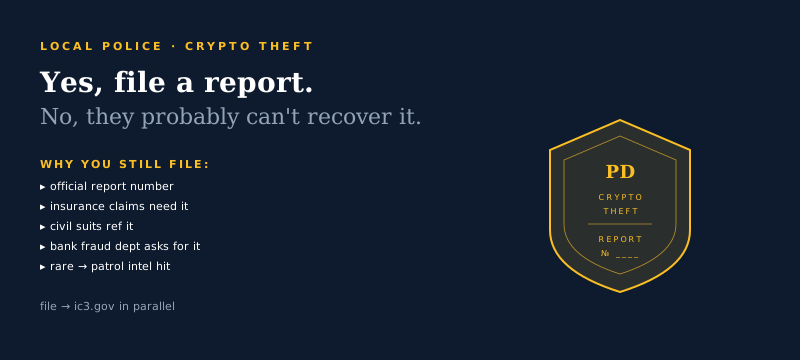
Most local police departments have limited cryptocurrency expertise. An officer takes your report, assigns a case number, and the report enters a system. Unless your local department has a dedicated cybercrime unit, the investigation typically goes no further at the local level. This is not negligence — it is a resource and jurisdiction reality. Crypto fraud is borderless. Most of the people running these operations are overseas, often in jurisdictions with no extradition treaties. Local law enforcement has no authority there and no specialized tools to trace blockchain transactions.
The local report still matters. It creates an official record that is required for insurance claims, civil litigation, and federal escalation. File it — just don't expect local police to be the ones who take action.
FBI / IC3 Report
Reports to the FBI's Internet Crime Complaint Center (IC3) are aggregated, analyzed, and used to identify patterns across thousands of cases. When enough reports point to the same wallet addresses, platforms, or criminal networks, that intelligence package may trigger or contribute to a federal investigation. Your report is a data point — valuable, but not individually case-opening.
However: if your case involves significant losses and you can provide strong evidence — transaction hashes, wallet addresses, platform URLs, communication records — it increases the chance of your case being individually reviewed rather than simply entered as a statistic.
What Law Enforcement Can and Cannot Do
✓ What They Can Do
- Issue subpoenas to US-based exchanges for KYC data
- Freeze accounts at compliant exchanges with court orders
- Seize cryptocurrency from identified wallets via warrant
- Coordinate internationally through MLAT agreements
- Prosecute individuals once identified and within jurisdiction
- Distribute seized assets to victims through victim compensation
- Pursue civil forfeiture against identified funds
✕ What They Cannot Do
- Reverse blockchain transactions — they are permanent
- Force foreign exchanges or governments to cooperate
- Pursue cases below thresholds for resource allocation
- Move quickly — federal investigations take 1–3+ years
- Guarantee individual victim restitution even after seizures
- Act on reports without actionable forensic evidence
- Pursue suspects in non-cooperative jurisdictions
Which Agencies Actually Investigate Crypto Fraud
🏛️ FBI / IC3 Federal
The primary federal agency for internet-based financial crimes in the US. The FBI has dedicated cryptocurrency units with trained agents and blockchain analysis tools. They pursue large-scale crypto fraud operations, pig butchering networks, and exchange-based money laundering. Report at ic3.gov.
Best for: Large losses, organized fraud networks, cases with strong on-chain evidence pointing to US-connected exchange accounts.
💰 IRS Criminal Investigation (IRS-CI) Federal
IRS-CI has some of the most technically sophisticated blockchain analysts in federal law enforcement. They are primarily focused on tax evasion and financial crimes, but work crypto fraud cases that intersect with money laundering. They were instrumental in recovering the Bitfinex Bitcoin.
Best for: Large-scale laundering cases with clear financial crime angles.
🌐 Homeland Security Investigations (HSI) Federal
HSI investigates transnational crime including crypto-financed fraud, human trafficking-adjacent pig butchering operations, and cross-border money laundering. They have international reach through attaché offices worldwide.
Best for: Cases with international dimensions, particularly operations linked to Southeast Asia.
⚖️ Department of Justice — NCET Federal
The DOJ's National Cryptocurrency Enforcement Team (NCET) handles prosecution of the most significant crypto fraud, exchange compliance failures, and cryptocurrency-based crime. They receive cases from FBI, HSI, and IRS-CI rather than directly from victims.
Best for: Cases that have already been escalated through other federal channels.
🌍 INTERPOL / Europol International
Both agencies coordinate international cryptocurrency fraud investigations through member nations. INTERPOL's Financial Crimes unit and Europol's EC3 (European Cybercrime Centre) have run joint operations targeting pig butchering and crypto fraud networks across Southeast Asia and Europe.
Best for: Cases where the forensic trail clearly leads to identifiable foreign entities and a coordinated international response is needed.
What Determines Whether Law Enforcement Takes Action
Federal investigators are not indifferent to crypto fraud. They are capacity-constrained and evidence-dependent. Understanding what makes a case actionable is the key to knowing what you can actually influence.
Loss Amount
This is the blunt truth: case prioritization is heavily influenced by total losses. Individual cases under $100,000 rarely trigger dedicated federal investigation on their own. They contribute to aggregate intelligence. Cases over $500,000 with strong evidence attract significantly more attention. Cases in the millions involving the same identifiable network can be case-opening. This is not justice — it is resource reality.
Quality of On-Chain Evidence
This is the single biggest factor you can control. A law enforcement report accompanied by transaction hashes, wallet attribution analysis, and identified exchange deposit addresses is fundamentally different from a narrative report with no technical evidence. Agents need a starting point. Forensic blockchain analysis provides that starting point — turning your case from a report into an actionable lead.
Jurisdictional Reach
If stolen funds can be traced to a US-regulated exchange, law enforcement has a direct legal pathway: subpoena the exchange, get the account holder's KYC data, and pursue from there. If funds ended up at an offshore, unregulated exchange with no US presence, that legal pathway doesn't exist. Forensic tracing determines which category your case falls into — and that determination shapes everything.
Timeliness of Reporting
Exchanges have data retention policies and account life cycles. Funds that flowed through an exchange six months ago leave records that may be purged or harder to access than funds from six weeks ago. Faster reporting — and faster forensic documentation — preserves the evidentiary window that law enforcement needs to act.
Pattern Connections
Your case gains disproportionate weight when on-chain evidence connects it to other victims or to a known criminal network already under investigation. If the wallet addresses from your case match addresses flagged in 50 other IC3 reports, your case becomes part of a critical mass. This is another reason forensic quality matters — connecting your case to a broader pattern accelerates the aggregate.
Where a Blockchain Forensic Investigator Fits In
Law enforcement has the legal power to subpoena exchanges, seize assets, and prosecute. What they need — and what they frequently lack for individual cases — is the forensic foundation to act on. That's where a private blockchain forensic investigator becomes relevant.
A forensic investigation translates your raw transaction history into a documented, professional evidence package: every wallet the funds touched, identified exchange deposit addresses, entity attribution, methodology, and conclusions. When you attach that report to your IC3 filing, you are giving investigators a finished lead rather than asking them to start from scratch.
More practically, forensic investigation opens parallel tracks that don't depend on law enforcement timing or prioritization at all:
- Civil litigation — Attorneys can pursue civil asset freezing orders and exchange subpoenas independently of any criminal investigation. A forensic report is the evidentiary foundation for this.
- Exchange direct reporting — Submitting a forensic report directly to an exchange's compliance team — particularly if the deposit address is recent — occasionally triggers internal freezes before funds are withdrawn.
- International coordination — Private forensic reports can be submitted to international bodies like INTERPOL's IFCACC (International Financial Crime Against Children & Adults) or to national financial intelligence units in countries where the exchange operates.
Learn what a full forensic investigation covers →
Civil vs. Criminal Recovery — Which Path Makes Sense
Most victims default to thinking about criminal justice — police, FBI, prosecution. But for individual cryptocurrency recovery, the civil track is often more directly relevant.
Criminal Track
The goal of criminal prosecution is punishment and deterrence, not victim restitution. When the DOJ seizes $112 million from a pig butchering network, that money goes into a forfeiture fund. Victim restitution is possible but is secondary to the prosecution itself, often distributed across hundreds of victims in amounts far below individual losses, and takes years to materialize. The criminal track matters — it dismantles networks and creates deterrence — but it is not a direct recovery mechanism for individual victims.
Civil Track
Civil litigation, filed by a private attorney on your behalf, can pursue exchange subpoenas, asset freezing orders (Mareva injunctions in common law jurisdictions), and direct claims against identifiable defendants. When forensic investigation has identified a specific exchange account and the funds are still there, civil emergency freezing applications have been successful in multiple jurisdictions. This track moves at attorney speed, not federal investigation speed — which can be significantly faster when evidence is strong.
The civil track is expensive and is most viable for larger losses ($250,000+) where the math of litigation costs versus potential recovery makes sense. For smaller losses, law enforcement reporting and forensic documentation remain the primary options.
The Realistic Picture in 2026
Law enforcement capacity for crypto fraud has improved significantly over the past five years. The FBI has more trained blockchain analysts than it did in 2020. INTERPOL and Europol have run successful coordinated operations against pig butchering networks. Exchanges are under more regulatory pressure to cooperate with law enforcement requests. The infrastructure for crypto fraud prosecution is better than it has ever been.
At the same time, the volume of crypto fraud has grown faster than enforcement capacity. Pig butchering alone generates tens of billions per year. The industrial scale of the problem means that individual cases face resource competition regardless of merit.
The honest answer to "can police recover stolen cryptocurrency" is: sometimes, in the right circumstances, with the right evidence, at the right scale. Your job as a victim — and the job of a forensic investigator working on your behalf — is to create those right circumstances as completely as possible.
File every report. Document everything. Get a forensic investigation done while the evidence is fresh. Submit your forensic package to law enforcement along with your IC3 report. Engage an attorney if your losses justify civil action. None of these steps guarantees recovery. All of them improve the odds.
Wallet Witness provides forensic investigation and evidence packaging specifically designed to support law enforcement referrals and civil legal action. If you've been defrauded, a free consultation will tell you what the on-chain evidence in your case actually looks like. Book a free consultation →