In This Guide
- Daubert and FRE 702: The Gatekeeping Framework
- Kumho Tire: Extension to Technical Experts
- The Four Daubert Factors Applied to Blockchain Forensics
- FRE 702 After the 2023 Amendments
- Key Case Law in Crypto Expert Admissibility
- The Black-Box Methodology Challenge
- Preparing Your Expert for a Daubert Challenge
- Filing a Daubert Motion Against the Opposing Expert
- Frequently Asked Questions
Daubert and FRE 702: The Gatekeeping Framework
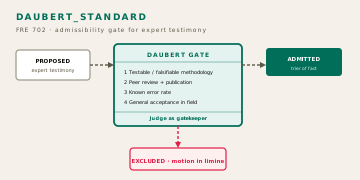
In Daubert v. Merrell Dow Pharmaceuticals, Inc. (1993), the Supreme Court held that Federal Rule of Evidence 702 imposes a gatekeeping obligation on trial courts to ensure that expert testimony is based on sufficient facts or data, is the product of reliable principles and methods, and reflects a reliable application of those methods to the facts of the case.
The practical effect is that an expert’s opinion is not automatically admissible just because someone with credentials says it. Before it reaches the jury, the judge must determine that the underlying methodology is scientifically or technically valid. This is the gatekeeping function — the trial court is the last line of defense against junk science and speculative expert opinions.
For blockchain forensic testimony, Daubert matters enormously. The field is young, the methodologies are not universally standardized, and the proprietary tools at the center of most analyses (Chainalysis, TRM Labs, Elliptic) are not academic open-source software with peer-reviewed documentation. Opposing counsel who understands the Daubert framework can mount serious challenges to blockchain expert testimony if the report and expert preparation are inadequate.
Kumho Tire: Extension to Technical Experts
In Daubert, the Supreme Court described four non-exclusive factors for evaluating expert testimony: testability, peer review, known error rate, and general acceptance. These factors were articulated in the context of scientific testimony, and some courts initially questioned whether they applied to non-scientific technical experts.
Kumho Tire Co. v. Carmichael (1999) resolved the question. The Court held that the trial court’s gatekeeping obligation under FRE 702 applies to all expert testimony — scientific, technical, or based on other specialized knowledge. The four Daubert factors are not a rigid checklist; they are flexible guidance that courts adapt to the specific type of expertise at issue.
For blockchain forensics, this means the Daubert inquiry focuses on whether the specific analytical methods used in the case — wallet clustering, address attribution, fund flow tracing, mixer identification — are reliable when applied by this expert to this data. The relevant question is not whether blockchain analytics in the abstract is reliable, but whether the specific methodology the expert applied passes muster.
The Four Daubert Factors Applied to Blockchain Forensics
1. Testability
The Daubert testability inquiry asks whether the methodology can be and has been tested. In blockchain forensics, the core techniques are testable because blockchain data is public and permanent. A fund tracing conclusion can be independently verified by anyone with access to the same public blockchain data. Wallet clustering conclusions based on common-input-ownership heuristics can be evaluated against ground-truth datasets.
Academic researchers have published studies testing the accuracy of clustering heuristics against known-ground-truth wallet sets. The Bitiodine paper (Spagnuolo et al., 2014), the Harrigan & Fretter study on address reuse, and subsequent academic work on exchange clustering all constitute published testing of the core methodologies. An expert should be prepared to cite this literature.
2. Peer Review and Publication
Blockchain analytics methodologies have been published in academic venues including the IEEE Security & Privacy Workshops, the Financial Cryptography and Data Security conference, and peer-reviewed journals. Commercial tools are not peer-reviewed in the academic sense, but the underlying heuristics they implement are. An expert who can ground their methodology in published academic research — rather than relying solely on a proprietary tool’s output — presents a significantly stronger Daubert profile.
3. Known Error Rate
This is the factor most frequently cited by opposing experts in Daubert challenges. Wallet clustering heuristics have known false positive rates. The common-input-ownership heuristic (CIOH) has been shown to miscluster CoinJoin transactions, exchange consolidation transactions, and certain wallet software patterns. An expert who acknowledges these limitations, explains why they do not affect the specific case conclusions, and notes where uncertain attributions were excluded from the analysis will fare better than one who asserts 100% accuracy.
Commercial platforms like Chainalysis and TRM Labs publish confidence metrics for their attribution databases. Citing these metrics — and explaining that the case conclusions rely only on high-confidence attributions — directly addresses the error-rate inquiry.
4. General Acceptance
Blockchain analytics has achieved general acceptance in law enforcement, regulatory, and judicial contexts. FinCEN has issued guidance on blockchain analytics in AML contexts. The DOJ and FBI routinely use Chainalysis and TRM Labs in criminal prosecutions, with expert testimony routinely admitted. The SEC and CFTC use blockchain analytics in enforcement actions. Federal courts have admitted blockchain forensic expert testimony in dozens of criminal and civil cases. This institutional acceptance is persuasive evidence of general acceptance under Daubert factor four.
General acceptance does not mean universal acceptance. Some defense experts challenge whether the commercial analytics tools’ attribution databases are sufficiently accurate. Courts have generally found that this goes to weight rather than admissibility — but the argument is made, and your expert should be prepared for it.
FRE 702 After the 2023 Amendments
Rule 702 was amended effective December 1, 2023, to address a circuit split on how courts should evaluate the preponderance-of-the-evidence standard for expert admissibility. The key change: courts must now find that it is more likely than not that (1) the expert’s specialized knowledge will help the jury, (2) the testimony is based on sufficient facts or data, (3) the testimony is the product of reliable principles and methods, and (4) the expert’s opinion reflects a reliable application of the principles to the facts.
The amendment was designed to stop courts from treating reliability challenges as going only to weight, and to reinforce the gatekeeping function. Post-2023, courts are expected to actively evaluate reliability rather than simply noting that reliability disputes go to weight. This makes the quality of the expert’s methodology documentation more important, not less.
For blockchain forensic engagements filed in federal court, attorneys should brief the post-2023 Rule 702 standard in Daubert motions and oppositions, and should ensure the expert report reflects the preponderance standard for each opinion.
Key Case Law in Crypto Expert Admissibility
| Case | Court | Outcome & Significance |
|---|---|---|
| United States v. Sterlingov | D.D.C., aff'd D.C. Cir. 2023 | Chainalysis Reactor testimony admitted over black-box challenge. Court found general acceptance in law enforcement sufficient; methodology challenge went to weight. |
| United States v. Lord | 5th Cir. 2018 | IRS special agent’s blockchain tracing testimony admitted. Court noted blockchain data’s public verifiability as supporting reliability. |
| SEC v. Ripple Labs | S.D.N.Y. 2022–2024 | Blockchain analytics experts on both sides. Highlights that opposing blockchain experts are now common in high-stakes crypto litigation. |
| In re Celsius Network | Bankr. S.D.N.Y. 2023 | Multiple blockchain forensic experts engaged by trustee and creditor committees; reports used to identify preferential transfers and undisclosed assets. |
The Black-Box Methodology Challenge
The most consistent and potentially most effective Daubert challenge to blockchain forensic testimony is the argument that commercial analytics tools are “black boxes” — the expert inputs addresses and the software outputs labels and connections, without the expert being able to independently validate the underlying methodology.
The challenge has teeth. Chainalysis does not publish the full details of its reactor clustering algorithms. TRM Labs’ risk scores are proprietary. If an expert’s opinion rests entirely on a tool’s output with no independent validation, a court applying the post-2023 FRE 702 preponderance standard may find that reliability has not been established by a preponderance.
How to Counter the Black-Box Challenge
The most effective counters involve showing that the expert’s conclusions are independently verifiable and do not depend solely on the tool’s proprietary output:
- Ground-truth verification: For addresses attributed to specific exchanges, the expert can independently confirm attribution by analyzing deposit/withdrawal patterns, IP correlations in published exchange data leaks, or direct exchange confirmation through subpoena
- Manual trace: The expert can manually trace fund flows using public blockchain data and block explorer APIs, independent of any commercial tool, and confirm the result matches the tool output
- Academic literature on heuristics: Citing published academic papers that validate the underlying clustering and attribution methodologies removes the “no peer review” argument
- Limiting reliance on high-uncertainty attributions: An expert who explicitly limits opinions to high-confidence attributions, and acknowledges where uncertainty existed, presents a more defensible Daubert profile than one who asserts certainty throughout
Preparing Your Expert for a Daubert Challenge
Preparation begins long before the Daubert hearing. The expert report is the foundation — if it adequately documents the methodology, the Daubert challenge will be difficult to sustain. If it does not, the hearing becomes a remediation exercise that the expert may not be able to win.
Report-Stage Preparation
- Include a dedicated methodology section that explains, in plain language, how wallet clustering and address attribution work and which specific techniques were applied
- Identify every tool used and describe what function each tool performed, distinguishing between proprietary outputs and the expert’s independent analysis
- Cite peer-reviewed academic literature supporting each methodology
- Acknowledge known limitations and explain why they do not affect the case conclusions
- State confidence levels for attribution conclusions and note where lower-confidence attributions were excluded
Deposition Preparation
The Daubert deposition, if there is one, will focus on: how the expert’s opinions were formed, whether the expert could have reached the same conclusions without the proprietary tool, and whether the expert can describe the tool’s methodology from first principles. The expert should be able to explain clustering, attribution, and tracing in plain English without reference to any specific software.
Filing a Daubert Motion Against the Opposing Expert
When the opposing party has a blockchain forensic expert, a well-prepared Daubert motion targets the same weaknesses described above. The motion brief should:
- Establish the FRE 702 standard, including the post-2023 preponderance requirement
- Apply each Daubert factor to the opposing expert’s specific methodology, not blockchain forensics in the abstract
- Focus on what the opposing expert’s report does not disclose: unexplained tool outputs, missing confidence levels, excluded data, no peer review citation
- If available, cite a competing expert declaration addressing the methodological deficiencies
- Request a Daubert hearing with live testimony from the opposing expert on methodology
Even if a Daubert motion to exclude does not succeed outright, the hearing record creates a foundation for cross-examination and jury argument on reliability. A judge who finds the methodology “barely adequate” will permit jurors to hear the reliability evidence. Prepare the Daubert motion and hearing as both an exclusion effort and a trial preparation exercise.