In This Article
Crypto has replaced offshore bank accounts as the most common way to hide marital assets. It's bought anonymously, custodied without statements, transferred peer-to-peer with no intermediary on record, and easily mischaracterized as worthless on financial affidavits. For the spouse on the other side of that concealment, on-chain forensic tracing is the most powerful discovery tool available in family court today.
This article is for both spouses who suspect concealment and the attorneys representing them. It walks through how concealment works, how to detect it, and how forensic methodology turns the blockchain into evidence the court will accept.
Why Crypto Is the New Hidden Asset in Divorce
Three things about cryptocurrency make it the modern vehicle of choice for concealment:
- No statements. A self-custody wallet generates no monthly statement, no 1099, and no automatic disclosure to any third party. The asset exists on the blockchain but reaches the disclosing party only if the holder mentions it.
- Pseudonymous addressing. A wallet address is a string of characters with no name attached. The spouse can create a new address in 30 seconds without notifying anyone.
- Self-custody is normalized. Hardware wallets, MetaMask, Phantom, and dozens of other consumer products have made it normal to hold significant value off any centralized platform. A spouse can claim ignorance, lack of access, or that the asset has been "lost."
The structural advantage of crypto concealment is also its weakness. While there's no statement, the on-chain record is permanent and publicly visible. Every transaction, every transfer, every wallet creation event is recorded forever. Forensic tracing converts that public record into evidence usable in court.
Red Flags That a Spouse Is Hiding Crypto
The following indicators, especially in combination, are reliable signals of crypto concealment:
Financial signals
- Unexplained transfers from a joint bank account to Coinbase, Kraken, Gemini, Crypto.com, Cash App, or PayPal during the marriage
- Wire transfers to identifiable exchange accounts
- Form 8949 (capital gains) entries on prior joint tax returns indicating crypto sales
- Form 1099-B or 1099-MISC from a crypto exchange
- Schedule 1 reporting of crypto income
- References to "digital assets" on Form 1040 (line item present since 2020)
- Credit card charges to Trezor, Ledger, GridPlus, or other hardware wallet vendors
- Subscription charges to Coinbase Pro, Binance, OKX, or other trading platforms
Behavioral signals
- Sudden interest in cryptocurrency or "investing" without prior history
- References to Bitcoin, Ethereum, or specific tokens in personal communications
- Use of crypto-specific apps on phones or computers (MetaMask, Phantom, Trust Wallet, Exodus, BlueWallet)
- Unusual interest in tax filing alone or via separate accountant
- Refusal to discuss specific account balances or transaction history
Document signals
- Welcome emails from crypto exchanges in personal email accounts
- 2FA backup codes for unfamiliar services
- Browser bookmarks for crypto exchanges or block explorers
- Hardware wallet packaging or seed phrase paperwork in home or office
Common Concealment Tactics
The "I bought, then lost it" claim
The spouse acknowledges past crypto activity but claims the funds were lost, stolen, or transferred to a wallet they no longer control. Forensic tracing can verify or rebut this. If funds went to a wallet that has since transacted, "lost" is demonstrably false.
Self-custody migration
Funds are withdrawn from a Coinbase account that may appear on financial disclosures and moved to a self-custody wallet (MetaMask, hardware wallet) that doesn't. The spouse argues that only the disclosed exchange held marital assets. Forensic tracing follows the withdrawal to the self-custody address and identifies the current balance.
Friends and family transfers
Funds are transferred to a friend, family member, or business associate "for safekeeping" and excluded from disclosures. Tracing identifies the recipient address; entity attribution may identify the person; and the transfer can be challenged as a fraudulent transfer under state law.
DeFi and staking deposits
Funds are deposited into a DeFi protocol (Aave, Compound, Lido, Kelp) and reported as "no longer held" by the spouse. Forensic tracing identifies the deposit, the protocol position, and the current value. The position remains a marital asset.
Mixing and obfuscation
The spouse routes funds through a mixing service (Tornado Cash, Wasabi, JoinMarket) intending to break the trace. While mixers do reduce determinability, probabilistic clustering, timing analysis, and post-mix balance reconciliation often reconstruct the trail. Mixer use itself is also evidence of intentional concealment.
Cross-chain bridging
Funds are bridged from Ethereum to a less-tracked chain (Solana, BSC, Avalanche) on the assumption that the disclosing spouse will only inspect ETH. Modern multi-chain forensic tools follow the bridge transaction.
NFT and token allocation
Funds are converted to NFTs or obscure tokens that the spouse argues have no liquid market value. Forensic tracing identifies the holdings; valuation can be done at the date of acquisition or relevant marital snapshot date.
Discovery Tools and Legal Mechanisms
The legal mechanisms most useful for surfacing concealed crypto, in increasing order of intrusiveness:
Mandatory financial disclosures
Most U.S. jurisdictions require sworn financial disclosure statements that list all assets including digital assets. Concealment is sanctionable. The disclosure forms in California, New York, Florida, and Texas now specifically include cryptocurrency line items.
Interrogatories
Targeted written interrogatories request: every cryptocurrency exchange account ever held, every wallet address ever controlled, every transfer to or from a digital asset platform, and every cryptocurrency-related tax reporting since the date of marriage.
Document requests
Request all exchange account statements, all wallet transaction histories, all 1099s, all communications referencing cryptocurrency, all hardware wallet receipts, and all backup phrases or seed records.
Subpoena to exchanges
If a spouse has identifiable accounts at Coinbase, Kraken, Gemini, or other U.S.-regulated platforms, a subpoena duces tecum will produce account statements, deposit and withdrawal history, KYC records, and IP logs. See subpoenaing a crypto exchange for the procedural mechanics.
Forensic accounting and on-chain tracing
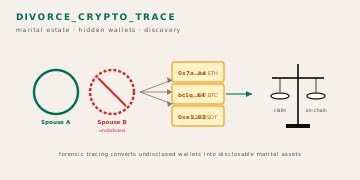
The forensic crypto investigator works with subpoenaed exchange records and any disclosed wallet addresses to map the full set of wallets controlled by the spouse and identify current holdings. This is the step that closes the discovery gap when the spouse has self-custody assets.
Court-ordered wallet disclosure
Some jurisdictions will compel disclosure of seed phrases, private keys, or wallet access under contempt sanctions. The viability of this remedy varies by jurisdiction and the specific facts.
The Forensic Tracing Process
Intake of disclosed and subpoenaed records
The forensic investigator collects everything: subpoenaed exchange records, prior tax returns, bank statements showing crypto-related transfers, communications, and any wallet addresses or seed records the disclosing spouse provides. The starting universe is the set of known and subpoenaed wallets.
Outflow tracing from disclosed accounts
The investigator traces every cryptocurrency withdrawal from the disclosed exchange accounts to the receiving address. This identifies the first hop into self-custody.
Wallet clustering
Standard blockchain heuristics (common-input ownership, change-address recognition, transaction-pattern analysis) are applied to identify the broader set of wallets likely controlled by the same entity. A spouse rarely uses a single wallet — they usually have a hot wallet, a cold wallet, exchange deposit addresses, and DeFi protocol addresses, all linked by common-input behavior.
Entity attribution
Each cluster is checked against forensic databases for known entity tags. Exchange deposit addresses are identified, DeFi protocol positions are catalogued, and any holdings at known counterparties are flagged for follow-up subpoena.
Current-balance valuation
The current value of each identified holding is calculated at the relevant date (marital snapshot date, separation date, or trial date as the jurisdiction requires). The valuation report supports equitable distribution claims.
Forensic report
The findings are compiled into a sworn forensic report suitable for use as an exhibit, expert declaration, or trial testimony. See blockchain forensic expert witness for what the deliverable contains.
Valuation and Date Selection
Cryptocurrency volatility makes the valuation date a strategically important question. Most jurisdictions allow argument over which date controls. The standard options:
| Date | When Used | Tactical Note |
|---|---|---|
| Date of separation | Most common in equitable-distribution states | Captures pre-litigation value, prevents post-filing manipulation |
| Date of filing | Some community-property jurisdictions | Sometimes simpler but enables short-window manipulation |
| Date of trial | Discretionary in some states | Reflects current value, tracks volatility both directions |
| Highest-value date | As remedy for proven concealment | Some courts allow this where concealment is established |
Cost, Timeline, and Fee Shifting
Typical cost ranges for forensic tracing in divorce:
- Initial assessment: Free to $500. Identifies whether traceable evidence exists.
- Standard tracing report: $2,500 to $8,000. One or two chains, moderate complexity, written report.
- Complex multi-chain investigation: $8,000 to $15,000. Cross-chain bridging, mixing analysis, multiple wallets.
- Expert testimony at trial: $4,000 to $8,000 per day plus prep time.
Many jurisdictions allow fee shifting against a spouse who concealed assets. The forensic costs that uncovered the concealment can often be recovered as part of the equitable-distribution remedy. Discuss with counsel before retention.
This is direct guidance: don't. On-chain history is permanent. The probability that the other side's forensic investigator will reconstruct the trail is high. Concealment that's uncovered usually results in unequal distribution favoring the disclosing spouse, fee shifting, possible contempt sanctions, and in extreme cases referral for perjury. Voluntary disclosure with valuation argument is almost always the better strategic path.
Frequently Asked Questions
Suspect Hidden Crypto in Your Divorce?
Wallet Witness works with family-law attorneys and individual spouses to surface and value concealed cryptocurrency. Initial case assessments are confidential and free.
Schedule a Confidential ConsultationNeed this work done?
If you or your attorney need a forensic trace, evidence package, or expert-witness report for a divorce case involving hidden or disputed crypto, see Divorce & Family Law Crypto Forensics for what the engagement covers (both sides represented).