In This Article
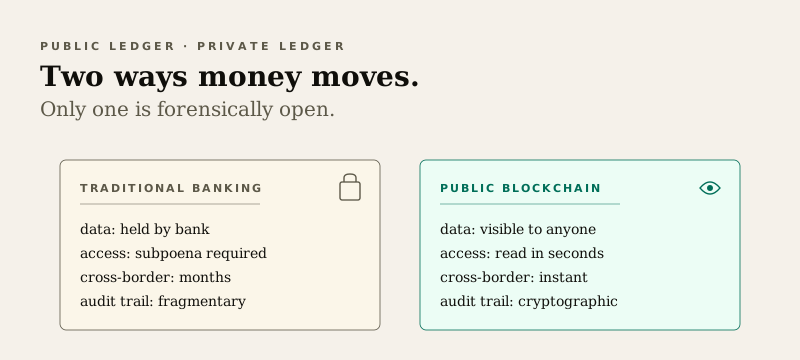
When cryptocurrency is stolen or fraudulently transferred, victims often have two investigative paths in front of them: blockchain intelligence tools that trace on-chain fund flows, and traditional financial investigation methods built around bank records, subpoenas, and institutional cooperation. These are not the same thing. They operate on different data, under different constraints, and produce different kinds of evidence.
Understanding the difference matters because the right investigative approach depends entirely on where your case sits in the chain from theft to potential recovery. This article explains both methods, where each excels, and — critically — where each hits a wall. If you haven't read our foundational explainer on what blockchain intelligence is, that's a good starting point before this comparison.
What Each Approach Actually Is
The analysis of public blockchain data — transaction graphs, wallet clusters, mixer interactions, exchange deposits — to trace fund flows and build evidentiary records. Works from data that is publicly visible by design. Requires no court orders, no institutional cooperation, and has no jurisdictional limits at the tracing stage.
The investigation of financial activity through institutional records — bank statements, wire transfers, correspondent banking records, brokerage accounts. Requires subpoenas, court orders, or voluntary cooperation from financial institutions. Heavily constrained by jurisdiction and mutual legal assistance treaties (MLATs) when records cross borders.
How Traditional Financial Investigation Works
Traditional financial investigation was developed for fiat currency and the institutions that hold it. Banks, brokerages, payment processors, and wire services are all required to maintain transaction records — and those records can be compelled by law enforcement or civil attorneys via subpoena.
The investigative chain works like this:
Identify the Financial Institution
Before any records can be requested, investigators need to know which institution holds the relevant accounts. In fiat fraud cases, this is often straightforward — the victim has bank statements showing wire destination accounts.
Issue Subpoenas or Legal Process
Law enforcement subpoenas the institution. Civil attorneys can issue civil subpoenas in active litigation. The institution then produces records: account holder identity, transaction history, correspondence, IP logs.
Follow the Money Hop by Hop
Funds are often moved through multiple accounts at multiple institutions. Each hop requires another subpoena to another institution. International hops require MLAT requests, which can take 6–24 months and are subject to diplomatic constraints.
Build Identity to the Criminal
Eventually the money trail either goes cold (cash-out, shell company, non-cooperative jurisdiction) or leads to an identifiable person or entity. KYC records from banks are the key to identity attribution.
Traditional financial investigation is powerful within cooperative jurisdictions with functioning legal systems and KYC-compliant banking. It becomes significantly less effective when funds move to banks in jurisdictions that don't cooperate with MLAT requests — a common feature of organized financial crime.
How Blockchain Intelligence Works
Blockchain intelligence operates on a fundamentally different data source: the public ledger. Every Bitcoin, Ethereum, or stablecoin transaction is permanently recorded on a distributed ledger that anyone can read. Blockchain intelligence turns that raw data into structured evidence. Our guide on how forensic investigators trace stolen crypto walks through the full methodology in detail.
Transaction Graph Analysis
Starting from the victim's sending address, investigators trace every wallet the funds touched. Each hop on the blockchain is visible: amounts, timestamps, destination addresses, and whether funds were split or consolidated.
Wallet Clustering
Blockchain intelligence tools use heuristics — common input ownership, address reuse patterns, peeling chain analysis — to cluster wallets that belong to the same entity. This dramatically reduces the apparent complexity of a transaction graph.
Exchange and Service Attribution
When funds reach a known exchange, mixer, or service, blockchain intelligence tools flag it. Major platforms like Binance, Coinbase, Kraken, and hundreds of others have attribution data — meaning investigators can identify that funds entered a specific platform even without accessing that platform's internal records.
Evidence Report Production
The trace is documented in a forensic report: wallet-by-wallet fund flow, exchange attribution, risk scores, and a narrative chain of custody. This report is what law enforcement or civil attorneys use to issue formal legal process to exchanges. See our guide on blockchain forensic evidence in federal and civil litigation.
Side-by-Side Comparison
| Factor | Blockchain Intelligence | Traditional Financial Investigation |
|---|---|---|
| Data source | Public blockchain ledger | Institutional records (banks, brokers) |
| Legal process required? | No — data is public | Yes — subpoenas or court orders |
| Cross-border tracing | Instant — blockchain ignores borders | Slow — MLAT required (6–24 months) |
| Speed | Hours to days | Weeks to years |
| Identifies person behind wallet? | Only if funds reach KYC exchange | Yes — directly via KYC records |
| Works if criminal uses mixer? | Partial — mixers degrade trace quality | N/A — traditional methods don't reach mixers |
| Evidence admissibility | Yes — accepted in federal/civil courts | Yes — established standard |
| Cost to initiate | Lower — no legal process needed | Higher — requires attorneys, court processes |
| Jurisdictional limits | None at the tracing stage | Significant — depends on cooperation treaties |
| Applicable to cash-out | No — ends at fiat conversion | Yes — bank records follow fiat |
Where Each Approach Falls Short
Blockchain Intelligence Limitations
- The off-ramp wall. Blockchain intelligence is extremely powerful within the on-chain world but hits a hard wall the moment funds convert to fiat. Once crypto is cashed out to a bank account, the blockchain trace ends. What happens in the banking system requires traditional investigation methods.
- Mixer and privacy coin degradation. Funds routed through mixers (Tornado Cash, Bitcoin mixers) or converted to privacy coins (Monero) significantly degrade trace quality. The trail doesn't disappear entirely — timing analysis and cluster heuristics can still produce leads — but confidence levels drop.
- Identity attribution requires legal process. Blockchain intelligence can tell you that funds went to a Binance deposit address. It cannot tell you whose Binance account it is. That requires legal process directed at Binance — which brings traditional investigation methods back into play.
- Smart contract complexity. DeFi protocols, smart contract interactions, and token swaps can obscure fund flows in ways that require specialized expertise to untangle. Not all blockchain analysts are equipped for complex DeFi tracing.
Traditional Financial Investigation Limitations
- Speed is a fatal weakness in crypto cases. Cryptocurrency moves in seconds. By the time a subpoena is served and records are produced, funds have moved through dozens of wallets. Traditional investigation timelines are fundamentally incompatible with crypto's velocity.
- Jurisdiction stops at the border. A bank in a non-cooperative jurisdiction produces nothing. Many crypto-enabled fraud operations deliberately route through financial institutions in countries that don't participate in mutual legal assistance. The trail simply stops.
- No visibility into on-chain activity. Traditional financial investigators looking at wire records have no visibility into what happened between the wire and the eventual cash-out. The blockchain trace fills that gap.
How They Work Together in Crypto Fraud Cases
In practice, the most effective crypto fraud investigations use blockchain intelligence and traditional financial investigation sequentially. Blockchain intelligence moves fast and sets the direction; traditional methods follow to build identity and compel records.
Blockchain intelligence traces funds from victim wallet → through intermediary wallets → to exchange deposit address (hours/days). Law enforcement or civil attorneys subpoena the exchange for account holder identity (days/weeks domestically, longer internationally). Traditional investigation then pursues the identified individual through banking records if funds moved to fiat. The blockchain report is what makes the legal process possible — without it, there's nothing to subpoena for.
The two approaches also reinforce each other's evidence. A blockchain forensic report showing fund flow into a specific exchange account, combined with traditional bank records showing a cash-out to a specific person's account, creates an extremely strong evidentiary chain that is difficult to challenge in court.
This is why working with investigators who understand both disciplines — or who work alongside attorneys experienced in compelling exchange records — produces better outcomes than either approach alone. Review the stages of a forensic investigation to see how this plays out in a real case timeline.
What This Means for Your Case
If you've lost funds to a crypto scam, the first investigative step is almost always blockchain intelligence — not because traditional methods aren't valuable, but because blockchain tracing is faster, cheaper to initiate, and produces the evidence that makes the subsequent legal steps possible.
A forensic trace can tell you within days whether your funds are still on-chain (recoverable through legal process), have reached an identifiable exchange (actionable via subpoena), passed through a mixer (more complex, not hopeless), or converted to fiat via an exchange with KYC data (best-case scenario for identity attribution).
Without that trace, you're asking law enforcement or attorneys to pursue a lead they can't act on. With it, you're handing them a documented fund flow and a specific exchange to subpoena. The difference in outcomes is significant.
See how much a crypto investigation costs and realistic recovery timelines for an honest picture of what to expect from the full process.
Frequently Asked Questions
What is blockchain intelligence?
Blockchain intelligence is the discipline of analyzing public blockchain data — transaction graphs, wallet clusters, mixer interactions, and exchange deposits — to trace fund flows and build evidentiary records. Unlike traditional financial investigation, it operates on publicly visible data without requiring subpoenas or bank cooperation. The ledger is open and permanent by design.
How does blockchain investigation differ from a traditional financial investigation?
Traditional financial investigation depends on institutional cooperation — banks must produce records, courts must issue subpoenas, and jurisdiction limits what can be compelled. Blockchain investigation works from public data available to anyone with the right tools. The tradeoff: blockchain analysis can trace funds across borders instantly but hits a wall at off-ramps (exchanges) where identity information is held by a third party.
Can blockchain intelligence identify the person behind a wallet address?
Blockchain intelligence can cluster wallets, trace fund flows, and identify exchange deposit addresses — but it cannot by itself deanonymize a wallet holder. Identifying the person requires the exchange to disclose KYC data, which requires either law enforcement action (subpoena) or civil litigation. Blockchain intelligence produces the evidence that makes those legal steps possible.
Is blockchain evidence admissible in court?
Yes. Blockchain transaction records are treated as documentary evidence derived from a public, immutable ledger. Courts have accepted blockchain analytics reports in both criminal and civil proceedings. The key is proper methodology, documented chain of custody, and a qualified expert who can explain the analysis. Read our full guide on blockchain forensic evidence in federal and civil litigation.
Need a Blockchain Intelligence Report?
We trace fund flows, build exchange attribution, and produce forensic reports that law enforcement and attorneys can act on. Free consultation — no obligation, just an honest assessment of where your funds went.