In This Article
- Where crypto romance scams actually come from
- The compounds: Sihanoukville, Myawaddy, Golden Triangle SEZ
- Who's actually behind the keyboard
- How the manipulation unfolds inside a compound
- Where the stolen crypto goes — TRON USDT and the Asian gray market
- Warning signs most victims miss
- What to do if you think you're in one
- Forensic investigation when funds went through Asia
If you've been hit by a crypto romance scam, the person who sent you those messages is almost certainly not in the country they claimed to be in. They were probably sitting in front of a computer in a fenced compound somewhere along the borders of Cambodia, Myanmar, or Laos — running a script, operating multiple victim accounts at once, and being supervised by armed staff working for an organized criminal network.
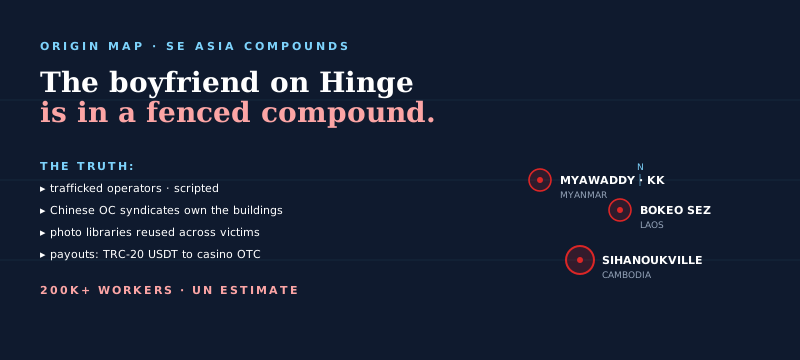
This is not speculation. The U.N. Office on Drugs and Crime estimates more than 200,000 people are currently being held in scam compounds across Southeast Asia, generating tens of billions of dollars per year in cryptocurrency theft. The U.S. State Department, Interpol, and humanitarian groups have all documented the same pattern. Understanding where these scams actually come from is the foundation of every meaningful blockchain forensic investigation into them.
Where Crypto Romance Scams Actually Come From
The vast majority of crypto romance scams targeting victims in the U.S., U.K., Canada, and Australia originate from industrial-scale fraud compounds in Southeast Asia — primarily Cambodia, Myanmar, and Laos. These compounds are typically run by Chinese organized crime syndicates and staffed by trafficked workers. The "boyfriend" or "girlfriend" you're chatting with is part of a coordinated operation, working to a script, often against their will.
The pre-2020 image of a romance scammer — a lone fraudster in a Lagos cybercafé — is wildly out of date. Romance fraud has industrialized. What used to be a one-on-one con is now a 24-hour shift-based operation with HR departments, training manuals, performance metrics, and physical infrastructure that resembles a corporate office park more than a criminal hideout.
That industrialization is why romance scams have exploded in volume since 2020 and why losses have grown faster than any other crypto fraud category. It's also why telling victims to "just spot the scam" has become harder — these operators are professionally trained, follow tested manipulation scripts, and have weeks of patience built into the playbook. For more on the manipulation tactics themselves, see the romance scammer playbook.
The Compounds: Sihanoukville, Myawaddy, and the Golden Triangle SEZ
Most reporting on this topic focuses on three geographic clusters, all near international borders for easy movement of money and people:
Sihanoukville and Poipet — Cambodia
Sihanoukville on Cambodia's southern coast became the original epicenter of compound-based scam operations starting around 2018, after a Chinese investment boom built dozens of casinos and high-rise hotels that were repurposed when COVID closed the gambling industry. Poipet, on the Thai border, is the secondary hub. Cambodian compounds operate with significant local protection and have been the subject of repeated U.S. sanctions, including against the Prince Group and several named compound operators.
Myawaddy, Shwe Kokko, and KK Park — Myanmar
The Thai-Myanmar border region — particularly the towns of Myawaddy and Shwe Kokko, and the notorious KK Park complex — became a major hub after 2021, when the Myanmar civil war effectively eliminated central government control of the border zones. These compounds operate in territory held by ethnic armed groups and Chinese-backed militia networks, making law enforcement intervention nearly impossible. Multiple international rescue operations through 2024–2025 have freed thousands of trafficked workers from these sites, but the compounds continue operating.
The Golden Triangle Special Economic Zone — Laos
The Golden Triangle SEZ in Bokeo Province, Laos — the area around the Kings Romans Casino — is the third major hub. Sanctioned by the U.S. Treasury in 2018 for transnational organized crime activity, the zone operates as a near-extraterritorial enclave under Chinese-leased land rights, with its own currency, security forces, and economic infrastructure largely outside Lao state control. It is heavily implicated in romance scam, pig butchering, and fake-investment operations targeting Western victims.
The reason these specific border zones host the compounds is straightforward: weak rule of law, proximity to multiple jurisdictions, established criminal logistics networks for trafficking people and money, and access to grey-market crypto liquidity through casino-adjacent OTC desks.
Who's Actually Behind the Keyboard
The person sending you romantic messages is rarely the criminal mastermind they appear to be. Documentation from the U.N., U.S. State Department, Global Anti-Scam Organization, and dozens of investigative news outlets all describe the same recruitment pattern:
- A person — often from China, Vietnam, Indonesia, Malaysia, India, the Philippines, or East Africa — answers a job posting for "customer service," "translation," "IT support," or "online marketing" in Thailand, Cambodia, Laos, or Myanmar. Salaries advertised are well above local market rates.
- On arrival, they are transported across a border to a compound. Passports are taken. Phones are confiscated or monitored.
- They are issued a script, a fake identity, photo libraries of stolen images, and weekly extraction quotas measured in U.S. dollars.
- Failure to meet quotas is enforced with beatings, electric shocks, denial of food, or sale to another compound. There are documented cases of organ harvesting and homicide.
- Workers can sometimes "buy out" their contracts — but the buyout amount is structured to be unreachable on the wages they're paid.
The emotional manipulation that works on you isn't a personal failure — it's a script being read by someone who has been trained to read it, often under threat. None of that excuses the harm done to you, and the criminal organization running the compound is fully responsible for what was stolen. But understanding the structure helps explain why these scams feel so consistent across cases, and why "just being smart enough to spot it" is harder than it sounds.
How the Manipulation Unfolds Inside a Compound
Contact on a Platform
The scammer initiates contact on a dating app, social media platform, LinkedIn, WhatsApp, or via a "wrong number" text. The profile is carefully constructed — attractive but not implausibly so, with a plausible backstory. Often presented as a professional (doctor, engineer, military officer, entrepreneur) working abroad.
Relationship Building
Daily contact. Genuine-seeming interest in your life. Sharing of personal details (often fabricated, but internally consistent). Planning a future together. Moving off the initial platform to WhatsApp or Telegram quickly. The scammer is attentive, available, and emotionally engaged — more so than most real relationships.
The Barrier to Meeting
Video calls are avoided or conducted on heavily filtered/brief calls. Excuses accumulate — work contracts abroad, military deployment, medical situations. A planned in-person meeting is perpetually upcoming but never happens. These barriers are manufactured to maintain the emotional relationship without exposing the deception.
The First Financial Request
A crisis arrives — a medical emergency, a contract dispute, a customs fee to release equipment, an investment opportunity with a tight deadline. The first request is modest relative to the relationship's apparent value. Sending it feels like supporting someone you care about, not giving money to a stranger.
Escalating Requests
Each resolved "crisis" is followed by another. The requests grow in size. Emotional pressure escalates — expressions of love, urgency, guilt. "If you really cared about me, you would help." Victims frequently send funds multiple times before recognizing the pattern.
Disappearance or Pivot
Either contact ends abruptly when the operator's quota assignment moves to a different victim, or the persona pivots to a secondary scam — a fake recovery service, a "lawyer" who can help retrieve funds, or a "blockchain investigator" who guarantees recovery for an upfront fee. These follow-on scams are often run from the same compound.
Where the Stolen Crypto Goes — TRON USDT and the Asian Gray Market
Forensic tracing of romance scam funds shows an extremely consistent pattern. Even when victims send Bitcoin or Ethereum, funds are typically converted to USDT on the TRON network (TRC-20) within a few hops. From there, the money flows through a predictable laundering pipeline:
- Initial deposit address controlled by the compound — often a fresh wallet used only for one or two victims, then abandoned.
- Aggregation wallet that pools funds from multiple victims operated by the same compound shift or team.
- OTC desks tied to casino operators in Sihanoukville, the Golden Triangle SEZ, or Myanmar border towns. These desks convert crypto to fiat, casino chips, or other crypto with minimal KYC.
- Settlement layer — proceeds reach compound operators as cash, casino credit, or crypto held on regional exchanges with weak compliance regimes.
TRON USDT is the dominant settlement layer for these operations because fees are pennies, transactions confirm in seconds, and the compound-adjacent gray market — including casino chip-to-crypto conversion — runs almost entirely on TRC-20 USDT. For deeper detail on the technical side of tracing these flows, see stolen USDT recovery and can stolen Bitcoin be traced.
A skilled forensic investigator can map this entire path. Whether the funds can be frozen at the end of the trace depends on which exchange or OTC desk the proceeds reach, and whether that platform cooperates with U.S. or international subpoenas.
Warning Signs Most Victims Miss
- Met online — has never appeared on a video call with their face clearly visible and unfiltered
- Claims to be abroad for work — military, medical, engineering, oil rig — making in-person meetings impossible
- Relationship moved to WhatsApp or Telegram very quickly after initial contact
- Communicates constantly and with intense emotional investment from early in the relationship
- Reverse image search of profile photos shows stock photos or images attributed to another person
- First financial request framed as temporary, urgent, and tied to a specific narrative (medical emergency, customs fee, business opportunity)
- Prefers crypto or wire transfers over traceable payment methods when asking for money
- Has a planned future together but can never quite execute an in-person meeting
- Friends and family express concern — which the scammer preemptively works to undermine
What to Do If You Think You're in One
- Do a reverse image search. Save the profile photos and run them on Google Images or TinEye. Compound photo libraries are reused across thousands of victims — the same face usually appears under multiple names.
- Request a live, unfiltered video call with a specific gesture (e.g., hold up three fingers, or write a specific number on paper). Compounds use pre-recorded or AI-modified video, which fails this test.
- Do not send any more crypto. Regardless of the crisis narrative, every dollar sent after suspicion is fully recoverable in the scammer's pipeline within minutes.
- Save all communications. Screenshots of every message, the original profile, transaction records, and TXIDs of every transfer.
- Talk to someone you trust offline. Outside perspective breaks the isolation that the script is specifically designed to create.
- Do not confront the scammer directly. This triggers the secondary scam — a "lawyer," "recovery service," or "blockchain investigator" who appears days later, often run from the same compound.
Forensic Investigation When Funds Went Through Asia
The fact that funds traveled through compound-controlled wallets in Cambodia, Myanmar, or Laos doesn't make them untraceable. Blockchain transactions are public regardless of geography — what changes is the recovery picture, not the trace itself.
A forensic investigation in a romance scam case typically produces three things: a documented fund flow showing every wallet your crypto touched, identification of the exchange or OTC desk where the funds were eventually offloaded, and connection of your case to known compound infrastructure that may already be under federal investigation. That report is what turns a victim complaint into an actionable lead for the FBI, IC3, or international counterparts.
For a full breakdown of the recovery process, realistic timelines, and what a forensic report can and can't accomplish, read the romance scammer playbook. For the legal pathways available afterward, see can you sue a crypto scammer and finding a crypto attorney.
After a romance scam is identified, victims are frequently targeted by fake recovery services — sometimes operated by the same criminal group. Anyone who contacts you claiming they can reverse your transactions, get your money back for a fee, or that they are a "crypto recovery specialist" who found your case online is a scammer. Legitimate investigators don't cold-contact victims. They don't guarantee recovery. And they don't charge large upfront fees before doing any work.
Lost Crypto in a Romance Scam?
We trace fund flows, identify where your crypto went on-chain, and produce forensic reports that law enforcement can act on. Free consultation — no obligation, no recovery guarantees, just honest answers about what your case looks like.