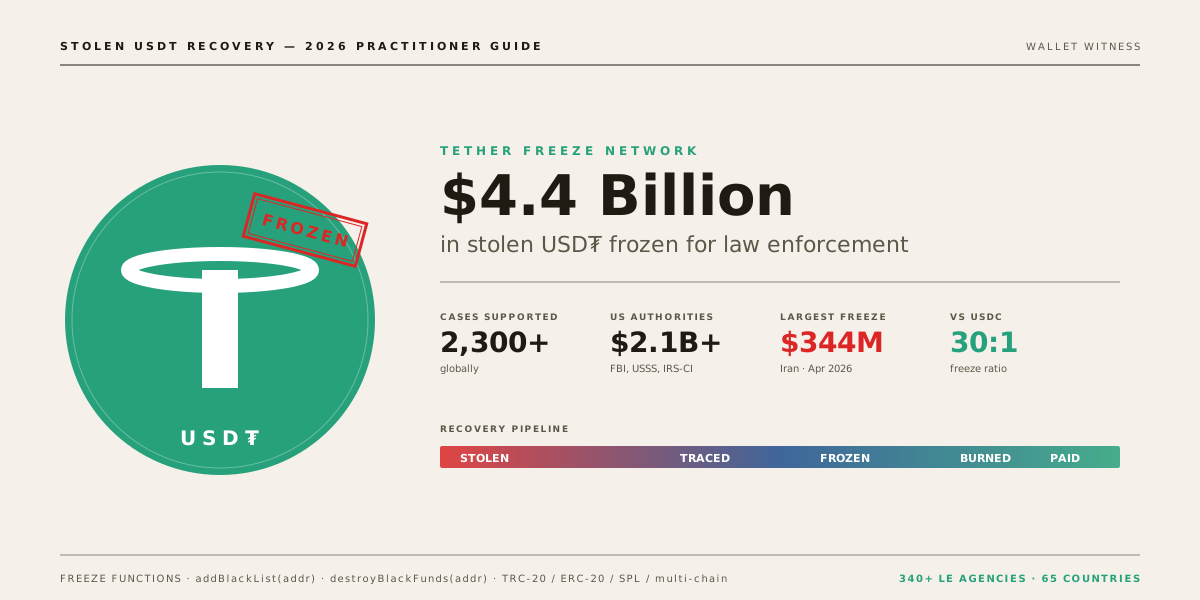
USDT is the single most-recoverable major crypto asset in 2026. Tether (the issuer) can freeze stolen USDT at the smart-contract level on every chain where USDT exists natively — Tron, Ethereum, Solana, Avalanche, Polygon, Algorand, Tezos. As of April 2026, Tether has frozen $4.4B+ across 2,300+ cases, including $2.1B+ tied directly to U.S. law enforcement and over 1,200 U.S. cases. The largest single freeze on record is the April 23, 2026 OFAC action: $344M across two Tron wallets tied to Iran.
Recovery is real but conditional. Tether won't act on victim emails alone. The two paths to a freeze are a formal law-enforcement request (FBI, IRS-CI, USSS, HSI) or an attorney-routed forensic evidence package. Once frozen, funds enter civil or criminal forfeiture proceedings and are restored to victims through a burn-and-reissue mechanism in which Tether destroys the frozen tokens and re-mints the equivalent to a government-controlled wallet.
This article is the practitioner's walkthrough — the on-chain mechanics, the named cases, the T3 Financial Crime Unit, the freeze request process, and the realistic timeline from "stolen" to "recovered."
For the law-enforcement workflow specifically — how detectives use Tronscan, identify exchange off-ramps, and route freeze requests through T3 — see the deeper LE-focused walkthrough in Tron USDT Tracing for Law Enforcement. For the dominant fraud category that drives most U.S. Tron-USDT freeze requests, see Pig Butchering Scams in 2026.
In This Article
- Why USDT recovery is different
- By the numbers: Tether's $4.4B freeze track record
- How a Tether freeze actually works on-chain
- The 44-minute multisig window most articles miss
- USDT on every chain — what's actually freezable
- USDT vs USDC vs DAI — what each issuer will actually do
- The T3 Financial Crime Unit
- Major named freezes — a forensic case library
- On-chain anatomy of a real $212M freeze
- When Tether will (and won't) freeze
- How to actually request a freeze
- After the freeze: burn-and-reissue and victim restitution
- Why timing decides everything
- Common failure modes
- What this means for your case
- Frequently asked questions
Why USDT Recovery Is Different
Most stolen crypto stays stolen. Bitcoin transferred to an attacker's wallet sits there until the attacker decides to move it. Ether sent to a phishing drainer is gone the moment the signature lands. DeFi tokens disappear into mixers and bridges that no central authority can reverse. Public blockchains were architected so no third party could undo a transaction.
USDT breaks that rule. Not because the blockchain works differently, but because Tether (the company that issues USDT) built a privileged function into its smart contracts that lets it freeze any address. Once Tether blacklists an address, the USDT at that address still exists on-chain, but every attempt to move it fails at the contract level. The funds go inert.
That's why USDT recovery is a real category in modern blockchain forensics, and why "Bitcoin recovery" is mostly a marketing term. With Bitcoin, recovery means tracing funds to a centralized exchange and hoping you can subpoena that exchange before the attacker withdraws. With USDT, recovery means triggering a freeze before the attacker hits an off-ramp. And the freeze is something the issuer can actually execute, repeatedly, at scale, from a position of legal indemnity.
The practical implication for working investigators: if your case involves USDT at any point in the laundering pipeline, the freeze pathway is the single highest-use recovery option you have. Higher than exchange subpoenas. Higher than civil forfeiture against unidentified individuals. Higher than waiting for OFAC to sanction the destination wallet. The freeze can happen in days; everything else takes months or years.
By the Numbers: Tether's $4.4B Freeze Track Record
The scale of Tether's enforcement cooperation has grown dramatically in 2024-2026. The headline numbers, current as of April 2026:
- $4.4 billion+ frozen in USDT globally since cooperation began
- 2,300+ cases supported across all jurisdictions
- $2.1 billion+ tied specifically to U.S. authorities
- 1,200+ U.S. law enforcement cases assisted
- 340+ law enforcement agencies across 65 countries
- $1.26 billion frozen on Ethereum + Tron in 2025 alone (per BlockSec on-chain analysis)
- $3.3 billion total USDT frozen between 2023 and 2025 (USDT alone)
For comparison, Circle — the issuer of USDC, the second-largest stablecoin — froze approximately $109 million in USDC over the same 2023-2025 window. That's a roughly 30-to-1 ratio in favor of Tether's cooperation rate. We dig into the operational difference in the USDT vs USDC section below.
The trajectory matters. Tether's freeze volume has accelerated almost every quarter since 2023, both because Tether's compliance team has scaled and because U.S. and international law enforcement have learned to route requests through Tether more efficiently. The 2024-2026 ramp also coincides with the launch of the T3 Financial Crime Unit (covered below), which created a dedicated coordination layer specifically for Tron-based USDT.
How a Tether Freeze Actually Works On-Chain
The freeze isn't magic. It's a smart-contract function call.
USDT contracts on every supported chain include three privileged methods that only Tether's admin multisig can call:
| Function | What it does | Reversibility |
|---|---|---|
addBlackList(address) | Marks the target address as frozen. After execution, every transfer involving that address fails at the contract level with "account is frozen" or "contract execution failed." | Reversible via removeBlackList |
removeBlackList(address) | Removes a before-frozen address from the blacklist. Restores normal transfer functionality. | Reversible |
destroyBlackFunds(address) | Permanently destroys all USDT held at a blacklisted address. Used during forfeiture proceedings to enable burn-and-reissue restitution. | Irreversible |
The frozen state has one important property that confuses victims and investigators new to USDT cases: the balance still appears in block explorers normally. Open the address on Tronscan or Etherscan after a freeze and you'll see the full balance, the transaction history, no warning. The freeze only manifests when someone tries to move the funds — the transaction broadcasts, the network attempts to execute it, and the USDT contract rejects the transfer.
In practical terms: if you have a frozen address on your trace, the funds aren't "missing." They're sitting there, visible, untouchable, waiting for the next legal step.
The Tron-specific mechanics
Most USDT volume in 2026 lives on Tron, so it's worth understanding the Tron-specific implementation. The TRC-20 USDT contract on Tron is at address TR7NHqjeKQxGTCi8q8ZY4pL8otSzgjLj6t. It's controlled by a Tether-owned multisig wallet at TBPxhVAsuzoFnKyXtc1o2UySEydPHgATto — tagged on Tronscan as "Tether: MultisigWallet."
The multisig requires more than one signature to execute privileged calls. That design choice prevents any single Tether employee from unilaterally freezing or unfreezing USDT, which is good for institutional integrity. But it has a consequence that almost no other writeup discusses, and which matters enormously for time-sensitive cases.
The 44-Minute Multisig Window Most Articles Miss
On Tron, the freeze process is two-phase. First a Tether signer submits a blacklist proposal. Then a second signer must confirm it before the freeze actually takes effect. In between, the proposal is publicly visible on-chain. Sophisticated operators monitoring Tether's multisig can move funds out of the targeted address during this window. Documented gaps have been measured at up to 44 minutes.
Here's how the two-step works mechanically. When Tether decides to freeze an address on Tron, the workflow is:
- First signer calls
submitTransaction(...)on the Tether multisig, proposing theaddBlackList(targetAddress)action. This call broadcasts to the Tron network as a normal transaction. Anyone monitoring the multisig can see the proposal. - The proposal sits in a queue with a transaction ID. It is technically pending — the freeze hasn't yet executed. The target address is still fully operational at this moment.
- A second signer calls
confirmTransaction(transactionId). This is the call that actually triggers theaddBlackListexecution and freezes the address.
The Iran freeze of April 23, 2026 (covered in detail below) shows exactly this pattern. The on-chain confirmation transaction (confirmTransaction(uint256 transactionId) with transactionId = 8491) is publicly visible on Tronscan. The submission transaction would have happened earlier, with the time delta between submission and confirmation defining the freeze window.
For an unsophisticated attacker who isn't watching Tether's multisig, this delay doesn't matter. For a state-sponsored operator or an organized scam compound with on-chain monitoring infrastructure, it can be the difference between $200M frozen and $200M cashed out.
The practical implication for forensic investigators: if you suspect the operator is sophisticated, prioritize getting the freeze request to Tether before the trace is publicly disclosed. The strongest freeze requests run quietly through law enforcement channels, not through public Twitter announcements.
USDT on Every Chain — What's Actually Freezable
USDT exists as a "native" issuance on multiple chains, which means Tether holds direct freeze authority on each. It also exists as bridged versions on chains where Tether doesn't directly issue — in those cases, freeze authority is more limited or nonexistent.
Native USDT — full freeze authority
| Chain | USDT volume share | Freeze mechanism |
|---|---|---|
| Tron (TRC-20) | Largest single chain by USDT volume; pig butchering and SE Asia operations dominate this chain | Multisig addBlackList, two-step process |
| Ethereum (ERC-20) | Original USDT host; high-value institutional and DeFi flows | addBlackList via Tether admin |
| Solana (SPL) | Growing share; Solana DeFi and consumer flows | SPL token freeze authority |
| Avalanche, Polygon, Algorand, Tezos | Smaller share; specific application flows | Native freeze authority on each contract |
Bridged USDT — limited or no freeze authority
When USDT is bridged from a native chain to a non-native chain via a third-party bridge protocol, the resulting "wrapped" version isn't the same token Tether issues. It is usually a synthetic representation backed by USDT held in the bridge's reserves. Tether's freeze authority on the underlying reserves remains, but freezing a wrapped version on the destination chain depends on whether the bridge protocol itself has a freeze function — and many don't.
This is a forensic consideration when tracing through bridges. If stolen funds enter a bridge as native USDT and exit as wrapped USDT, the freeze pathway usually requires either freezing the bridge's reserve address (large blast radius) or freezing the funds before they enter the bridge. Once the wrapped version is moving on a non-native chain, the recovery options narrow a lot.
USDT vs USDC vs DAI — What Each Issuer Will Actually Do
The three biggest stablecoins each have a different posture toward freeze cooperation. The differences aren't subtle.
| Stablecoin | Issuer | 2023-2025 frozen | Practical posture |
|---|---|---|---|
| USDT | Tether | ~$3.3B | Aggressive proactive cooperation; works directly with 340+ LE agencies; T3 partnership for Tron-side investigations |
| USDC | Circle | ~$109M | Slower, more legalistic; usually waits for formal legal orders; criticized publicly for delay during major incidents |
| DAI | MakerDAO | N/A | Decentralized; no single freeze authority; recovery via DAI is functionally impossible |
The 30-to-1 USDT-vs-USDC ratio is operationally meaningful. For an investigator, the practical takeaway is: USDT cases have a real recovery pathway; USDC cases are roughly an order of magnitude harder; DAI cases are unrecoverable through issuer freeze.
The Drift Protocol hack of early 2026 became a public flashpoint for the USDC posture. Independent investigators reported that Circle observed approximately $230 million in stolen USDC moving through the laundering pipeline for roughly six hours without freezing — despite their terms allowing it — and was later sued over the incident. The contrast between Tether's response speed and Circle's was, in that case, the difference between meaningful recovery odds and effectively none.
Why people swap USDC to USDT: 👇
— jussy (@jussy_world) April 17, 2026
@circle
> Watched how $230M was stolen from Drift for 6 hours
> Froze 16 wallets for a random civil case
> Said they “can’t freeze without legal orders” - But their own terms allow it
> Minted $500M USDC during the hack
> Now getting sued over...
None of this means USDC is structurally bad — Circle is meaningfully more cautious than Tether by design, which has its own arguments. But for a forensic investigator working a recovery case, the difference in cooperation speed and freeze willingness is the operational reality you plan around.
The T3 Financial Crime Unit
One of the most under-discussed developments in stablecoin enforcement is the T3 Financial Crime Unit (T3 FCU), launched in September 2024. T3 is a public-private coalition formed by three of the major actors in Tron-based USDT: TRON (the chain itself, via the TRON DAO), Tether (the USDT issuer), and TRM Labs (a leading blockchain intelligence firm).
The thesis behind T3 is operational concentration. The vast majority of stolen-USDT activity flows through Tron-side infrastructure — Tron has the largest USDT volume by chain and is the dominant vehicle for SE Asian pig butchering operations, illegal gambling, and laundering through high-throughput, low-fee transactions. By creating a dedicated coordination layer specifically for Tron-based USDT, the three parties could move on cases dramatically faster than the prior model of routing requests individually through each company's separate compliance teams.
Milestones
- September 2024 — T3 FCU launches as the first private-sector financial crime coalition specifically for stablecoin enforcement
- January 2025 — T3 announces $100M+ frozen across global enforcement actions
- January 2025 (specific bust) — T3 partners with Spain's Guardia Civil to freeze $26.4M tied to a cross-border crypto money laundering network
- August 2025 — T3 announces $250M+ in cumulative freezes; launches the T3+ Global Collaborator Program with Binance as the first formal partner
- October 2025 — T3 surpasses $300M in total assets frozen
- February 2025 (specific case) — T3 contributes ~$9M to the recovery effort following the $1.46B Bybit hack
For an investigator, T3 is operationally significant for one specific reason: it shortens the path from a forensic finding to a freeze. Where the pre-T3 model required separate engagement with TRON, Tether, and a forensic firm, T3 acts as a coordinated entry point that handles the trace, the freeze authorization, and the chain-level execution as an integrated workflow. For Tron-side cases — which is where most pig butchering and laundering activity lives — this is now the highest-velocity recovery channel available.
For broader context on how forensic investigations operate in this stack, see how blockchain forensic investigators trace crypto in 2026.
Major Named Freezes — A Forensic Case Library
The abstract numbers ($4.4B frozen, 2,300 cases) become concrete when you look at specific cases. Each of these is publicly documented and each illustrates a different category of USDT freeze enforcement.
$344M Iran — April 23, 2026 (largest single freeze in history)
The largest single Tether freeze on record. On April 23, 2026, Tether froze $344 million in USDT across two Tron addresses in coordination with the U.S. Treasury's Office of Foreign Assets Control (OFAC) and U.S. law enforcement. The two frozen addresses held approximately $212.9M and $131.3M respectively; both were tied to Iran's Central Bank and local Iranian crypto exchanges, with sanctions-evasion as the underlying conduct.
🚨LARGEST CRYPTO FREEZE TIED TO IRAN’S WAR: $344M IN USDT BLOCKED
— Coin Bureau (@coinbureau) April 26, 2026
The US Treasury confirmed the funds, held across two Tron wallets ($212.9M and $131.3M), were tied to Iran’s Central Bank and local crypto exchanges.
The freeze was executed by Tether in coordination with OFAC as...
The Tether-side announcement was characteristically measured. CEO Paolo Ardoino's quote: "USD₮ isn't a safe haven for illicit activity. When credible links to sanctioned entities or criminal networks are identified, we act immediately and decisively."
$544M Turkey — February 7, 2026 (illegal gambling and money laundering)
Tether assisted Turkish authorities in freezing approximately $544 million in USDT tied to illegal online gambling and money-laundering operations. This was a Turkey-led action with Tether providing the technical execution. The case is notable for showing Tether's responsiveness to non-U.S. national authorities at scale — not just a U.S. enforcement story.
$225M Southeast Asia pig butchering — June 2025 (largest USSS history)
The Department of Justice, in coordination with OKX (the exchange where the funds had begun to land) and Tether, executed a civil forfeiture seeking $225 million in USDT linked to Southeast Asian pig butchering operations. The case is the largest single cryptocurrency seizure in U.S. Secret Service history. Critically, this is the case where the burn-and-reissue mechanism (covered below) was used at scale — Tether burned the frozen tokens and reissued the equivalent amount to a government-controlled wallet for victim restitution.
$61M North Carolina pig butchering — February 25, 2026
Federal authorities in the Eastern District of North Carolina seized over $61 million in USDT tied to a romance-and-investment pig butchering scam. One of the largest single recoveries of stablecoin assets connected to romance-based crypto fraud. The funds entered civil forfeiture proceedings with the realistic expectation of victim restitution. The case is now part of the standard reference set for prosecutors building similar cases.
$45M / 15 Ethereum addresses — October 31, 2025
On Halloween 2025, Tether immobilized more than $45 million in USDT across 15 Ethereum addresses linked to large-scale fraud. The multi-address pattern is typical of pig butchering operations that fragment funds across collector wallets to avoid single-point-of-failure risk in their laundering infrastructure.
$26.4M Spain Guardia Civil — January 2025 (T3's first major bust)
The T3 Financial Crime Unit's first headline action. Working with Spain's Guardia Civil, T3 froze $26.4 million in USDT tied to a cross-border crypto money laundering network. The case established the operational template for T3 engagements: a national law enforcement agency identifies a target, T3 provides on-chain investigation and freeze coordination, the freeze executes in coordination with the formal investigation rather than waiting for completion.
$23M Garantex — April 2025 (sanctioned Russian exchange)
Tether assisted the U.S. Secret Service in freezing $23 million in USDT tied to transfers on Garantex, the Russian crypto exchange that was OFAC-sanctioned in April 2022. The freeze contributed to broader U.S. and European action against Garantex that culminated in a coordinated takedown of the exchange's infrastructure and the indictment of two of its administrators.
$9M Bybit hack assistance — February-April 2025 (T3 partnership)
Following the $1.46B Bybit hack (the largest exchange theft in history), the T3 Financial Crime Unit contributed approximately $9 million in frozen assets to the broader recovery effort. The portion is small relative to the $1.46B total, but the case illustrates how T3 plugs into multi-party recovery coordination during major incidents rather than operating in isolation.
$1.6M terrorism financing
An earlier case in which Tether was publicly acknowledged by U.S. authorities for freezing $1.6 million in USDT tied to terrorism financing. The amount is small but the case is significant as one of the precedents showing the strategic importance of stablecoin freeze authority in national security contexts.
On-Chain Anatomy of a Real $212M Freeze
Forensic writeups about USDT freezes usually stay at the news-summary level. Here's what one actually looks like on-chain, using the April 23, 2026 Iran freeze as the worked example.
The freeze transaction
The confirmation transaction that executed the $212.9M freeze is publicly viewable on Tronscan:
- Transaction hash:
ebe670f1518f67077d28ec4b54dd0d236a5f1edfa90651524aeb42a21e6975fe - Block: 82,092,618
- Timestamp: April 23, 2026, 12:02:36 UTC
- Project tag: Tether
- Method called:
confirmTransaction(uint256 transactionId)withtransactionId = 8491 - Multisig contract:
TBPxhVAsuzoFnKyXtc1o2UySEydPHgATto(Tether: MultisigWallet) - Frozen address:
TNiq9AXBp9EjUqhDhrwrfvAA8U3GUQZH81 - Amount frozen at this address: 212,922,653 USDT (~$212.9M)
Whale Alert flagged the freeze in real time:
❄ ❄ ❄ ❄ ❄ ❄ ❄ ❄ ❄ An address with a balance of 212,922,653 $USDT (212,932,235 USD) has just been frozen!
— Whale Alert (@whale_alert) April 23, 2026
What the trace shows
The confirmTransaction call is the second step of the multisig. Earlier in the day there would have been a corresponding submitTransaction call that proposed the blacklist action with the same transactionId of 8491. Anyone monitoring the multisig (Tronscan tags it, Whale Alert tracks it) could have seen the proposal in the queue before the confirmation executed.
The companion freeze on the second Iran-linked address ($131.3M) executed via a separate multisig confirmation transaction with its own transactionId. Together, the two confirmations make up the $344M figure in Tether's official announcement.
For an investigator working a forensic case, this on-chain visibility has two implications:
- Freeze evidence is publicly verifiable. When Tether announces a freeze, you can independently confirm it by pulling the on-chain transaction. This matters for litigation contexts where opposing counsel may challenge the existence or scope of the freeze.
- The multisig is monitorable. If you have a sophisticated operator on the other side of your case, they likely have monitoring on Tether's multisig. The freeze request needs to move through law enforcement channels with appropriate operational security — not via public Twitter mentions or unsigned email chains.
When Tether Will (and Won't) Freeze
Tether's compliance team applies a real evidence bar. They aren't in the business of freezing on speculation, on victim emails alone, or on third-party allegations without backing. The cases that get freeze action share a common evidence profile:
What gets frozen
- Formal law-enforcement requests from FBI, IRS-CI, U.S. Secret Service, HSI, FinCEN, state Attorneys General, or international equivalents (Royal Thai Police, Spain's Guardia Civil, Turkey's national police, etc.) — this is the highest-priority lane
- OFAC-sanctioned addresses — once an address is added to the SDN list, Tether's compliance against U.S. sanctions law is automatic
- Attorney-routed forensic packages with a signed forensic report identifying specific scammer-controlled addresses, plus a credible legal basis (civil action filed, restraining order obtained, or active criminal investigation)
- Tether's own internal investigations — the compliance team proactively monitors for high-volume suspicious patterns and freezes preemptively (the $45M October 2025 Ethereum freeze likely fits this category)
- T3 Financial Crime Unit cases on Tron, where T3's joint investigation produces an internal evidence package that triggers Tether action through the partnership
What doesn't get frozen
- Victim emails describing the loss with no forensic backing
- Spreadsheets of suspect addresses from victim-organized recovery groups without independent verification
- Allegations against addresses with no on-chain evidence of misconduct — Tether won't freeze on character claims about who controls an address
- "Recovery service" requests from non-attorney intermediaries — these get filtered out as non-credible
- Cases where the funds have already moved off-chain — once USDT has been swapped to BTC, ETH, or another non-USDT asset, there's nothing left to freeze in the USDT contract
How to Actually Request a Freeze
The mechanics of getting a freeze in 2026, in the order they actually happen.
Step 1: The forensic trace
Before any freeze request can credibly land, you need a forensic trace identifying the specific addresses still holding the stolen USDT. The trace must show:
- The victim's original wallet and the transaction(s) that left it
- The full forward graph of fund flows through any intermediate wallets
- The current location of the funds, broken out by which addresses are still freezable (USDT) vs which have laundered through to other assets or chains
- Confidence levels — clearly labeled where the trace is direct and where it is probabilistic (post-mixer, post-DEX swap)
- Identification of any cooperative exchanges in the path that could act in parallel via subpoena
This is the work an investigator does. We cover the methodology in detail in how blockchain forensic investigators trace crypto in 2026.
Step 2: The legal channel
Tether responds reliably to two channels:
- A formal law-enforcement request from a recognized agency. This is the strongest lane. If your case is one law enforcement is willing to take, route through them.
- An attorney-routed evidence package. A licensed attorney sends Tether's compliance team the forensic report, a legal narrative explaining the basis for the freeze request (civil suit filed, restraining order, evidence of criminal conduct), and the specific addresses to freeze. This is the second-strongest lane and often the practical path when law enforcement engagement is slow.
What doesn't work: the victim emailing Tether directly, even with a forensic report attached. Tether's compliance team filters these — not because they don't believe the victim, but because the volume of victim email is unmanageable and the bar for action requires the legal liability layer that an attorney or law-enforcement channel provides.
Step 3: The freeze request itself
Once the request is in Tether's compliance queue, the typical response timeline ranges from hours (for high-priority law enforcement requests with strong evidence) to some weeks (for attorney-routed cases that require additional verification). The freeze, when it executes, is the on-chain transaction we documented above — a multisig confirmation that triggers addBlackList on the target address.
Step 4: Post-freeze coordination
After the freeze executes, the case shifts from forensic investigation to legal proceedings. The funds are immobilized but not yet recovered. The next phase is detailed below in After the freeze.
After the Freeze: Burn-and-Reissue and Victim Restitution
A freeze is necessary but not sufficient for recovery. The frozen USDT is sitting at the original address with all transfers blocked — it isn't in the victim's hands and not in a recovery escrow. The transformation from "frozen" to "in the victim's hands" requires court action and a specific Tether mechanism called burn-and-reissue.
The mechanism
The sequence:
- Civil or criminal forfeiture proceeding. Law enforcement files a forfeiture complaint against the frozen funds. The complaint argues that the assets are proceeds of crime and should be forfeited to the government for distribution to victims. The defendant (often unidentified scammer-controlled addresses) is served via publication, and a court rules on the forfeiture.
- Court order issued. If forfeiture is granted, the court orders the assets to be delivered to a government-controlled wallet for distribution.
- Tether burns the frozen tokens. Tether calls
destroyBlackFunds(address)on the frozen address. The USDT held there's permanently removed from circulation. - Tether reissues the equivalent USDT to the government-controlled wallet specified in the court order. The total USDT supply is unchanged — equal amount destroyed and reissued.
- Victim restitution. The government agency (usually DOJ Asset Recovery and Civil Forfeiture or equivalent) administers distribution to identified victims based on documented losses.
The $225M Southeast Asia pig butchering case (June 2025) is the leading public example of this mechanism running at scale. Tether burned the frozen tokens, reissued the equivalent to a U.S. government wallet, and the funds are now flowing through the civil forfeiture process for victim distribution.
Realistic timeline
From initial freeze to victim payment, the typical timeline is 6 to 18 months, sometimes longer. The phases:
- Freeze to forfeiture filing: 1-3 months while law enforcement assembles the formal complaint
- Forfeiture filing to court order: 3-9 months for civil forfeiture; longer for contested cases
- Court order to burn-and-reissue: Days to weeks — this is the fastest part once authorized
- Reissue to victim distribution: 1-6 months as the government processes victim claims and verifies losses
This is the realistic picture. Anyone telling you that a freeze immediately puts money back in the victim's pocket is misrepresenting how the legal process works. The freeze is the first major checkpoint, not the finish line.
Why Timing Decides Everything
The cumulative friction in the freeze pipeline means that the first 7 days of a USDT theft case matter more than the next 7 months combined. The reasons:
- Funds laundered out of USDT can't be frozen. If the operator swaps USDT to BTC or ETH within hours of the theft, the freeze pathway is closed before any request can land. Speed in initiating the trace is the primary determinant of whether USDT recovery is even possible.
- Multisig delay can be exploited by sophisticated operators. The 44-minute window between freeze proposal and confirmation, discussed above, is enough for a monitored operator to move funds. Quiet, fast routing through law enforcement matters.
- The forensic trace is most accurate when fresh. Address clusters move, exchanges may close out activity, and transaction patterns shift over time. A trace built within 48 hours of the theft is materially more reliable than one built at the 2-week mark.
- Law enforcement engagement compounds. The earlier law enforcement is engaged, the more time their channels have to formalize the freeze request, coordinate with Tether, and pair the freeze with other investigative steps (exchange subpoenas, OFAC referrals).
- Recovery rates correlate sharply with response speed. Cases where forensic engagement begins within 48 hours have meaningfully better outcomes than cases that begin in week three.
The single most actionable piece of advice for any USDT theft victim: contact a forensic investigator within the first 48 hours, not after a month of trying to handle it yourself.
Common Failure Modes — Why Recovery Doesn't Happen
Even with USDT's structural recovery advantage, plenty of cases don't get a freeze. The recurring failure patterns:
Funds reached an off-ramp before the trace started
If the operator cashed out at a non-cooperative exchange or P2P trader before the victim engaged forensic help, the USDT contract no longer holds the funds — the freeze authority is moot. This is the most common failure mode and almost always traces back to delay.
No law-enforcement engagement
Cases that never reach FBI / IRS-CI / USSS / state AG channels are dramatically harder to escalate to Tether. Attorney-routed packages can sometimes substitute, but the law-enforcement channel is the highest-priority lane and skipping it usually means the freeze request gets queued behind hundreds of higher-priority cases.
Victim-direct contact instead of professional channels
Victims who email Tether directly, even with detailed loss documentation, almost never get freeze action. Not because the victim is wrong, but because the compliance team's intake bar is structured around credentialed senders. Routing through an attorney or law-enforcement is the difference between "ignored" and "actioned."
Funds laundered through bridges to non-native USDT
If the trace shows funds bridged from native Tron USDT to a wrapped version on a non-native chain (or to a different asset entirely), the freeze pathway closes at the bridge. The trace continues but the recovery options narrow.
Insufficient forensic evidence
Spreadsheets, screenshots, and casual narratives don't meet Tether's bar. The forensic report needs to be a structured, signed document with chain-of-custody, transaction graph, attribution analysis, and explicit confidence levels. Anything less usually gets bounced back for clarification or filed without action.
What This Means for Your Case
If you're a victim of USDT theft — pig butchering, wallet drainer, exchange hack, business compromise, anything — the realistic framing:
- Time matters more than anything else. Engage forensic help within 48 hours. The 7-day mark is roughly when the recovery odds curve flattens.
- Document everything before contacting anyone. Transaction hashes, wallet addresses, the platform / scammer interface, communications with the operator. Screenshot, save, don't delete the chat or block the scammer.
- File at IC3.gov and ReportFraud.ftc.gov immediately. Federal records create the basis for later law-enforcement engagement. We cover the IC3 process in how to report a crypto scam to the FBI.
- Contact your state AG's cybercrime unit. State AGs are often more responsive than federal channels for individual cases below the federal-prosecution threshold.
- Engage forensic help to build the trace. A structured forensic report is the foundation for everything that follows. Most legitimate firms (including ours) offer free initial assessments.
- Engage counsel for the legal layer. If law enforcement is slow or unresponsive, an attorney-routed freeze request is the alternative path. Coordinated forensic + legal effort is what actually drives recovery.
- Set realistic expectations on timeline. Even a successful freeze usually takes 6-18 months to convert to victim restitution through forfeiture. The freeze is the first major checkpoint, not the end.
Free Forensic Case Assessment
Lost USDT to a scam, hack, or wallet drainer? Tell us what happened. We'll trace the funds, identify which addresses are still freezable, and tell you honestly what recovery looks like in your specific case. Initial assessments are free and usually returned within 24 hours.
Start a Free Case ReviewFrequently Asked Questions
addBlackList(address). When called by Tether's admin multisig, that function flags a specific wallet as frozen. After the call, every transfer attempt from that address fails with a contract-execution error. destroyBlackFunds(address) permanently burns the frozen tokens, which enables burn-and-reissue restitution.destroyBlackFunds(address) and reissues equivalent USDT to a government-controlled wallet for victim distribution. Typical timeline from freeze to victim payment: 6-18 months.Final Thoughts
USDT recovery in 2026 is a real category — not a marketing term, not a hope, an actual operational pathway with $4.4B+ frozen and growing. The mechanism is well-understood, the case law is established, and the response infrastructure (FBI, OFAC, T3, Tether's compliance team) is more mature than it has ever been. For a victim of USDT theft, the recovery pathway is the strongest single lever in stablecoin enforcement.
What it requires is fast, professional engagement. Forensic trace within 48 hours. Law-enforcement reporting through proper channels. Attorney-routed evidence packages where law enforcement can't move fast enough. Realistic expectations on the 6-18 month timeline from freeze to restitution. None of this is glamorous — it's procedural work, run with discipline, against operators who are racing the same clock.
The 2026 enforcement environment is the strongest it has ever been for stablecoin recovery. The window for sophisticated operators to launder USDT undisturbed is closing. If you're working a case, get the trace started.