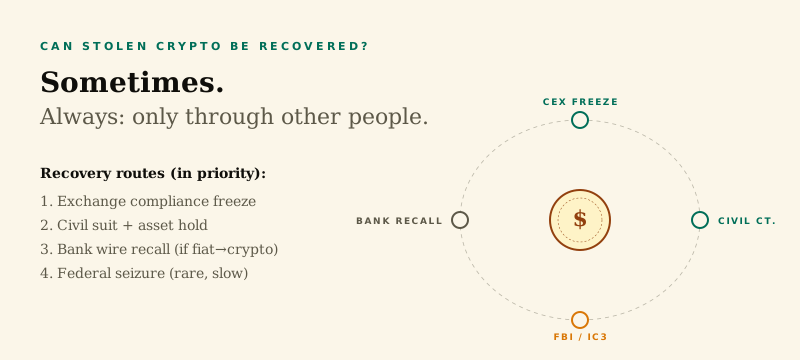
Best ways to recover funds from a crypto scam, ranked:
- Stablecoin issuer freeze (Tether/Circle blacklist) — fastest, when funds still in USDT/USDC
- Bank wire recall — only works inside 24–72 hours of the wire
- Exchange compliance freeze — when funds reach a regulated exchange
- Civil litigation — for losses over ~$20K with a clear defendant
- Law enforcement seizure — IC3 + FBI/DOJ asset forfeiture
- International MLAT — slow, but real for cross-border cases
- Class action / victim coordination — works on large multi-victim operations
In This Article
This is the question almost every crypto scam victim searches within the first 24 hours of realizing what happened. It deserves a straight answer — not a sales pitch, not false hope, and not the crushing "crypto transactions are irreversible" response that leaves you with nothing actionable.
The truth is somewhere in the middle. Here's what it actually looks like.
The Honest Answer
Sometimes. Not always. Not never. Sometimes — and the factors that determine which category your case falls into are mostly knowable before you spend a dollar on anything.
Cryptocurrency transactions are technically irreversible. Once funds leave your wallet, no one can reverse the transaction on the blockchain. That part is true. But irreversibility on the blockchain doesn't mean the money is gone forever — it means you can't undo the transfer directly. What you can do is trace where it went, identify who controlled it, and pursue recovery through legal and regulatory channels that don't require reversing the transaction.
Those channels work. Not every time. But they work often enough that giving up without investigating is leaving a real option on the table.
If you're searching for ways to get your crypto back, you are being actively targeted by recovery scammers right now. They buy ad space on exactly this search, they post in victim forums, and they cold-message people who report scams. Before you contact any recovery service, read the red flags section below.
What Determines Whether Recovery Is Possible
Not every case has the same odds. These are the factors that most determine whether yours has a realistic shot:
Did funds reach a regulated exchange?
If stolen funds ended up at Binance, Coinbase, Kraken, or any KYC-compliant exchange, there's an identity attached to that account. That's a subpoena target — the most actionable finding in any investigation.
How quickly are you acting?
The blockchain record is permanent, but exchange-side data ages out and funds get moved. Acting fast doesn't change the on-chain trail — it increases the odds funds are still sitting where they landed.
How much did you lose?
Larger losses justify the legal investment required for recovery. Civil litigation, international subpoenas, and attorney fees have baseline costs — cases under $20K often don't make financial sense to pursue aggressively.
Which blockchain was involved?
Bitcoin, Ethereum, USDT, Solana, and BNB are all highly traceable. Privacy coins like Monero are a genuine exception — if funds were converted to XMR, the trail may end there.
Where is the scammer based?
Scammers in jurisdictions with strong mutual legal assistance treaties — US, EU, UK, Singapore — are more reachable than those operating from countries with no cooperative law enforcement relationships.
What evidence do you have?
Transaction hashes, wallet addresses, screenshots of communication, and platform URLs are all evidence. The more you have documented, the stronger every legal avenue becomes.
The 7 Recovery Methods That Actually Work — Ranked
These are the seven real paths to crypto recovery, ranked by realistic success rate and speed in my casework. None are guaranteed. All require knowing where your funds went — which is what a blockchain forensic trace produces. The order matters: 1 and 2 are fastest. 3–5 are most common. 6–7 are slow but real on the right cases.
Stablecoin Issuer Freeze (Tether / Circle)
If your stolen funds are still held as USDT or USDC and they haven't moved off those tokens, this is the single fastest recovery path. Tether (USDT) and Circle (USDC) both maintain a blacklist function — they can freeze tokens at a specific wallet address on request. Tether has frozen hundreds of millions of dollars in scam proceeds this way. The request typically requires a law enforcement referral plus the address. The trade-off: the funds become un-transferable, but actually returning them to victims is a separate legal step.
Bank Wire Recall (Fiat Side Only)
If you funded the scam by sending a bank wire to buy crypto — and you act within 24–72 hours of the wire — your bank may be able to recall the wire before it clears. This doesn't recover the crypto itself, but it claws back the dollars before they become crypto. Past 72 hours, the wire has cleared and this option is closed. Call your bank's fraud department immediately and ask for a wire recall by name.
Exchange Compliance Freeze
Major exchanges have compliance teams that respond to documented fraud cases. If a forensic report identifies a specific deposit address at a regulated exchange (Binance, Coinbase, Kraken, OKX), a formal disclosure request — especially backed by a civil filing or law enforcement referral — can trigger a voluntary freeze on the account before funds are withdrawn. Time is critical. The earlier you act, the better the odds the funds are still sitting at the exchange. See subpoenaing a crypto exchange for the legal mechanics.
Civil Litigation
If a forensic investigation identifies the exchange account that received your funds, an attorney can file a civil complaint and subpoena the exchange for account holder identity. From there, civil claims — including asset freezes (TROs) and recovery judgments — can be pursued. This path works independently of law enforcement and has produced some of the largest individual crypto recoveries on record. See can you sue a crypto scammer for the litigation pathway in detail.
Law Enforcement Seizure (FBI / IC3 / DOJ)
Filing at IC3.gov contributes to pattern investigations that periodically result in major seizures and victim restitution. The DOJ's National Cryptocurrency Enforcement Team (NCET) and the FBI's Virtual Asset Exploitation Unit (VAXU) coordinate large takedowns where seized crypto is returned to identified victims through asset forfeiture proceedings. Individual cases rarely trigger direct action — but victims who file detailed reports with forensic backing are best positioned for restitution when seizures happen. See how to report a crypto scam to the FBI.
International Legal Assistance (MLAT)
Many large crypto fraud operations are run from overseas. Mutual Legal Assistance Treaties (MLATs) between countries allow law enforcement to share evidence and pursue suspects across borders. Europol, Interpol, and bilateral agreements between the US and key jurisdictions have supported crypto fraud prosecutions. This path is slow but has produced results in cases involving millions of dollars — particularly when funds reach exchanges in countries with cooperative law enforcement.
Class Action / Victim Coordination
Many crypto scams victimize hundreds or thousands of people through the same operation — pig butchering compounds, fake investment platforms, rug pulls. When a forensic investigation links your case to a known infrastructure, joining (or starting) a class action with other victims of the same operation can dramatically improve cost-effectiveness. Each victim shares the legal costs, the case is more attractive to law firms working on contingency, and exchange compliance teams treat coordinated victim claims more seriously than individual ones.
What Doesn't Work (Avoid These)
Several "recovery approaches" promoted online are dead ends or scams. Save your money and time by skipping them entirely:
- "Hacking back" your funds. Confirmed blockchain transactions cannot be reversed by any technical means. Anyone claiming hack-back capability is either lying or doesn't understand the technology. Either way, fraud.
- Paying a "tax" or "fee" to unlock your scam-platform balance. If a fake trading platform is asking for tax/fees to release your "balance," the platform is the scam. Your balance was never real. Every additional payment is pure theft.
- Hiring a recovery service that contacted you unsolicited. Real investigators don't cold-DM victims. Recovery services that reach out via Telegram, social media, email, or forum reply are almost always second scams — sometimes run by the same operation that ran the first one.
- Posting in public victim forums and waiting for help. The recovery scammers are watching those forums specifically to identify fresh victims. Posting about your loss attracts second-scam targeting, not real help.
- Negotiating with the scammer. They have your money. They have no incentive to return any of it. Direct contact only feeds them more information about how desperate you are.
- Waiting it out. Recovery windows close. Bank recalls expire in days. Exchange freeze opportunities expire in weeks. The blockchain itself is permanent, but every other recovery channel is time-bound.
Why Most "Recovery Services" Are Scams
This is the part of the article that matters most if you're in the early stages of researching your options. The recovery scam industry is enormous — it specifically targets people who have just been defrauded, because those people are motivated, distressed, and actively searching for solutions.
Here's how to identify them:
- They guarantee recovery — no legitimate investigator can guarantee this. The blockchain doesn't work that way and neither does law enforcement.
- They charge upfront fees before doing any work or showing any findings — legitimate investigators assess your case first.
- They contacted you — by DM, email, or comment after you posted about being scammed. Legitimate services don't cold-target victims.
- They claim to have "hacked back" your funds or have special access to exchanges — this is not how any of this works.
- They ask for your wallet seed phrase or private keys — this is the scam itself. Anyone who has these controls your wallet entirely.
- They only accept payment in cryptocurrency — legitimate professional services accept standard payment methods.
- They claim to work with the FBI, Interpol, or specific government agencies — these agencies do not subcontract to private recovery firms.
- Their website was created recently and has no verifiable track record — check domain age, look for real case details, verify the person behind it.
Recovery scams are sometimes run by the same organization that scammed you the first time. After the initial fraud, they monitor victim forums and complaint boards, then re-approach victims posing as recovery specialists. The fee you pay them is the second theft. If anyone reaches out to you unsolicited about recovering your funds — it's a scam.
The Right First Steps to Take Right Now
- Stop all contact with the scammer. Do not send more money regardless of what they tell you. Any "tax," "fee," or "insurance" required to release your funds is a continuation of the scam.
- Document everything immediately. Screenshot every conversation, note every wallet address, save every platform URL. Evidence degrades — do this now.
- Gather your transaction records. Find the transaction hash for every transfer you made. This is the starting point for any forensic investigation.
- File reports with IC3.gov and the FTC. Do this even if you think nothing will happen — these reports matter for pattern investigations.
- Get a forensic assessment before paying anyone anything. Know what your case actually looks like before committing resources to any recovery path.
Why a Forensic Investigation Is Always Step One
Every legitimate recovery path — civil litigation, law enforcement, exchange disclosure — requires knowing where your funds went. Without that, you're filing vague complaints, hiring attorneys with no evidence to work from, and hoping something sticks.
A blockchain forensic investigation changes that. It maps the complete movement of your funds from your wallet to wherever they ended up. If they hit an exchange, we identify which one and which deposit address — giving your attorney a subpoena target and law enforcement an actionable lead. If they passed through mixers or bridges, we document the methodology and trace as far as the chain allows.
The investigation doesn't guarantee recovery. But it determines whether recovery is possible — and it gives you the strongest possible foundation for every path that is. Doing anything else first is working backward.
Wallet Witness offers a free initial consultation to review your case and give you an honest assessment of what a forensic investigation would find — and whether your case has a realistic recovery path. No pressure, no fees discussed until you know what the investigation would actually cover. Book your free consultation →
Frequently Asked Questions
Can you get crypto back after being scammed?
Sometimes — but it depends on several factors: how quickly you act, whether the funds reached a regulated exchange, which blockchain was involved, and whether law enforcement or civil litigation is pursued. Recovery is never guaranteed, but a blockchain forensic investigation is always step one — it identifies where the funds went and which legal paths are available.
What is the best way to recover funds from a crypto scam?
The best path depends on your specific case. Ranked by realistic success rate: (1) Stablecoin issuer freezes (USDT/USDC) if funds are still held in those tokens; (2) Bank wire recall if you funded the scam by wire transfer in the last 24–72 hours; (3) Exchange compliance freeze if the scammer's deposit address is identified at a regulated exchange; (4) Civil litigation with subpoena power for cases over $20K; (5) Law enforcement seizure via IC3 + DOJ; (6) International MLAT requests; (7) Class action coordination with other victims of the same operation. A blockchain forensic trace is required to know which of these are open to your case.
Can Tether (USDT) freeze stolen funds?
Yes. Tether and Circle (USDC) can both blacklist addresses on request from law enforcement, freezing the tokens at those addresses so they cannot be transferred. This has been used to freeze hundreds of millions of dollars in scam proceeds. The request typically requires a law enforcement referral plus identification of the specific address holding the stolen funds — which is exactly what a forensic investigation provides.
Can my bank reverse a wire transfer to a crypto exchange?
Sometimes — within a narrow window of 24–72 hours from when the wire was sent. After that, the wire has cleared and reversal is no longer possible. If you were scammed via fiat → crypto purchase, calling your bank's fraud department immediately is one of the highest-priority actions you can take. The bank cannot recover the crypto itself once it leaves the exchange, but they may be able to recall the wire if you act fast.
How do I recover stolen cryptocurrency?
The legitimate recovery paths are: civil litigation using blockchain forensic evidence, law enforcement action via IC3 and the FBI, exchange disclosure requests identifying the account that received your funds, and in some cases international legal assistance. Any service promising guaranteed recovery for an upfront fee is almost certainly a scam.
Can the FBI recover stolen crypto?
The FBI has successfully seized and returned cryptocurrency in major cases — but individual cases rarely result in direct recovery unless they're part of a larger pattern investigation. Filing at IC3.gov is important, but pairing it with a forensic report significantly improves your chances of action. See can police recover stolen cryptocurrency for the realistic odds.
Are crypto recovery services legitimate?
Most "crypto recovery services" that promise to get your money back for an upfront fee are scams — they specifically target people who have already been defrauded. Legitimate blockchain forensic investigators trace funds and build evidence packages; they do not guarantee recovery and do not charge based on a percentage of recovered funds. See legitimate vs scam recovery services for the full red-flag list.
How long does crypto recovery take?
A blockchain forensic investigation typically takes 3–14 days depending on complexity. Civil litigation can take months to years. Law enforcement investigations vary widely. The forensic trace itself is the fastest part — what takes time is the legal process that follows.
What doesn't work for recovering stolen crypto?
Several approaches commonly promoted online do not work: "hacking back" your funds (impossible — confirmed blockchain transactions cannot be reversed), paying a "tax" or "fee" to unlock your scam-platform balance (the platform is fake, the balance is fictional), hiring a recovery service that contacted you unsolicited (almost always a second scam), and waiting for the scammer to feel guilty and return funds (does not happen). Avoid all of these — they extend the loss rather than recover from it.
Find Out If Your Case Has a Recovery Path.
A free consultation with a blockchain forensic investigator is the only way to know what's actually traceable in your case — and which recovery options are worth pursuing. No commitment. Just answers.