In This Article
You hit send. Then you noticed the address was off — or the chain was wrong — or it didn't match what you'd copied. The transaction confirmed before you could cancel it.
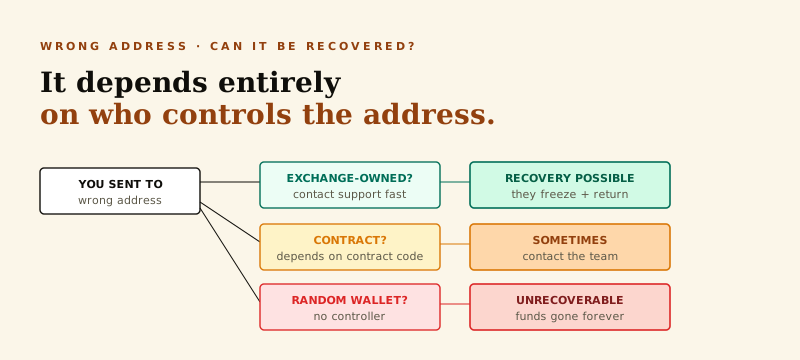
Whether recovery is possible depends entirely on which scenario you're in. The three look similar but have completely different paths forward.
Three Scenarios, Three Recovery Paths
Before anything else, identify which case applies: a typo to a random address, a transfer on the wrong chain, or address poisoning where someone tricked you with a look-alike. Each has a fundamentally different recovery path. Misidentifying the scenario wastes the time that matters most.
Scenario 1: Genuine Typo
You typed (or copied poorly) and sent funds to an address that exists but isn't who you intended. Three sub-cases here, ranging from recoverable to lost.
1A. The address is a wallet someone holds
Most realistic-looking addresses correspond to actual wallets owned by actual people. The wallet history might show an active user, a balance, recent transactions. Recovery is theoretically possible if you can identify the person and they choose to return funds.
Forensic tracing helps in two ways. First, by examining the address's activity, an investigator can determine whether the wallet has touched a centralized exchange — meaning the person passed KYC at some point and is identifiable through legal process. Second, by clustering analysis, the investigator can sometimes identify the wallet's owner through other public-facing labels (ENS, public wallets associated with services, named clusters in commercial intelligence platforms).
1B. The address is a known service or contract
If you accidentally sent USDC to a Uniswap router, a custodial exchange's hot wallet, or another known contract address, recovery depends entirely on the operator. Contact their support immediately with the transaction hash. Some services have address-recovery procedures (with fees and verification); some don't.
1C. The address is unowned or inaccessible
If the address is a dead burn address (e.g., 0x000...000), a contract that doesn't have a withdrawal function for that token, or a randomly generated address with no corresponding private key in existence, the funds are effectively destroyed. No recovery is possible.
Scenario 2: Wrong Chain
You sent USDT on TRC-20 to an ERC-20 address. Or BNB on BSC to an Ethereum address. The destination address looks valid because EVM addresses share the same format across most chains, but the funds didn't arrive because they're on a different network entirely.
This is sometimes recoverable, with caveats:
- Centralized exchange destination, same private key on both chains: Often recoverable. Many exchanges (Binance, OKX, Coinbase) maintain addresses on multiple chains. If you sent on the "wrong" chain to one of their EVM addresses, support can sometimes credit the funds or sweep them, typically for a recovery fee. Open a support ticket immediately with the tx hash.
- Self-custody wallet (MetaMask, Trust, Rabby) on EVM-compatible chain: Often recoverable by you. The same seed phrase generates the same address across all EVM chains. Add the destination chain to the wallet, and the funds appear. This is a recovery in seconds, not weeks — but only if both chains are EVM-compatible.
- Fundamentally different networks: Bitcoin to a Solana address, or Solana to an Ethereum address — the address formats are different, so usually the transaction fails or never confirms. If it somehow did confirm, recovery is essentially impossible because no party controls a key for both chains.
If your destination is a self-custody EVM wallet, check it on the chain you actually sent to before doing anything else. Most "lost" wrong-chain transfers are sitting visible in the recipient's wallet on the unexpected network — just unrendered because the wallet UI was set to a different chain.
Scenario 3: Address Poisoning
This isn't a mistake. This is fraud.
Address poisoning is a scam where attackers send tiny zero-value (or near-zero) transactions to your wallet using a vanity-generated address that closely resembles one you've sent to before. The poisoned address appears in your transaction history. When you later go to send to that legitimate address, you (or your wallet's auto-fill) pulls the poisoned look-alike instead.
The first and last few characters match. The middle differs. Most users only verify the prefix and suffix.
Recovery here follows the scam-recovery path, not the typo-recovery path:
- The destination is attacker-controlled by definition.
- Forensic tracing follows the funds through laundering hops to the eventual cash-out exchange.
- A subpoena to the cash-out exchange identifies the recipient.
- Civil and criminal recovery paths apply.
We cover the mechanics in detail in Address Poisoning: What It Is and How to Protect Yourself, and the broader recovery framework in Can You Get Crypto Back After Being Scammed?
What to Do in the First Hour
-
1
Identify the scenario
Look at the address. Compare it character-by-character to what you intended to send to. If the prefix and suffix match but the middle differs, treat it as address poisoning. If you're on the wrong chain, check the destination on the actual chain you sent to. If neither — it's a true typo.
-
2
Document the transaction
Save the tx hash, sending address, destination address, chain, token, amount, and timestamp. Screenshot your wallet history and the block explorer view of the transaction. This is the foundation of every later step.
-
3
Check the destination on a block explorer
Look up the destination address on Etherscan, Blockchair, or the relevant explorer. Has it received funds before? Sent funds? Touched any known service? Active or dormant? This determines whether recovery has any handle.
-
4
Contact the right support team
Wrong-chain to an exchange: open a support ticket with the exchange. Typo to a service: contact that service. Address poisoning: file IC3 and contact a forensic investigator. Don't waste time emailing the wallet's general support if the destination is an unrelated wallet they don't control.
-
5
Engage forensic help if the destination is unidentified
If the destination wallet's owner isn't obviously identifiable, a forensic trace can determine whether the wallet has been linked to a known service or KYC exchange — the precondition for any legal recovery action.
Habits That Prevent It
- Always verify the full address, not just first/last 4 characters. Address poisoning relies on this single bad habit.
- Send a small test transaction first. For any transfer above a threshold you can comfortably lose, send $1-5 first. Confirm receipt before sending the rest.
- Use the recipient's preferred network. Confirm the chain explicitly — "USDT on Tron" vs. "USDT on Ethereum" vs. "USDT on BSC" are all different things. Ask if you're not sure.
- Use address book features. Most wallets allow saving verified addresses with labels. Sending to the saved label removes the typo and copy-paste risks at once.
- Clear poisoned entries. If your transaction history contains addresses you didn't initiate — tiny incoming transactions from unknown senders — treat them as poisoning attempts. Don't copy from your history; copy from the verified source.
Sent to the Wrong Address? Get a Trace.
We trace destination wallets to determine if they're identifiable, whether they've touched a KYC exchange, and what recovery path actually has a handle. Free initial review — share the transaction hash and we'll tell you what's possible.