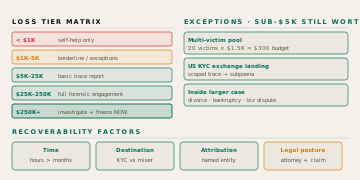
This guide answers a question I get on almost every intake call: "Is my loss big enough to be worth investigating?" It is the right question. A blockchain forensic investigation costs real money, and you should know whether the math works before you spend a dollar. This is an honest dollar-by-dollar walkthrough — including the situations where I tell people their case is below the threshold and what they can do instead.
Different from our cost guide, which explains what an investigation costs, this article is about the inverse question: given what you lost, does the cost make sense?
As a rough threshold, losses above $5,000 generally justify a paid investigation if there is a realistic recovery path. Below that, the math gets harder — but several specific situations change the calculation entirely. Read on for the exceptions before assuming your loss is too small.
Contents
The Default $5,000 Threshold
For a single-victim case with no special circumstances, the rough rule is this: if you lost less than around $5,000, a paid forensic investigation is usually not worth the cost on a pure ROI basis. If you lost more, it usually is. That is a starting point, not a hard rule — and the rest of this article covers when the rule does and does not apply.
| Loss Range | Default Recommendation | Common Exceptions |
|---|---|---|
| Under $1,000 | Self-help only — investigation cost exceeds the loss | Multi-victim joint case; part of a larger civil suit |
| $1,000 – $5,000 | Borderline — usually not worth a standalone paid investigation | Funds clearly traced to a US KYC exchange; victim group; related litigation |
| $5,000 – $25,000 | Usually investigable; basic trace report is the right starting point | — |
| $25,000 – $250,000 | Almost always investigable; full forensic engagement justified | — |
| $250,000+ | Investigate immediately; engage an attorney in parallel for asset freeze | — |
Why That Threshold Exists
The threshold is a math problem, not a judgment about your loss. Here is what drives it.
Investigation cost. A basic single-chain trace report typically costs $1,500 to $3,500. A standard investigation with attribution and exchange identification is $3,500 to $8,000. Below that floor, the investigator's time simply does not fit a smaller engagement.
Realistic recovery rate. Even when funds are perfectly traced, recovery is not automatic. It requires a subpoena, civil suit, exchange cooperation, or law enforcement seizure. The proportion of identified funds that ultimately get returned varies enormously by case — some clients recover most of what was traced, others recover nothing because the funds left a US-jurisdiction exchange before action could be taken.
Total downstream cost. If you ultimately need an attorney to file suit or pursue a subpoena, those legal costs are separate from the forensic fee. A complete recovery effort (forensics + legal) typically runs $5,000 to $25,000 in professional fees before any recovery comes back. That total has to make sense against the loss.
For more on the recovery side of the equation, see whether you can get crypto back after a scam and whether stolen Bitcoin can be traced.
When a Sub-$5K Case Is Still Worth It
Three specific situations make smaller cases worth investigating despite the math.
1. Multi-Victim Joint Investigation
If you were scammed by an operation that hit dozens or hundreds of other victims — pig butchering platforms, fake yield farms, rug pulls, romance investment scams — the same wallets and the same trace work apply to all of you. We can run one investigation across the whole victim group and split the cost. Twenty victims at $1,500 each is a $30,000 budget for an investigation that supports a class action or coordinated law enforcement referral. That math works.
If you are in a Telegram or Discord support group with other victims of the same operation, this is the conversation to have. See our pig butchering recovery guide for how multi-victim cases work in practice.
2. Funds Reached a US KYC Exchange
If you can already see (or strongly suspect) that the stolen funds reached Coinbase, Kraken, Gemini, or another major US exchange, the recoverability profile changes. A short, targeted trace report focused on confirming the deposit and identifying the deposit transaction can support a subpoena that names the account holder. The investigation does not need to cost $8,000 — it needs to be precise enough to support the subpoena. Talk to us about a scoped engagement.
3. The Loss Is Part of a Larger Case
If you are already in a divorce, business dispute, bankruptcy, or civil suit, the forensic report serves multiple purposes. Even a smaller dollar amount of "missing" crypto can shift the legal calculus in the broader case. Attorneys often retain a forensic investigator on a smaller direct loss because the report value to the underlying litigation is much higher than the standalone recovery value. See our pieces on hidden crypto in divorce, crypto in bankruptcy, and fraudulent transfer tracing.
When the Math Becomes Obvious
Above $25,000, the question is no longer whether to investigate — it is how fast. At those amounts the cost of inaction is much higher than the cost of investigation, and recovery options (civil suit, asset freeze, exchange subpoena, criminal referral with priority) all become genuinely realistic. The same is true for any case involving:
- An identifiable scammer who can be sued (i.e., a real person, business, or named entity)
- Funds that demonstrably reached a major US or EU exchange
- A theft tied to a fiduciary relationship (estate, trust, business partnership)
- A pattern of fraud where multiple victims can pool resources
- Insurance coverage that requires a forensic report to substantiate the loss
What Changes Recoverability (Beyond the Number)
Two cases with the same dollar loss can have wildly different recoverability profiles. The amount lost is not the only variable. The most important factors are:
| Factor | What Helps Recovery | What Hurts Recovery |
|---|---|---|
| Time since theft | Hours to days — funds still in transit | Months — funds long since cashed out or laundered |
| Where funds went | US-based KYC exchange; OTC desk with US presence | Sanctioned mixer; offshore exchange; self-custodial cold storage |
| Scammer attribution | Real person or registered business identifiable | Anonymous wallet with no off-chain footprint |
| Asset type | USDT, USDC, BTC, ETH on major chains | Obscure altcoins on obscure chains |
| Legal posture | Existing attorney relationship; prior civil claim | No legal vehicle; victim acting alone |
If you have favorable factors on the right side of that table, even a smaller loss can be worth investigating. If you have the unfavorable factors stacked against you, even a larger loss may be hard to recover. This is the kind of analysis you get on a free assessment call — we tell you which side of the table your case sits on before quoting any work.
If Your Loss Is Below the Threshold
If the honest answer is that your case is too small for a paid investigation, here is the productive path. None of this requires hiring us.
- File with IC3 (the FBI's Internet Crime Complaint Center). It is free and creates the official record. See our IC3 filing guide.
- File a complaint with your state attorney general. State AGs sometimes consolidate small cases into pattern investigations.
- Report to the exchange that received the funds (if you can identify it from a basic block explorer search). Provide the deposit transaction hash. They will not refund you, but they will sometimes flag the receiving account.
- Document everything. Save every transaction hash, every screenshot, every message. If a multi-victim case forms later, your documentation is what makes it possible to join.
- Look for support groups. Other victims of the same operation are how multi-victim joint investigations come together. See what to do after a crypto scam for the full action list.
Below-threshold victims are the prime target for crypto recovery scams. The smaller your loss, the more aggressive the targeting, because scammers know you cannot afford a real investigator. If anyone reaches out promising to "recover" your money, read this first.
FAQ
Not Sure If Your Case Is Worth Investigating?
Submit your case for a free assessment. Within 24 hours we will tell you honestly whether the math works, what it would cost, and what to do if your loss is below the threshold. No fee, no obligation, and we will tell you no when no is the right answer.
Get a Free Case Assessment