In This Article
Cash App lets users buy, hold, and withdraw Bitcoin in one of the smoothest mobile experiences in fintech. That same smoothness makes it one of the most-targeted apps for Bitcoin scams in the United States.
If you've lost Bitcoin through Cash App — whether to a hacker who took your account or to someone who tricked you into sending it — recovery is possible, but the path depends almost entirely on a single question: was the transaction authorized?
Authorized vs. Unauthorized: The Line That Decides Everything
Federal Regulation E gives strong refund protection for unauthorized electronic fund transfers — transactions you didn't initiate. It gives much weaker (but not zero) protection when you authorized the transaction yourself, even if you were deceived. Cash App's response to your dispute will turn on this distinction. Frame your case correctly from the first message.
Unauthorized. Someone else accessed your Cash App account — through a stolen phone, an intercepted text code, a SIM-swap, or a session hijack — and sent the Bitcoin without your knowledge or permission. You did not consent to the transaction. Reg E protection is strong here.
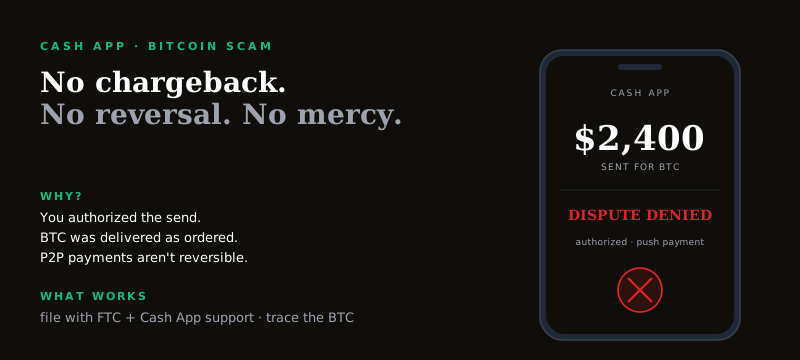
Authorized. You logged into Cash App yourself, you tapped Send, and the Bitcoin went to the wallet you specified. The fact that someone deceived you into doing it — convinced you it was a "verification" payment, a "mining" deposit, a "support" address, or a romantic partner's wallet — doesn't change that you authorized the transfer. Reg E protection here is much narrower, though Cash App's expanded fraud handling (rolled out across 2024) covers more authorized-scam cases than it used to.
Cash App Bitcoin Scam Patterns
The Cash App scam ecosystem clusters around five recurring patterns. Recognizing yours helps with both the dispute and the on-chain trace.
Account takeover
Attacker gets in via SIM swap, phishing, or stolen device. They convert your USD balance to Bitcoin and withdraw it to a wallet they control. This is unauthorized — Reg E applies.
"Verification" Bitcoin sends
Fake support, customs, or government impersonator tells you to send Bitcoin to "verify your identity" or "release funds." You authorize the send. Authorized scam.
Bitcoin Boost / sweepstakes scams
Someone claims you've won a prize but need to send Bitcoin to cover a fee. Or claims they'll multiply your Bitcoin if you send first. Authorized scam.
Pig butchering / romance
Long-form social manipulation through dating apps or social media leading to repeated Bitcoin sends to a "trading platform" that doesn't exist. Authorized scam, often very large total losses.
$Cashtag impersonation
Scammer copies your contact's profile photo and a near-identical $Cashtag. You send Bitcoin to who you think is a friend. Often framed as authorized; document the impersonation aggressively.
Fake support phone/social DMs
Scammer poses as Cash App support, walks you through "fixing" an issue that ends with them having access or you sending Bitcoin. Can be either category — depends on whether they took control or directed your hand.
What Reg E Actually Requires of Cash App
Cash App is a financial service operated by Block, Inc. Its Bitcoin functionality is provided through Block's licensing structure. For consumer transactions in the United States, electronic fund transfer activity falls under Regulation E (12 CFR Part 1005), which implements the Electronic Fund Transfer Act.
What Reg E gives you for unauthorized transactions:
- Liability cap. If you report within 2 business days of discovering an unauthorized transaction, your liability is capped at $50. After 2 days but within 60 days, it can rise to $500. After 60 days, you may be liable for everything.
- Investigation timeline. Cash App must complete the investigation within 10 business days of receiving notice (extendable to 45 days if they provisionally credit your account).
- Provisional credit. If the investigation takes more than 10 business days, Cash App must provisionally credit you for the disputed amount within those 10 days, pending the final outcome.
- Written explanation if denied. If Cash App denies the dispute, they must provide a written explanation and the documents they relied on.
What Reg E does not automatically give you for authorized transactions: a refund. If you tapped Send and the Bitcoin went where you told it to go, the federal floor of protection is much lower. Some states have stronger consumer protection laws on top of Reg E, and the CFPB has expanded interpretation of authorized-fraud coverage in recent years — but you can't assume a refund will come.
Many "authorized" scams have unauthorized elements. If the scammer remoted into your phone, took control of your screen, intercepted a verification code, or pressured you while logged into your account — those facts can move the case toward unauthorized. Document them in the dispute. Don't volunteer "I sent it" when the more accurate framing is "they directed the transaction while having access to my account."
What to Do in the First Hour
-
1
Lock your account
Open Cash App, go to your profile, change your password, sign out of all devices, and disable Bitcoin withdrawals if the option is available. If you suspect SIM swap, contact your carrier to lock the SIM and report fraudulent porting.
-
2
File the dispute through Cash App
In Cash App: Profile → Support → Report a Payment Issue. Use the words "unauthorized transaction" if it was account takeover. Attach any context you have. The clock for Reg E protections starts when you give notice — in writing is best.
-
3
Capture the on-chain evidence
The Bitcoin transaction has a hash visible in your Cash App Bitcoin activity. Record it. Look it up on a Bitcoin block explorer (mempool.space, Blockchair, blockstream.info). Save the destination address and screenshot the transaction. This is the evidence trail Cash App can't reconstruct on its own.
-
4
File IC3 and a local police report
Submit a report at ic3.gov (FBI's internet crime complaint center). File a local police report, even if local police won't actively investigate. The report numbers are useful for the Cash App dispute, future subpoenas, and any civil action. Keep copies.
-
5
Engage on-chain tracing
Forensic investigators trace the destination Bitcoin address through laundering hops to the eventual cash-out exchange. The cash-out is where KYC creates an identifiable receiver — the recovery handle that survives whether or not Cash App refunds you.
The Dual Track: Cash App + On-Chain
Cash App can do something on-chain tracing can't: refund you from its own balance sheet, fast, if the transaction qualifies. On-chain tracing can do something Cash App can't: identify the actual recipient and create a path for civil or criminal recovery against them.
Run both in parallel. Don't wait for the Cash App outcome before starting the trace. Two reasons: first, the trace evidence supports the dispute (an exchange-deposit destination strengthens "unauthorized" framing because it shows clear fraud-handler patterns); second, even if Cash App reimburses, the funds are still gone from the on-chain world — and law enforcement values the trace regardless of who eats the loss financially.
For more on the broader recovery framework, see Can You Get Crypto Back After Being Scammed? and Can Stolen Bitcoin Be Traced?
What the Outcomes Actually Look Like
Three realistic outcomes from a Cash App Bitcoin dispute:
- Full refund (unauthorized cases, prompt reporting). Account takeover, SIM swap, session hijack with timely notice typically resolves with Cash App refunding the disputed amount under Reg E. The Bitcoin is gone from chain; Cash App eats the loss.
- Partial credit or goodwill resolution (mixed cases). When the line between authorized and unauthorized is blurry — remote-access scams, social-engineering with account access, large-loss authorized scams — Cash App sometimes offers partial credit, especially when the user pushes back through formal channels (CFPB complaint, state AG, written demand). Outcomes vary widely.
- Denial (clean authorized scams). Pig butchering, sweepstakes, romance, "verification" sends — if you authorized them and there's no account compromise to point to, Cash App often denies. The recovery handle is then exclusively the on-chain trace and the legal action it enables.
A denial isn't the end. Three escalations exist: (1) request the documents Cash App relied on, in writing, citing 12 CFR § 1005.11; (2) file a complaint with the Consumer Financial Protection Bureau (consumerfinance.gov) and your state Attorney General; (3) reframe with new evidence from the on-chain trace if it shows fraud patterns Cash App's review missed. Many denials get reversed at step (2).
Lost Bitcoin Through Cash App? Get a Trace.
We trace the destination Bitcoin wallet through laundering hops to the cash-out exchange — the evidence that strengthens your Cash App dispute and creates a recovery handle if Cash App denies. Free initial review.