In This Article
You bought crypto on a card. You sent it to someone. You realized it was a scam. You called your bank. They said "we can't help — you authorized that purchase." Now what?
This guide is the honest answer to the chargeback question for crypto fraud, including the cases where banks do reverse charges, the cases where they almost never will, and what comes next when the dispute is denied.
The Honest Short Answer
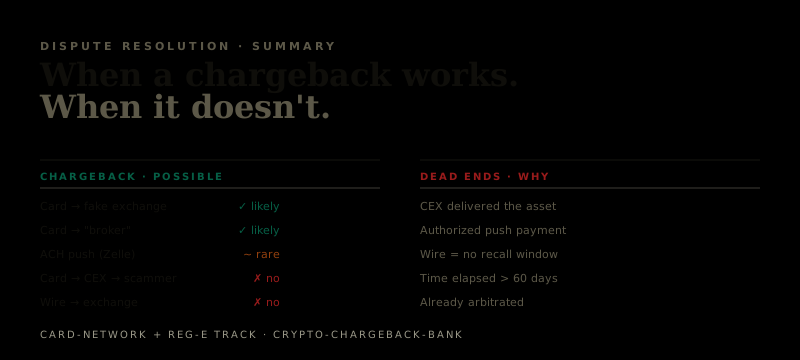
Chargebacks succeed when the merchant failed to deliver, when the card was used without your authorization, or when the purchase itself was fraudulent at the merchant level. Chargebacks fail when you authorized the purchase, the exchange delivered the crypto as ordered, and you then sent that crypto to a scammer. The bank views delivery, not downstream loss, as the disputable event.
That distinction is the entire game. Below, the specific scenarios on each side of the line.
When Chargebacks Actually Work
1. Unauthorized Card Use
Someone used your card to buy crypto without your permission — lost card, stolen card, account takeover, family member who shouldn't have had access. Reg E and Reg Z both protect you. The bank reverses the charge, the exchange takes the loss or pursues the unauthorized buyer.
2. Non-Delivery by the Exchange
You purchased crypto and never received it. The exchange never credited the asset to your wallet or account. This is a textbook non-delivery dispute under Visa/Mastercard reason codes (commonly 13.1 "Merchandise/Services Not Received" or its current equivalent). Banks will typically pursue this.
3. Account Funding Through Identity Theft
A scammer opened a fake exchange account in your name, funded it with your card, then transferred the crypto out. Both the unauthorized account opening and the unauthorized card charge are disputable. Provide proof you didn't open the account — KYC mismatches, IP records, device records.
4. Fraudulent Merchant or Counterfeit Exchange
You sent funds to what you thought was a real exchange but turned out to be a fraudulent platform impersonating one. If the merchant of record is itself a scam (not a real exchange), banks may treat this as merchant fraud rather than a fund-transfer issue. Outcomes vary by issuer.
5. Romance/Pig Butchering Caught Within Days
If you funded the purchase on credit and dispute very quickly — sometimes before the exchange has even fully cleared the deposit — some issuers will reverse on grounds of "obtained by deception" or fraud-induced authorization. This is increasingly rare as exchanges have tightened settlement, but it has happened.
When Chargebacks Fail (And Why)
The most common scenario victims walk into:
- You bought BTC, ETH, or USDT from Coinbase, Kraken, Binance.US, Cash App, or similar.
- The exchange delivered the crypto to your account or wallet.
- You then sent that crypto to a scammer (Telegram contact, fake broker, romance scam, "tech support," IRS imposter, etc.).
- You disputed the original card purchase with your bank.
The bank will almost certainly deny this dispute. Here's why, exactly:
Authorization is intact. You made the purchase intentionally. You entered the CVV, signed the 3DS challenge, or approved the bank's push notification.
Delivery occurred. The exchange — the actual merchant on the charge — did exactly what you paid them to do. Crypto landed in your account. The exchange has timestamped logs, KYC records, and on-chain proof of delivery to submit as chargeback rebuttal.
The fraud was downstream. The scammer is not the merchant on your card statement. The bank cannot claw money back from someone who never appeared in the card transaction.
Some victims, frustrated by initial denials, refile the dispute as "unauthorized" hoping for a different outcome. Don't. If you authorized the purchase and signed it, claiming otherwise is bank fraud and account-closure territory. Honest disputes have paths; misrepresented ones close doors.
Reg E vs. Reg Z — What Governs Your Dispute
Two federal frameworks plus the Visa/Mastercard rules govern most US disputes. Which one applies depends on how you funded the purchase.
| Funding | Governs | Window | Strength for Crypto Disputes |
|---|---|---|---|
| Credit card | Reg Z + Visa/MC rules | 60 days (billing error); ~120 days (chargeback non-receipt) | Strongest — broad chargeback rights |
| Debit card | Reg E + Visa/MC rules | 60 days from statement | Moderate — covers unauthorized but limited for authorized purchases |
| ACH from bank | Reg E + NACHA rules | 60 days; 15 days for unauthorized | Weakest — very narrow grounds for reversal |
| Wire transfer | UCC Article 4A | None (final on settlement) | Almost none — recall only if instant |
| Zelle/P2P | Reg E (as of 2024+ guidance) | 60 days from statement | Improving — banks now must investigate fraud-induced transfers more seriously |
Visa and Mastercard reason codes layer on top of Reg E and Reg Z. The most relevant codes for crypto disputes are:
- 10.4 (Other Fraud) / 11.3 (No Authorization). Use when the card was used without your authorization.
- 13.1 (Merchandise/Services Not Received). Use when the exchange didn't deliver the crypto.
- 13.5 (Misrepresentation). Use when the merchant misrepresented what was being sold — rare for legitimate exchanges, more applicable to fraudulent platforms.
- 13.7 (Cancelled Merchandise/Services). Use when you cancelled before delivery and were charged anyway.
How to File the Chargeback Correctly
-
1
Match your facts to the right reason code
Be specific and accurate. If the card was used without your authorization, file as unauthorized. If the exchange didn't deliver, file as non-receipt. Don't reach for a code that doesn't fit your facts — the rebuttal will reveal the mismatch.
-
2
Document everything in writing
Banks vary in what they require. At minimum: timestamps, screenshots of the purchase confirmation, the exchange's delivery confirmation (if any), correspondence with the merchant attempting resolution, and a written statement of facts.
-
3
Attempt merchant resolution first
Visa and Mastercard rules generally require you to attempt resolution with the merchant before disputing. Email or open a support ticket with the exchange, save the response (or non-response), and reference it in your dispute.
-
4
File within the window
60 days for billing errors. ~120 days for non-receipt under Visa/MC. Earlier is always better — the merchant has less time to provide rebuttal evidence and the issuer has more flexibility.
-
5
Follow up in writing if denied
The first denial is not always final. You can request the merchant's rebuttal documents, respond with corrections, and escalate to the issuer's executive office or the CFPB if you believe the dispute was wrongly denied.
What to Do After a Denial
A denied chargeback closes the bank-side path. It does not close the recovery path.
The on-chain trace is independent of the chargeback process. Once crypto left your wallet or exchange account, the funds left a permanent, public record on the blockchain. That record points to a destination wallet, and from there, forensic tracing follows the funds through laundering hops to the eventual cash-out point — usually a centralized exchange.
That cash-out exchange becomes the actionable handle. A subpoena to the exchange — supported by a forensic report identifying the deposit address — produces the recipient's identity, KYC documents, IP and device records, and deposit history. We cover the subpoena process in Subpoenaing Coinbase, Binance & Kraken for Stolen Crypto.
The chargeback fails because the bank can't reach the scammer. The forensic trace works because it follows the scammer directly. Different evidence, different jurisdiction, different outcomes. Many of our highest-recovery cases began with a denied chargeback.
Beyond the trace, several other channels remain open:
- IC3 / FBI report. Aggregates the case into federal investigation queues; required documentation for several recovery paths.
- State attorney general consumer fraud complaint. Some states pursue large pattern cases.
- Civil suit. If the recipient is identified, civil action can yield default judgments and asset freezes.
- IRS theft loss documentation. Forensic reports support tax loss positions in qualifying cases.
- CFPB complaint. Useful when the bank has handled the dispute incorrectly procedurally.
Chargeback Denied? The Trace Is the Next Step.
The bank can't reach the scammer. We can. We trace funds from your wallet or exchange account through laundering hops to the cash-out exchange and produce a forensic report usable for subpoena, civil action, and law enforcement referral. Free initial review.