In This Article
After losing money to a crypto scam, the question most victims ask first is the wrong one: can I get my money back? The better question is: what legal options do I actually have, and which ones apply to my situation?
This article answers that honestly — including the parts that attorneys sometimes gloss over.
The Short Answer
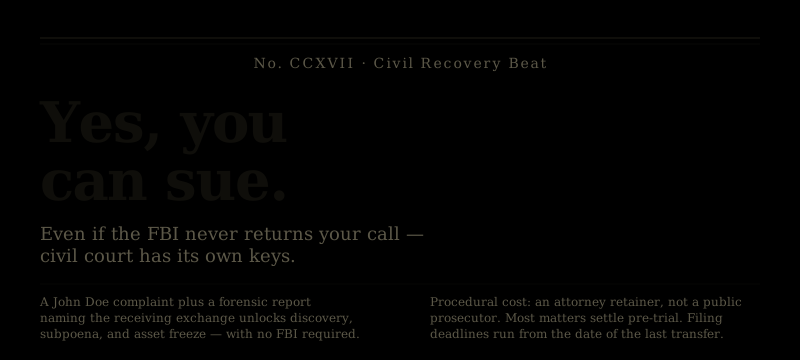
Yes, you can sue a crypto scammer — but the practical question is whether you can identify one to sue. Blockchain forensic evidence that traces your funds to an exchange deposit is typically what makes a civil case viable, because it enables a subpoena that converts an anonymous wallet address into a named defendant. Without that chain, you have a case against nobody. See is it worth filing a crypto lawsuit for a cost-benefit breakdown.
Civil vs. Criminal — The Difference
These are two separate systems with different goals, different actors, and different outcomes.
Criminal prosecution is pursued by the government — the DOJ, FBI, or state prosecutors. The standard of proof is "beyond reasonable doubt." If successful, the defendant faces fines and imprisonment. You, as the victim, don't control this process — you're a witness, not a party. The government decides whether to prosecute.
Civil litigation is a lawsuit you bring directly. The standard of proof is "preponderance of evidence" — more likely than not. If successful, you can obtain a money judgment, asset seizure, or injunctive relief. You control the case with your attorney.
The two are not mutually exclusive. A civil case and a criminal referral can proceed simultaneously. A forensic report useful for civil litigation is equally useful as a criminal referral package.
Your Four Legal Paths
Direct Civil Action
Sue the scammer directly for fraud, conversion, or unjust enrichment. Requires identifying a defendant — which usually means tracing funds to a KYC'd exchange and subpoenaing account holder information.
Temporary Restraining Order
A TRO freezes assets before they can be moved. In crypto fraud cases, TROs are sought against exchange accounts containing traced funds. Speed is critical — most successful TROs are obtained within 48-72 hours of the scam.
Discovery via Exchange
File suit naming an exchange as a respondent or third party, then subpoena the account holder records for the deposit address your funds reached. This is often the first step toward naming the actual defendant.
Law Enforcement Referral
File with IC3 and the FBI with a forensic report attached. Well-documented cases with clear fund flows get assigned to field offices. This runs parallel to civil action and doesn't preclude it.
Who You Can Actually Sue
This is the practical heart of the issue. Crypto scammers operate anonymously by design. You can't sue "0x7F4aBc..." — you need a legal person or entity.
Here's who commonly ends up as defendants in crypto fraud civil cases:
- The scammer directly — once forensic evidence traces funds to an exchange and a subpoena reveals account holder identity. This is the end goal of the investigation chain.
- The exchange holding the funds — if funds are still sitting in an exchange account, a named exchange can be served with a TRO and compelled to freeze the account. Exchanges comply with court orders in most jurisdictions.
- Co-conspirators — money mules and facilitators who knowingly moved funds are also liable. Blockchain evidence often reveals multiple individuals involved in a single scam.
- The fake platform operator — if the platform was run under a registered business entity (even a shell company), that entity can be named as a defendant.
Many crypto scammers operate from Southeast Asia, West Africa, or Eastern Europe. This makes direct civil action complicated but not impossible. If your funds touched a US-regulated exchange at any point, US courts can assert jurisdiction over that exchange and compel disclosure. Cases involving significant losses often engage foreign counsel and MLAT (Mutual Legal Assistance Treaty) mechanisms to pursue overseas defendants.
What Evidence You Need
- Transaction records — every transaction hash for funds you sent, from your wallet or exchange withdrawal history
- Communication records — all messages, emails, chat logs, and screenshots from the scammer
- Platform documentation — screenshots of the fake investment platform, trading interface, or job platform, including URLs and account information
- Identity documents provided to the scammer — if you submitted KYC documents to a fake platform, document what was submitted and when
- Blockchain forensic report — a documented trace of fund flows from your sending address through to exchange deposits, produced by a qualified investigator
- Loss documentation — total amounts lost, dates, and sources of funds (bank statements, exchange records)
What Blockchain Forensics Does for Your Case
A blockchain forensic report is not optional for viable civil litigation — it's the foundation. Here's specifically what it provides:
- Chain of custody for the funds — documents every wallet-to-wallet move with timestamps and amounts, in a format courts can receive as evidence
- Exchange identification — identifies which exchange received the funds and at which deposit address, enabling targeted subpoenas
- Transaction flow diagrams — visual representations of the fund flow suitable for use in pleadings and court presentations
- Wallet clustering evidence — demonstrates that multiple wallets are controlled by the same entity, which matters for establishing the scope of the fraud
- Connection to other victims — forensic analysis often reveals that the same wallet infrastructure was used across multiple victims, which supports class action or coordinated law enforcement action
A forensic investigation initiated within days of a scam has significantly more options than one started weeks later. Exchange account freezes via TRO are only viable while funds are still sitting — once moved to unhosted wallets or converted to cash, the window closes. For any significant loss, engaging a forensic investigator and an attorney simultaneously, not sequentially, produces better outcomes. Read the first 72 hours guide to understand what actions matter most immediately after a scam.
What Outcomes Are Realistic
Honest expectations, based on how these cases actually resolve:
- Exchange account freeze via TRO — achievable within days if funds are still at an exchange. Highest success rate for recent cases with large losses.
- Judgment against a named defendant — achievable if forensic evidence plus subpoena reveals identity. Collecting on a judgment against an overseas scammer is a separate challenge.
- Law enforcement action leading to asset seizure — possible for cases with strong forensic packages that connect to ongoing investigations or known criminal organizations.
- Settlement — some organized scam operations, when confronted with specific forensic evidence and a credible legal threat, negotiate to avoid further exposure. Uncommon but documented.
- No recovery — the realistic outcome when funds have been fully laundered, the scammer is overseas with no US nexus, and the amounts don't justify the litigation cost. This needs to be said plainly.
When to Engage an Attorney
For losses above $50,000, engage a cryptocurrency fraud attorney as soon as possible — ideally within 48 hours of realizing you've been scammed. The TRO window closes fast.
For losses below $50,000, evaluate the cost of litigation against the likely recovery. Many attorneys won't take small crypto fraud cases on contingency. A forensic report still has value for law enforcement referrals and for building toward a class action if other victims can be identified.
Regardless of loss size, start with a forensic investigation. It's the prerequisite for every other option — and it tells you whether the evidence supports viable civil action before you commit to attorney fees.
When interviewing attorneys, ask specifically:
- Have you handled cryptocurrency fraud cases before?
- Do you work with blockchain forensic investigators?
- What is your assessment of the TRO window for this case?
- What is your fee structure — hourly, contingency, or hybrid?
Ready to Build a Case?
The forensic investigation comes first — it's what makes every legal option viable. We trace fund flows, identify exchange deposits, and produce attorney-ready reports. Free consultation with no obligation.