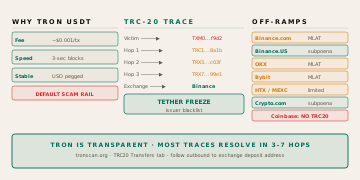
If your department gets a crypto theft case, USDT on Tron is the most likely asset and chain you will encounter. Pig butchering operations, romance investment scams, Telegram-based fraud, and fake yield platforms overwhelmingly route money through TRC-20 USDT. This guide explains why, how to trace it efficiently using free tools, how to invoke Tether's freeze authority, and which exchanges to target with legal process for off-ramp interception.
This is a technical reference for working small-agency detectives and prosecutors. For the consumer-facing version of how Tron-USDT scams operate, see our piece on Telegram USDT scams.
Tether's freeze process, exchange compliance behaviors, and supported deposit assets change frequently and are subject to issuer or platform policy decisions. The mechanics described below reflect publicly documented behavior as of mid-2026 but should be re-verified with the issuer or exchange before relying on them in legal process. Consult your prosecutor on legal authority for any freeze or seizure request.
Fees: ~$0.001 per transfer (vs $5–50 on Ethereum). Speed: 3-second block times. Liquidity: Tether issues more USDT on Tron than on Ethereum, making it the deepest stablecoin pool. Off-ramps: Every major non-US exchange supports TRC-20 USDT deposits. The combination makes Tron the default rail for laundering scam proceeds.
Contents
- Why Tron USDT Dominates Scam Laundering
- Real Case Studies: The $200M+ Tron Freeze Track Record
- The Southeast Asia Pipeline: Compounds and the Tron Highway
- Tracing TRC-20 USDT With Tronscan
- Common Tron Laundering Patterns
- Tether Issuer Freeze Process
- T3 Financial Crime Unit: The Public-Private Partnership
- Major Off-Ramps and Legal Process Targets
- Cross-Chain Bridges From Tron
- FAQ
Why Tron USDT Dominates Scam Laundering
Tron is not the largest blockchain by market cap, but it is the largest by USDT supply and dominant by stablecoin transaction volume. Multiple academic and industry analyses (Chainalysis, TRM, Elliptic) have documented that the majority of crypto fraud proceeds in 2024–2026 transit Tron USDT at some stage.
From a criminal operator's perspective, Tron offers:
- Negligible per-transaction cost — laundering through 5–10 wallets costs cents, not dollars
- Speed — funds clear and become available for further movement in seconds
- USD denomination — the unit of account stays stable while the funds move
- Wide off-ramp acceptance — every major Asian and Eastern European exchange supports TRC-20 deposits, including those with limited KYC
- Limited mixer ecosystem — fewer mixers than Ethereum, but operators rely instead on chains of disposable wallets and exchange accounts
From an LE perspective, Tron's transparency is an asset. Every transfer is publicly visible and labeled. The lack of robust mixer infrastructure means most Tron traces resolve to a centralized exchange within 3–7 hops.
Real Case Studies: The $200M+ Tron Freeze Track Record
Tether has frozen well over a billion dollars of USDT across all chains since 2022, with the bulk of those freezes concentrated on the Tron network because that is where the criminal activity lives. The cases below are public, documented, and demonstrate exactly how Tether's freeze authority is exercised in coordination with US law enforcement. For a deeper dive on the broader Tether freeze track record across all chains and the on-chain anatomy of the $212M Iran freeze, see our companion piece on stolen USDT recovery.
Industry analytics consistently confirm what working investigators already see in the field — Tron is the dominant chain for crypto-scam laundering and the trend is not slowing:
Tron continues to dominate the chain rankings for illicit USDT volume in 2026. The metrics show no slowdown — pig butchering, sanctions evasion, and scam compound laundering are all heavily concentrated on TRC-20.
— PANews (@PANews) View tweet
The $225M Pig Butchering Freeze (2023–2024)
In November 2023, Tether announced it had frozen $225 million in USDT on Tron in coordination with the U.S. Department of Justice and OKX, tied to a pig butchering syndicate operating out of Southeast Asia. This remains the single largest USDT freeze in stablecoin history. Reporting at the time identified the syndicate as having moved funds through hundreds of disposable wallets before consolidating into the addresses Tether ultimately froze. The case set the operational template for how Tether, OKX-side compliance, and DOJ now coordinate on large pig-butchering proceeds. Tether's official announcement documents the action.
The Israel/IDF-Designated Terror Financing Freezes (2023–2024)
Following the October 7, 2023 attacks, Israeli Defense Forces and the National Bureau for Counter Terror Financing identified a network of Tron addresses associated with Hamas and Palestinian Islamic Jihad fundraising. Tether froze 32 separate Tron addresses totaling tens of millions of USDT in coordinated action across late 2023 and 2024. The case demonstrated that Tether will freeze on credible state-actor terrorism showings without requiring full criminal process, dramatically shortening the timeline from intelligence to freeze.
The DOJ + Secret Service "Operation Spincaster" Tron Freeze (2024)
A multi-agency operation focused on pig butchering and approval-phishing scams resulted in additional Tron USDT freezes through 2024 totaling tens of millions of dollars. Operation Spincaster was specifically built around the Tron USDT laundering pattern and remains the named federal initiative when LE asks "who handles Tron-USDT freezes at the federal level."
On-chain investigator analysis: another large Tron-USDT scam-related freeze. The pattern repeats — victim wallets → disposable wallet chain → consolidation address → freeze action.
— Lookonchain (@lookonchain) View tweet
What These Cases Mean for Your Investigation
The pattern across all major Tron USDT freezes is the same:
- LE identifies the predicate criminal activity (pig butchering, terrorism financing, sanctions evasion).
- Forensic tracing identifies the current location of the funds on Tron.
- The freeze request goes to Tether through their compliance portal with case documentation.
- Tether reviews and, on a credible showing, blacklists the address within hours to days.
- Separate court process directs Tether to issue replacement tokens to a government-controlled address for victim recovery.
The lesson for working detectives: freezes happen. Tron is not a black hole. The bottleneck is rarely Tether's willingness to act — it is the speed of the forensic trace, because funds typically move within hours of arriving at any single Tron address. Submit the freeze request the moment your trace identifies the current holding address, even if your court process is still being drafted.
LE Case Active? Time-Sensitive Tracing Available.
Wallet Witness specializes in Tron USDT tracing tied to time-sensitive freeze submissions. We work with detectives and federal agents on active investigations and can produce trace reports within 24–48 hours for freeze-window cases.
Contact a Forensic InvestigatorTracing TRC-20 USDT With Tronscan
The free public block explorer for Tron is tronscan.org. Open it in a browser and paste any Tron address (begins with T followed by 33 alphanumeric characters, e.g., TXM0...f9d2).
- Paste the address in the search bar. The address detail page loads with multiple tabs.
- Click the "TRC20 Transfers" tab (not "TRX Transfers" — that shows the native TRX token, not USDT).
- Sort by date and identify the deposit transaction matching your case (TXID, amount, timestamp).
- Click outbound transactions from the address to see where funds went next.
- Repeat for each subsequent address until you reach a destination tagged or recognized as an exchange-controlled deposit address.
Identifying exchange addresses on Tron is generally easier than on Ethereum because exchange deposit addresses on Tron tend to receive thousands of small deposits daily and quickly forward consolidated balances to known hot wallets. Tronscan labels many of these. If a destination address has hundreds of incoming TRC-20 transfers per day from many distinct senders, it is almost certainly an exchange-controlled address — even if not explicitly labeled.
Common Tron Laundering Patterns
Tron USDT laundering follows recognizable patterns. Recognizing the pattern shortens the trace and informs the legal process target.
| Pattern | Indicator | Typical Off-Ramp |
|---|---|---|
| Direct exchange deposit | Stolen funds → 1 hop → exchange deposit address. Common for low-sophistication scams. | Binance, OKX, Bybit, HTX, MEXC |
| Disposable wallet chain | Funds pass through 3–8 freshly created wallets, each used once, before exchange deposit. | Same major exchanges; pattern is laundering, not avoidance |
| Multi-victim consolidation | One destination address receives funds from many victim wallets within a short window. | Indicates organized scam; pattern is highly traceable |
| Bridge to Ethereum | USDT is bridged from Tron to Ethereum or another chain via JustLink, Multichain, or similar bridges. | Trace continues on the destination chain; coordinate with Ethereum-side analysis |
| OTC desk routing | Funds routed to known peer-to-peer or OTC desk deposit addresses, especially in Southeast Asia. | Off-ramp to fiat in jurisdictions with limited cooperation |
The Southeast Asia Pipeline: Compounds and the Tron Highway
The largest single source of Tron USDT laundering is not retail scams in the U.S. or Europe. It is the industrial-scale pig butchering and romance-investment fraud operations run out of compounds in Cambodia, Myanmar, Laos, and the Philippines. These are not loosely organized scammers. They are factory-scale operations, often physically located in fortified compounds, staffed by trafficked workers forced to run scripts targeting victims worldwide. The on-chain signature of these operations is overwhelmingly TRC-20 USDT.
The on-chain data is unambiguous — Tron has become the default infrastructure layer for crypto scam laundering. The volume metrics, the wallet patterns, and the compound-scale operations all converge on the same chain.
— Alex Svanevik 🐧 (@ASvanevik) View tweet
Why Compounds Standardize on Tron-USDT
From the operator's perspective, Tron-USDT solves four problems that no other rail solves as well:
- Per-victim economics: at $0.001 per transfer, an operation that processes thousands of victim deposits per week pays trivial network fees. Ethereum gas would consume meaningful margin.
- Currency stability during the laundering window: a compound that holds funds for hours or days while moving them through wallet chains needs the asset value to not move 10% on them. USDT is dollar-pegged.
- Asian off-ramp depth: exchanges in the operator's region (HTX, OKX, Bybit, MEXC, Binance) all offer deep TRC-20 markets and varying degrees of KYC laxity for the off-ramp step.
- Operational simplicity: the compound's tech staff trains workers on a single asset and a single chain. Bitcoin, Ethereum, and altcoins add training cost and operator error risk.
The Chen Zhi / Prince Group Case
Chen Zhi was extradited to the U.S. in January 2026 in connection with the operation of compound facilities in Cambodia under the Prince Group umbrella. The on-chain analysis underlying the case identified Tron-USDT flows in the hundreds of millions of dollars through addresses associated with the operation. The case has become the reference point for how compound-scale operations get prosecuted and is one of the largest pig butchering enforcement actions to date. For broader context on the SE Asia compound landscape, see our piece on pig butchering scam recovery. For the front-end victim playbook these compounds run, see our analysis of the romance scammer playbook and crypto romance scams — both rely on the same Tron-USDT laundering infrastructure described in this article.
The April 2026 DOJ Multi-Agency Takedown
On April 29, 2026, the DOJ announced a coordinated takedown involving 276 arrests and 9 compound facilities, with cooperation from FBI, Dubai authorities, and Chinese law enforcement. The forensic basis for the action was on-chain analysis of Tron-USDT laundering patterns from compound-controlled wallets to identified off-ramp exchanges. The takedown demonstrates that international LE coordination on compound-scale Tron-USDT cases is now operationally functional, even when historically the cooperation gap was a primary impediment.
What This Means for Your Local Case
If you are a detective working a single victim's pig butchering loss, your $50,000 case is one data point in an operation that may be moving tens of millions per week. The forensic trace from your single victim often connects to wallet clusters that touch dozens or hundreds of other victims and ultimately resolve to the same compound operations DOJ is already tracking. Two implications:
- Aggregate the trace. The destination wallets in your case may already be on a federal target list. Your trace report becomes additional evidence in a larger case rather than a standalone investigation. For realistic guidance on what comes after the trace, see our piece on whether police actually recover stolen crypto.
- Submit federal referrals aggressively. FBI's Operation Level Up (the federal pig-butchering victim notification program) is actively absorbing case data from local LE. A trace report submitted with an IC3 complaint can route into the federal aggregation if the destination addresses overlap with active targets.
Tether Issuer Freeze Process
USDT is a centralized stablecoin issued by Tether Limited. The smart contract design gives the issuer the ability to blacklist addresses — when an address is blacklisted, the tokens at that address can no longer be transferred. This is a recovery lever that does not exist for non-stablecoin assets, but the process is governed by Tether's policies (not statutory entitlement) and outcomes are at issuer discretion.
Tether has, in publicly reported instances, honored freeze requests submitted by law enforcement on a credible criminal showing. The process:
- Identify the target wallet from your trace. Funds must currently be at the target address — if they have already been moved, the freeze is ineffective.
- Submit a request through Tether's law enforcement portal (lawenforcement.tether.to) with: agency identification, case description, target address, transaction hashes establishing the funds' origin in criminal activity, and a request to freeze.
- Tether reviews and decides. Decisions are at Tether's discretion but are typically granted on a credible LE showing that the address holds proceeds of a US-related crime. Response times vary from hours to days.
- If approved, Tether blacklists the address. The tokens at that address become non-transferable on-chain. They are not transferred to LE — they are frozen in place at the original address.
- For recovery, separate court process is required to direct Tether to issue replacement tokens to a government-controlled address (or to compensate victims). Tether's standard practice is to coordinate with US prosecutors on this.
The Tether freeze window is narrow. Funds typically move from a destination wallet within hours. Submit the freeze request the moment your trace establishes the current location — even before you have a court order. Tether processes voluntary LE freezes on direct compliance contact; the court order comes later for the recovery step.
T3 Financial Crime Unit: The Public-Private Partnership
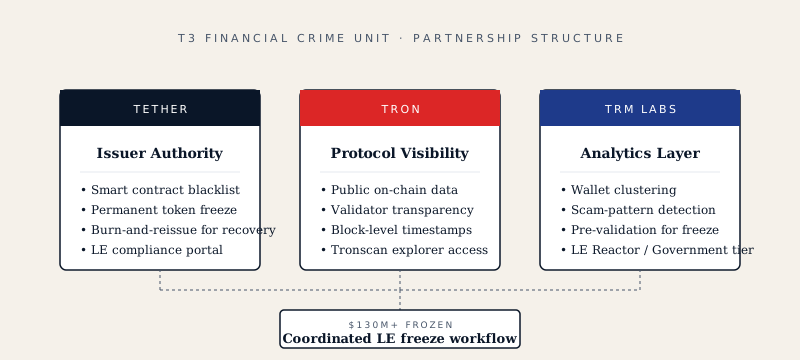
In 2024 Tether, Tron, and TRM Labs launched a formal public-private partnership called the T3 Financial Crime Unit, which has become the de facto operational nexus for Tron-USDT freeze coordination with global law enforcement. T3 is not a separate legal entity that LE can subpoena — it is a coordination function that pulls together Tether's freeze authority, Tron's protocol-level visibility, and TRM Labs' analytics tooling under a single workstream.
What T3 Actually Does
- Proactive monitoring — TRM and Tron-side analytics surface high-volume scam-pattern wallets before LE has formally requested a freeze.
- Freeze coordination — LE freeze requests routed through T3 channels often see faster Tether action because the case has already been pre-validated against TRM's intelligence.
- Asset return support — T3 has facilitated multiple cases where frozen USDT was returned to victims via court-supervised distribution.
- Public freeze totals — T3 has publicly reported freezing well over $130 million in stolen funds since launch, the majority of which is Tron-USDT.
How LE Engages T3 in Practice
For working detectives, the practical entry points are:
- Standard Tether freeze submission through
lawenforcement.tether.to— this routes to the T3 workflow even though the LE-facing portal is branded Tether. - TRM Labs LE engagement — agencies with TRM Reactor licenses or TRM Government access have direct case-coordination channels into the T3 workflow.
- Federal coordination — FBI, USSS, HSI, and IRS-CI have established coordination relationships with T3 for high-value cases, particularly those involving compound-scale pig butchering operations.
T3's existence is the reason Tron-USDT is no longer functionally a free zone for criminal laundering. Tether's freeze authority has always existed; what changed in 2024 is that the proactive monitoring and pre-validation now compresses the time from "stolen funds arrive at an address" to "address is frozen" from days to hours in coordinated cases. For detectives working time-sensitive cases, treating T3 as the relevant counterparty (rather than Tether alone) accelerates outcomes meaningfully. The same pre-validation infrastructure underlies the DOJ-coordinated work on DPRK threat-actor laundering — see our analyses of the DPRK Drift Protocol hack and DPRK Kelp DAO hack for examples of how this analytics layer surfaces nation-state actor flows.
Major Off-Ramps and Legal Process Targets
Tron USDT funds typically reach a centralized exchange within 1–7 hops. Below are the dominant off-ramps and the legal process realities for each.
| Exchange | Jurisdiction | Legal Process Path |
|---|---|---|
| Binance.com | Foreign (HQ unclear) | Voluntary cooperation common; MLAT for compelled production |
| Binance.US | US | Standard 2703(f), subpoena, Rule 41 warrant |
| OKX | Foreign (HQ Seychelles) | Voluntary cooperation possible; MLAT for compelled |
| Bybit | Foreign (HQ Dubai) | Voluntary cooperation possible; MLAT for compelled |
| HTX (formerly Huobi) | Foreign (HQ Seychelles) | Limited voluntary cooperation; MLAT in practice |
| MEXC | Foreign (HQ Seychelles) | Limited cooperation; MLAT |
| KuCoin | Foreign (Seychelles) | Has settled with US enforcement; cooperation improving |
| Crypto.com | US-licensed entity for US users | Standard 2703(f), subpoena, warrant |
| Kraken | US | Limited TRC-20 deposit support; standard process where applicable |
For the deeper legal-process framework on subpoenas to crypto exchanges, see our subpoena guide covering FRCP Rule 45, MLAT, and exchange-specific production specifics.
Cross-Chain Bridges From Tron
Sophisticated operations bridge Tron USDT to other chains to break the trace. The common bridges:
- JustLink — native Tron oracle/bridge; supports Tron-to-Ethereum movement
- Multichain (now defunct) — formerly the dominant Tron-Ethereum bridge; collapsed in 2023
- Wormhole — cross-chain bridge supporting multiple chains
- Centralized exchanges as de facto bridges — depositing TRC-20 USDT to Binance and withdrawing as ERC-20 USDT or USDT on BSC accomplishes the chain change without a smart contract bridge
Bridge transactions are visible on-chain on both sides. The departure transaction on Tron is visible in Tronscan; the arrival transaction on Ethereum (or BSC, Solana, etc.) is visible on the destination chain explorer. Trace continuity across the bridge requires correlating timestamps and amounts.
FAQ
Need Tron USDT Trace Support?
Wallet Witness specializes in Tron USDT tracing and Tether freeze coordination. We work with LE on active cases, produce trace reports tied to specific exchange off-ramps, and support Tether freeze submissions. LE inquiries are prioritized.
Contact a Forensic Investigator