In This Article
Drift Protocol, the leading perpetuals exchange on Solana, was compromised in an incident that is producing an on-chain forensic signature consistent with the established attack pattern of Lazarus Group, the elite cyber unit operating under North Korea's Reconnaissance General Bureau (RGB). The exploit follows the same operational template the DPRK has used to drain over $5 billion across Ronin, Atomic Wallet, Stake.com, CoinEx, HTX, WazirX, Radiant Capital, and the headline-grabbing $1.5B Bybit cold-wallet drain in February 2025.
This article is the focused forensic breakdown of the Drift incident. For the parallel breakdown of the Kelp DAO restaking exploit, see DPRK Hacks Kelp DAO.
Attribution of crypto theft to specific nation-state actors is never made on a single signal. It is a multi-source assessment combining on-chain laundering pattern, malware family fingerprints, infrastructure overlap with prior campaigns, recipient-cluster reuse, and the timing and behavioral cadence of the attacker. The Drift incident registers against multiple of these axes simultaneously.
The 60-Second Summary
- Initial vector was operational, not contractual. Preliminary indicators point to compromise of a privileged key or signing credential, not a smart-contract bug in Drift's program logic.
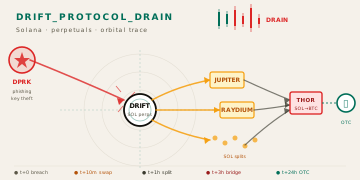
- The funds moved fast. Within minutes, stolen value was swapped through Jupiter and Raydium into SOL and stablecoins.
- Cross-chain exit was the tell. Solana-native attackers usually dump on Solana. The Drift attacker bridged out toward Bitcoin, which is the Lazarus signature.
- THORChain reappeared. The same trustless bridge infrastructure the FBI named in its 2024 advisory on DPRK theft laundering.
- Recovery is partial but possible. Bridge operators, stablecoin issuers, and centralized exchanges can still freeze tagged deposits during the first 12 to 72 hours.
Why Drift Protocol Fits the Lazarus Target Profile
Drift is the kind of protocol Lazarus operators select with care. It sits at the intersection of three risk factors that maximize payout per successful spear-phishing campaign:
- Concentrated TVL on a fast chain. Solana settlement is sub-second and irreversible. Once a privileged transaction lands, there is no rollback, no freeze button, and no time for a multi-signature emergency response to interrupt it.
- Mixed-execution architecture. Drift relies on an off-chain matching engine, on-chain settlement, and a layered admin permission system. Mixed-execution stacks have a wider attack surface than pure on-chain protocols because the human and infrastructure layer becomes part of the trust model.
- Identifiable engineering team. Lazarus operators build dossiers on individual engineers and operations staff via LinkedIn and GitHub. Public-facing protocol teams with named contributors are precisely the spear-phishing target profile.
This is the same target logic the DPRK applied to Radiant Capital in 2024 and to multiple bridge protocols before that. The pattern is durable because the underlying economics are durable.
What Appears to Have Happened
Public on-chain data and preliminary statements indicate the attacker did not exploit a smart contract vulnerability. Instead, the attack vector was operational compromise — access to a privileged key or backend signing credential that allowed unauthorized actions to be executed against the protocol. This pattern, where the contract code is sound but the human and infrastructure layer is compromised, is the dominant Lazarus signature in 2024 to 2026.
Once the attacker had the credential in hand, the on-chain execution was straightforward. With privileged access, the highest-payout transaction permitted by that role is submitted, and Solana finality does the rest.
Initial Access via Spear-Phishing
The dominant Lazarus initial-access vector since 2023 is the fake job offer. Operators pose as recruiters from real or fabricated companies on LinkedIn, Telegram, or Discord. The conversation moves to a "coding interview" or "take-home assignment" that delivers malware — commonly InvisibleFerret, BeaverTail, or a Python-based loader — the moment the target runs the supplied code.
The malware exfiltrates browser-stored secrets, AWS and 1Password credentials, signed commits, and any locally accessible private keys or seed material.
Privilege Discovery
Once inside the target environment, the attacker maps every privileged credential they can reach: AWS keys, GitHub access, internal Slack, deployer wallet seeds, signer keys, oracle admin credentials. Lazarus is patient at this stage. The Bybit incident showed them sitting on access for weeks before executing.
The Drain Transaction
With a privileged key in hand, the attacker submits the highest-payout transaction the role allows. On Solana, the parallel transaction execution model and sub-second finality mean that even an alerted protocol team has effectively no window to intercede. The drain lands in a single block.
The Solana-Specific Laundering Pattern
What makes the Drift incident technically interesting is the post-drain behavior on Solana — an ecosystem with very different laundering geography than Ethereum.
| Stage | Action on Solana | Forensic Visibility |
|---|---|---|
| 1. Drain | Privileged transaction empties protocol funds | Deterministic — on-chain, fully visible |
| 2. Atomize | Funds split across multiple fresh Solana wallets | Deterministic — clusterable |
| 3. Convert | Swap to SOL and stablecoins via Jupiter, Raydium routes | Deterministic |
| 4. Bridge | Cross-chain swap to ETH or BTC via THORChain or Wormhole | Deterministic but cross-chain — requires multi-chain analytics |
| 5. Mix | Tornado Cash on the ETH side, BTC CoinJoin on the BTC side | Probabilistic — partial unwinding only |
| 6. OTC | Off-chain conversion through DPRK-affiliated brokers | Off-chain — law enforcement and OSINT only |
The most important window for forensic intervention is Stages 1 through 4. Funds remain traceable, and bridge operators, stablecoin issuers, and centralized exchanges can still freeze tagged addresses on receipt. The window is typically 12 to 72 hours. After that, mixing dominates and recovery probability flattens sharply.
Why Attribution Points to North Korea
On-chain signals
- Bridge selection. THORChain plus eXch is heavily DPRK-loaded relative to the broader cross-chain user base. The pattern recurred in Atomic Wallet, HTX, Stake.com, CoinEx, and the Bybit outflow tail.
- BTC end-state. Most opportunistic Solana attackers stay in SOL or stablecoins. Lazarus consistently terminates at Bitcoin because BTC remains the most liquid asset for OTC settlement in the jurisdictions where the regime's brokers operate.
- Wallet rotation discipline. The attacker rotated to fresh, never-used receiving addresses at each major hop. This is operationally expensive and consistent with a disciplined actor running a controlled laundering process, not an opportunist.
- Pacing. Funds were not dumped in one block. They were drained, swapped, and bridged in measured intervals, behavior that maximizes price-impact efficiency and complicates real-time tracking.
Off-chain signals
- Initial access narrative. If the breach started with a fake job offer, a "coding interview", or a malicious npm package, the prior probability of DPRK involvement is unusually high.
- Malware family identification from incident response — InvisibleFerret, BeaverTail, OdysseyStealer, or related Python loader strains map directly to known DPRK tradecraft.
- FBI and CISA advisories. The US government's formal attribution carries more weight than any single private analyst's view.
OFAC Compliance Exposure for Drift Users
Forensic attribution to North Korea is not just a journalistic detail. It has direct legal consequences:
- OFAC SDN listing means any US person or entity that knowingly transacts with funds traceable to a sanctioned address may face civil penalties, regardless of intent.
- Tornado Cash and several DPRK-linked addresses are explicitly designated. Receiving funds that have passed through these services creates compliance exposure.
- Stablecoin issuers (Tether, Circle) are required to freeze sanctioned addresses on their respective chains, and have repeatedly done so for DPRK-linked wallets.
- Centralized exchanges with US presence must screen incoming deposits against OFAC lists. Funds that touch flagged wallets may be frozen and reported to FinCEN regardless of the depositor's identity.
If you withdrew from Drift in the window surrounding the incident and your funds touched intermediary infrastructure used by the attacker, your deposits to a centralized exchange could be flagged. Document your withdrawal trail and consult with a forensic firm before transacting further.
What to Do If You Held Positions on Drift
- Document everything immediately. Record your wallet addresses, your deposit transaction hashes, your last-known balance, and the timestamps. Forensic recoverability depends on evidence quality.
- File with the FBI's IC3 at ic3.gov even if you believe Drift will handle remediation. Individual victim filings raise the case priority and create the legal basis for later asset return.
- Engage an independent forensic investigator if you held a material position. The protocol team's investigation will focus on protocol-level facts; a victim-side investigation produces evidence that supports your specific claim against any future recovery pool.
- Do not respond to "recovery agents" contacting you over Telegram, X, or Discord offering to help retrieve stolen funds. Lazarus and unrelated scam operators both run secondary scams targeting victims of headline incidents.
- Preserve any official communications from the Drift team. These will be relevant evidence in any future class proceeding or recovery distribution.
Frequently Asked Questions
Held Funds in Drift Protocol?
Wallet Witness is actively tracking the Drift incident on-chain. If you held a material position, a victim-side forensic record materially strengthens any future recovery claim. Initial case assessments are free.
Start a Free Case Review