In This Article
- The definition: what crypto forensics actually is
- How crypto forensics works
- Crypto forensics vs. traditional financial forensics
- What a crypto forensic investigator does
- Crypto forensics across major blockchains
- Who uses crypto forensic services
- What crypto forensics can and cannot do
- Frequently asked questions
Crypto forensics is the discipline of collecting, analyzing, and presenting cryptocurrency transaction data as evidence. Unlike traditional finance, where transactions are hidden behind bank secrecy, every on-chain transfer is permanently recorded on a public ledger. Crypto forensics turns that raw, pseudonymous data into an intelligible, documented narrative — one that can support legal proceedings, law enforcement referrals, and asset recovery efforts.
The field emerged in parallel with Bitcoin's adoption. As early as 2013, researchers were demonstrating that blockchain transactions — despite being pseudonymous — were far more traceable than cash. Today, crypto forensics is a professional discipline practiced by dedicated firms, internal compliance teams at major exchanges, and government agencies including the FBI, IRS-CI, and Europol.
This guide explains what crypto forensics is, how it works technically, who uses it, and what it can realistically accomplish for victims of theft or fraud.
The Definition: What Crypto Forensics Actually Is
Crypto forensics (also called blockchain forensics or cryptocurrency forensics) is the application of investigative science to blockchain transaction data. The core activity is tracing: following the movement of funds from a known starting point — a theft transaction, a fraudulent deposit, a disputed wallet — through a chain of addresses and potentially through obfuscation layers, until the funds reach an endpoint that can be linked to a real-world entity.
The word "forensics" carries legal weight deliberately. A crypto forensic investigation isn't just analysis — it produces documented, reproducible findings structured for use as evidence. Every step in the tracing process is recorded, every conclusion is grounded in on-chain data, and the final deliverable is built to withstand adversarial scrutiny in court.
Crypto forensics is not the same as "crypto recovery." A forensic investigation produces evidence. Recovery — the actual return of funds — requires legal process (subpoenas, civil judgments, law enforcement action) that the forensic evidence enables. Anyone promising to directly "recover" your crypto without explaining the legal mechanism should raise red flags. See our guide to legitimate recovery services vs. scams.
How Crypto Forensics Works
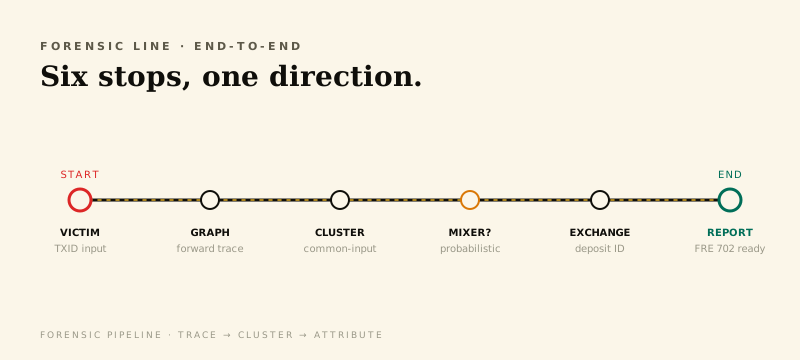
The blockchain is a permanent, public record of every transaction ever made on that network. Crypto forensics leverages this transparency using several core techniques:
Transaction Graph Analysis
Every input and output of a transaction is mapped to reveal the flow of funds over time. Investigators build a graph showing how value moved from the victim's wallet through intermediate addresses. Even when funds are split across dozens of wallets, the graph preserves the trail.
Wallet Clustering
Blockchain heuristics — particularly the common-input-ownership heuristic — allow investigators to group multiple addresses as likely belonging to the same controlling entity. When an actor consolidates funds from theft across several wallets before sending to an exchange, clustering reveals the consolidation pattern.
Entity Attribution
Forensic databases maintained by professional firms tag known wallets: exchange hot wallets, mixer service addresses, darknet market wallets, known scam infrastructure. When traced funds touch a tagged address, investigators can identify where the money went — including KYC-compliant exchanges where legal process can obtain identity information.
Obfuscation Layer Analysis
When stolen funds pass through mixers, chain-hop services, or privacy protocols, forensic techniques assess the degree of obfuscation and attempt to re-link funds on the output side. Mixing does not guarantee anonymity — it raises cost and complexity but rarely breaks the trail entirely.
Evidence Documentation
Unlike informal analysis, a crypto forensic investigation produces chain-of-custody documentation: transaction hashes, timestamps, block heights, wallet addresses, and methodology notes that allow an independent investigator — or a court — to verify every finding independently.
Crypto Forensics vs. Traditional Financial Forensics
Understanding the difference between crypto forensics and traditional financial forensics clarifies both what makes blockchain investigations powerful and where their limits lie.
🏦 Traditional Financial Forensics
- Transaction records held by banks — private by default
- Requires subpoenas or court orders to access records
- Legal jurisdiction determines what records are reachable
- Identity tied to account from the start
- Transactions can be reversed or disputed by the institution
- Currency cannot be moved without institutional approval
🔗 Crypto Forensics
- All transactions public on the blockchain — no subpoena needed to read them
- Tracing can begin immediately from publicly available data
- Jurisdiction matters only when reaching exchange KYC data
- Wallet addresses are pseudonymous — attribution requires additional work
- Transactions are irreversible once confirmed
- Assets can move globally in seconds with no institutional gatekeeping
The practical implication: a crypto forensic investigation can begin the moment a victim reports a theft. The investigator can trace where funds went without waiting for any legal process. The legal process becomes necessary only at the step where wallet addresses need to be tied to real identities held by exchanges.
What a Crypto Forensic Investigator Does
A crypto forensic investigator combines technical blockchain analysis with legal documentation skills. The day-to-day work includes:
- Case intake: Collecting transaction hashes, wallet addresses, dates, amounts, and any communications from the victim to establish a starting point
- Blockchain analysis: Using professional-grade tools to map transaction flows, identify wallet clusters, and follow funds across multiple hops
- Exchange identification: Determining when stolen funds deposited at a KYC-compliant exchange — the point where a legal subpoena can yield an identity
- Cross-chain tracing: Following assets that move through bridges or are swapped across chains (e.g., ETH converted to USDT then bridged to Tron)
- Report writing: Translating technical findings into plain-language reports structured for use by attorneys, courts, and law enforcement
- Expert support: In litigation cases, providing declarations, depositions, or expert witness testimony explaining blockchain mechanics and investigation findings
For victims of scams, investigators also contextualize findings within known fraud typologies — identifying whether a case matches pig butchering infrastructure, a rug pull, a romance scam, or a wallet drainer — which aids both investigation and prosecution.
Crypto Forensics Across Major Blockchains
Not all blockchains present the same investigative challenge. UTXO-based chains like Bitcoin behave differently from account-based chains like Ethereum, and privacy coins occupy a category of their own.
Bitcoin (BTC)
Bitcoin is the most-analyzed blockchain. Its UTXO model creates rich transaction graphs, and decades of forensic research have produced robust clustering heuristics. The majority of professional crypto forensics tools have their deepest capabilities on Bitcoin. Despite being the first cryptocurrency, Bitcoin is not particularly anonymous — it is pseudonymous, and the public ledger makes tracing generally achievable.
Ethereum and EVM Chains
Ethereum's account model and smart contract ecosystem add complexity. Token swaps, DeFi interactions, and NFT transfers all leave on-chain traces. EVM-compatible chains (Polygon, BNB Chain, Arbitrum, etc.) share similar investigation approaches. The sheer volume of transactions on Ethereum requires more sophisticated tooling to navigate efficiently.
Tron (TRX / USDT-TRC20)
Tron has become a preferred rail for fraud — particularly pig butchering and romance scams — because USDT on Tron has near-zero fees and fast finality. Crypto forensics on Tron follows the same principles but must account for the network's high volume and the prevalence of mixer-like aggregation services.
Solana
Solana's speed and low fees have made it popular for both legitimate DeFi activity and wallet drainer attacks. Forensic investigation on Solana is technically feasible but more tooling-intensive due to the chain's unique program model and compressed transaction formats.
Privacy Coins (Monero, Zcash)
Monero's ring signatures and stealth addresses make on-chain tracing significantly harder than transparent chains. Zcash shielded transactions present similar challenges. However, privacy coins must enter and exit exchanges — and those on/off-ramp events create traceable touchpoints even when the on-chain portion is obscured.
Who Uses Crypto Forensic Services
👩⚖️ Scam Victims
Individuals who lost funds to romance scams, pig butchering, fake exchanges, or wallet drainers need a documented investigation to support law enforcement reports and legal claims.
⚖️ Attorneys & Law Firms
Civil litigators representing clients in fraud, divorce, or business disputes involving crypto need forensic reports and expert witnesses who can explain blockchain evidence in court.
🏭 Businesses & Exchanges
Exchanges, DeFi protocols, and crypto businesses use forensic analysis to investigate internal fraud, hacks, or compliance incidents — and to satisfy regulatory requirements.
👮♂️ Law Enforcement
FBI, IRS-CI, Europol, and other agencies either conduct their own crypto forensics or partner with private firms to support criminal investigations and prosecutions.
⚖️ Bankruptcy Trustees
In crypto exchange collapses or business insolvencies, trustees use forensic analysis to locate and document assets for recovery on behalf of creditors.
🔒 Insurance Companies
Insurers covering crypto custody or exchange operators use forensic investigations to adjudicate claims and confirm the scope of losses.
What Crypto Forensics Can and Cannot Do
Setting realistic expectations is essential. Here is an honest accounting of what crypto forensics can reliably accomplish — and where the limits are.
What Crypto Forensics Can Do
- Produce a documented, reproducible on-chain trace of where stolen funds moved
- Identify exchange deposits where KYC data exists and legal process can obtain an identity
- Attribute wallet clusters to known criminal infrastructure, mixers, or fraud platforms
- Generate court-ready evidence packages for civil and criminal proceedings
- Support expert witness testimony explaining blockchain mechanics
- Provide law enforcement referral packages that increase the probability of investigation
What Crypto Forensics Cannot Do
- Directly recover or reverse a blockchain transaction — crypto transfers are irreversible
- Guarantee asset recovery — recovery requires legal action that the evidence supports
- Break true end-to-end privacy on networks like Monero with certainty
- Compel exchanges in foreign jurisdictions to cooperate without international legal process
- Identify a person from a wallet address alone — identity attribution requires exchange KYC or other off-chain evidence
If someone contacts you claiming they can "hack back" your crypto or use "blockchain reversal technology" to recover funds, you are likely facing a recovery scam — a second fraud targeting people who were already victimized. Crypto forensics does not work that way. Recovery requires documented evidence and legal process, not technical exploits.
Frequently Asked Questions
Need a Crypto Forensic Investigation?
Wallet Witness provides independent blockchain forensic analysis and crypto scam investigation services. Initial case assessments are free — describe what happened and a senior investigator will respond within 24 hours.
Start a Free Case Review