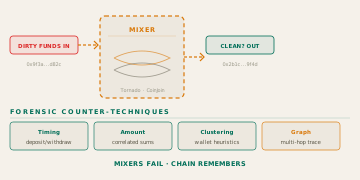
Cryptocurrency mixers and tumblers are designed to break the transaction trail — to make it impossible to follow stolen funds from source to destination. In practice, they reduce traceability. They rarely eliminate it.
This article explains how mixers and tumblers work, why criminals use them, and the forensic techniques investigators use to defeat them — from timing analysis and amount correlation to wallet clustering and graph heuristics. It also covers what evidence survives a mixer and how that evidence holds up in court.
This guide is written for attorneys, law enforcement, and investigators handling cases where stolen crypto passed through privacy tools. It explains the methodology behind mixer tracing so you can evaluate investigator findings and present them effectively.
Contents
What Mixers and Tumblers Do
A mixer (also called a tumbler) is a service that accepts cryptocurrency from multiple users and returns an equivalent amount — minus a fee — to new addresses, with the goal of breaking the direct on-chain link between source and destination.
The basic concept: if 100 people each put 1 BTC into a pool and each receive 1 BTC back from a different address, the transaction graph becomes a many-to-many relationship rather than a direct line. To an outside observer, it becomes harder to determine which output belongs to which input.
The operative word is "harder." Not impossible.
Types of Mixing Services
| Type | How It Works | Examples | Forensic Vulnerability |
|---|---|---|---|
| Centralized Mixer | Third-party service holds funds and redistributes — requires trusting operator not to log transactions | Bitcoin Fog (shut down), Helix (shut down) | Operator logs exist; seizure of server infrastructure recovers full transaction records |
| CoinJoin | Multiple users coordinate a single transaction where inputs and outputs are mixed — no central operator | Wasabi Wallet, JoinMarket | Amount correlation, timing, and UTXO clustering reveal associations with high confidence |
| Tornado Cash | Ethereum smart contract using zero-knowledge proofs — deposits and withdrawals are cryptographically decoupled | Tornado Cash (sanctioned) | Timing, deposit/withdrawal amount matching, metadata, and on-chain behavioral patterns |
| Cross-Chain Bridge + Swap | Funds sent across chains (ETH → BTC → Monero) and back to reduce traceability | Various DEX bridges | Bridge records are public; chain-crossing patterns are identifiable; Monero has known forensic weaknesses |
Why Mixers Often Fail to Protect Identity
Most criminals using mixers make operational mistakes that significantly reduce or eliminate the privacy benefit. The most common failures:
- Using round numbers: Depositing exactly 10 ETH and withdrawing approximately 10 ETH (minus fee) is a strong correlation signal — especially if few other users made the same deposit at that time
- Timing mistakes: Withdrawing shortly after depositing, or withdrawing at consistent intervals, allows timing correlation across many transactions
- Reusing destination addresses: Sending mixed funds back to a wallet previously associated with the same actor eliminates the anonymity benefit entirely
- Small anonymity sets: In periods of low mixer usage, each transaction has fewer potential sources and destinations, making correlation easier
- Post-mixer behavior: Even if the mixer itself is impenetrable, what happens next reveals identity. Depositing mixed funds to a KYC exchange, purchasing goods with delivery addresses, or interacting with previously known wallets all break anonymity
Forensic Techniques for Defeating Mixers
Timing Analysis
By correlating the timestamps of deposits and withdrawals within a mixing service, investigators can narrow the candidate set of matching transactions. If a deposit occurred at 14:32 UTC and a withdrawal of equivalent value occurred at 14:47 UTC during a period of low mixer activity, the probability of a direct link is calculable and often very high.
Amount Correlation
Most mixers operate in fixed denominations or pass through amounts within a fee range. Matching the exact amount deposited with the amount withdrawn — accounting for the known fee structure — reduces the pool of candidate transactions dramatically. In CoinJoin specifically, input and output amounts in the same transaction are directly visible on-chain.
Wallet Clustering (Common Input Ownership Heuristic)
In Bitcoin, when multiple inputs are spent together in a single transaction, it is highly likely they are controlled by the same entity. This "common input ownership" heuristic allows analysts to cluster wallets into entities — and then trace where mixed funds flowed after leaving the mixer by following entity-level behavior rather than individual addresses.
Graph Analysis and Peeling Chains
After mixing, funds often move through a series of intermediate wallets (a "peeling chain") before reaching their final destination. Graph analysis tools map these multi-hop paths and identify where value concentration occurs — typically at an exchange deposit address — allowing investigators to work forward from the mixer exit to the endpoint.
Behavioral Heuristics and Pattern Matching
Known criminal operations often exhibit characteristic patterns — transaction timing cadences, preferred fee levels, characteristic amount rounding, and consistent network behavior. When post-mixer wallets exhibit patterns previously associated with a known actor or cluster, probabilistic attribution becomes possible even without direct transaction linkage.
Tornado Cash: The Landmark Case
Tornado Cash was the most widely used Ethereum mixing service before the U.S. Treasury's Office of Foreign Assets Control (OFAC) sanctioned it in August 2022 — the first time a smart contract protocol was sanctioned. Its developers were subsequently prosecuted for money laundering conspiracy.
The Tornado Cash prosecutions revealed something important for investigators: even zero-knowledge proof mixers leave exploitable metadata. Investigators identified users through:
- On-chain timing correlation between deposits and withdrawals
- Deposit amounts matching known theft events
- Post-withdrawal behavior linking to previously identified wallets
- Exchange deposits immediately following withdrawal
- IP addresses captured by Tornado Cash's front-end interface (not the smart contract itself)
The Tornado Cash cases set important precedent: using a mixer to launder proceeds of crime is money laundering, the mixer's decentralized nature does not provide immunity, and the on-chain record is sufficient to establish intent when combined with behavioral evidence.
What Evidence Survives
Even after mixing, the following evidence persists and is available for forensic analysis:
- The deposit transaction itself — linking the pre-mixer wallet to the mixer, timestamped and immutable
- The withdrawal transaction — linking the mixer to the post-mixer wallet, timestamped and immutable
- All pre-mixer transaction history — everything before the mix, including the original theft, bridging, and any intermediate wallets
- All post-mixer transaction history — everything after withdrawal, including exchange deposits where identity is recoverable
- Amount and timing metadata — sufficient in many cases to establish probabilistic linkage between deposit and withdrawal
Admissibility in Court
Mixer-traced forensic evidence has been admitted in federal criminal prosecutions and civil fraud cases. The key requirements for admissibility under Federal Rule of Evidence 702 (Daubert standard) are:
- The investigator must clearly distinguish between deterministic findings (e.g., "these wallets received funds from the mixer exit at this timestamp") and probabilistic conclusions (e.g., "the timing and amount correlation suggests with high probability that deposit X corresponds to withdrawal Y")
- The methodology must be documented and reproducible — another qualified analyst should be able to examine the same data and reach consistent conclusions
- The tools used must be recognized in the field — Chainalysis, TRM Labs, Elliptic, and similar platforms are routinely accepted
- The expert must be able to articulate the probabilistic basis for any attribution claim and acknowledge its limitations under cross-examination
Courts have not required certainty — they have required rigor. A well-documented forensic analysis that acknowledges probabilistic limitations and shows its methodology is far more likely to survive a Daubert challenge than an overconfident report that presents correlations as certainties.
Frequently Asked Questions

Zack Coffing — Blockchain Forensic Investigator
Wallet Witness provides independent blockchain forensic analysis, mixer tracing, and expert witness services for attorneys and law enforcement. About the investigator →