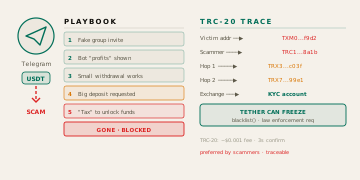
Telegram and USDT have become the preferred combination for cryptocurrency fraud. In case after case I investigate, the same pattern emerges: a victim was contacted via Telegram, directed to send USDT, and left with nothing when the contact vanished. This isn't coincidence — scammers have specific, operational reasons for choosing both.
This guide covers why this combination is so effective, the five most common Telegram USDT scam patterns, what to watch for in real time, and what you can actually do if you've already sent funds.
Contents
Why Telegram and USDT?
Scammers don't pick tools randomly. The Telegram + USDT combination solves several operational problems that other platforms and currencies don't.
| Tool | Why Scammers Choose It |
|---|---|
| Telegram | Anonymous accounts, no ID verification, encrypted messages, easy bot automation, large groups can be created instantly, accounts are hard to trace internationally |
| USDT (Tether) | Transactions are irreversible, widely accepted on all exchanges, no price volatility risk for the scammer, fast settlement, available on cheap networks like TRON (TRC-20) with low fees |
| TRON network specifically | TRC-20 USDT transfers cost fractions of a cent and confirm in seconds — ideal for high-volume scam operations processing many victims simultaneously |
USDT on TRON is particularly dominant. The majority of Telegram-based USDT scams route funds through TRC-20 addresses rather than ERC-20 (Ethereum) because the fees are negligible and confirmation is near-instant — reducing the window for a victim to reverse course.
The 5 Most Common Patterns
The Fake Investment / Trading Group
You're added to a Telegram group of "investors" watching a signal provider or "expert trader" post gains. The group is fabricated — bots and paid actors play other members. After building trust over days or weeks, you're invited to deposit USDT into a "platform" that shows fake profits. When you try to withdraw, you're told to pay a "tax," "fee," or "insurance deposit." That payment is the final theft.
The Romance / Relationship Setup
A stranger makes contact — often on a dating app, then moves to Telegram — and builds an emotional relationship over weeks. Eventually they introduce you to a trading "opportunity" they personally use. This is the pig butchering model applied through Telegram, with USDT as the payment method. See our full pig butchering guide for the detailed mechanics.
Fake Exchange / Wallet Support
You post in a crypto group or forum about a problem with your wallet or exchange. Within minutes, a "support agent" DMs you on Telegram. They walk you through "fixing" your account — which involves sending USDT to a wallet address they control to "verify" your identity or "unlock" your funds. No legitimate exchange provides support via Telegram DMs.
The USDT Flipping / Doubling Scam
Someone contacts you claiming to have a glitch, bot, or insider method that doubles or multiplies USDT. They may send you a small amount first to "prove" it works (funded from a secondary wallet they control). Once you send a larger amount, they disappear. The initial payment is designed to overcome skepticism — it costs them very little to manufacture that "proof."
The Job / Task Scam via Telegram
You receive a Telegram message about a remote job — reviewing products, completing tasks, liking videos. After completing initial tasks, you're told you need to "activate" your account or "unlock" a higher task level by depositing USDT. Deposits escalate with each level. Your "earnings" are shown on a fake dashboard and are never withdrawable. See our task scam guide for the full breakdown.
Inside the Investment Group Playbook
The fake investment group is the most prevalent pattern and worth examining in detail because the psychological architecture is sophisticated. The scam typically runs in five phases:
- Seeding the group: The operator creates a Telegram group with 200–500 fake member accounts. A "signal provider" or "portfolio manager" persona is established with a fabricated track record.
- Recruitment: Victims are added through random group adds, referrals from fake members, or by responding to posts on Reddit, Facebook, or other Telegram groups.
- Credibility building: For 1–2 weeks, the "expert" posts signals, fake profit screenshots, and market commentary. Fake members post confirming their gains. The victim is a passive observer building trust.
- The invitation: The victim is personally messaged (or the group posts) about a special opportunity — often a "private round," "arbitrage window," or "VIP signal." They're directed to a fake platform website.
- The trap: The platform shows real-time fake gains. Withdrawals require fees. Each fee unlocks another requirement. The victim is trapped between the sunk cost of what they've already sent and the fake profits tantalizingly visible on screen.
Red Flags in Real Time
These signals — while you're still in the conversation — indicate you are being scammed:
- You were added to a group you didn't join — random group adds are not how legitimate investment communities work
- The "platform" is a website you've never heard of — not Coinbase, Binance, or any regulated exchange
- Profits are visible but a fee is required to withdraw — this is the core mechanism of every fake platform scam
- You're asked to send USDT to a wallet address, not to a verified exchange account
- The "support" contact can only be reached on Telegram — legitimate exchanges have official support channels
- Any mention of "TRC-20 USDT" for the deposit — scammers prefer TRON because fees are negligible and transactions are harder for victims to reverse
- Urgency and time pressure — "this window closes in 2 hours," "limited spots" — manufactured scarcity is a manipulation technique
What to Do If You've Already Sent USDT
Act quickly. USDT transactions are irreversible by the sender, but Tether Ltd. retains the ability to freeze funds at the contract level — and exchanges can freeze accounts receiving stolen funds if notified before conversion.
- Record everything immediately: Screenshot the Telegram conversation, the scammer's username and user ID (tap their profile), the wallet address(es) you sent USDT to, and all transaction hashes from your wallet history.
- Find the receiving wallet on-chain: Use Tronscan (for TRC-20) or Etherscan (for ERC-20) to see where your USDT went after your transaction. Note any subsequent transactions — this tells you how quickly they moved it and where.
- File with IC3.gov: The FBI's Internet Crime Complaint Center is the primary federal reporting mechanism for crypto fraud. Include all wallet addresses and transaction hashes.
- Contact Tether: Tether Ltd. accepts freeze requests from law enforcement. A police report is typically required. This is time-sensitive — USDT is often converted or bridged within hours.
- Request forensic tracing: A blockchain forensic investigator can follow the USDT from your wallet through any subsequent transactions, identify exchange deposits, and build a documented evidence package.
Do not send additional USDT to "recover" previous funds. Do not engage further with the scammer. Do not use any "recovery agent" that contacts you — they are running a secondary scam targeting rug pull and fraud victims. See how to tell real investigators from scams →
Can Telegram USDT Theft Be Traced?
Yes — and more successfully than many victims expect, particularly for TRC-20 USDT on TRON.
Every USDT transfer is recorded permanently on-chain regardless of what happens on Telegram. Even after the scammer deletes the conversation and disappears, the transaction history from your wallet to theirs is immutable. Blockchain forensic investigation can:
- Map all subsequent transactions from the receiving wallet
- Identify if and when funds were deposited to a KYC exchange
- Cluster associated wallets using behavioral heuristics
- Identify patterns linking the receiving wallet to other known scam operations
- Produce a timestamped evidence package suitable for law enforcement or legal proceedings
The most successful outcomes occur when victims report quickly — within 24–48 hours — before funds are converted and dispersed. But even weeks later, the on-chain record is intact and traceable.
Frequently Asked Questions

Zack Coffing — Blockchain Forensic Investigator
Wallet Witness provides independent blockchain forensic analysis, on-chain tracing, and litigation support. About the investigator →