In This Article
- Romance scams are not improvised
- How the criminal operation is structured
- Victim profiling and target selection
- How personas are built and maintained
- The grooming timeline phase by phase
- Psychological techniques used
- The ask: how financial requests are introduced
- How to recognize you're inside a script
- What to do if you suspect you're being groomed
- Frequently asked questions
Romance scams feel personal because they are designed to feel personal. The messages, the emotional resonance, the sense of being truly understood by someone — all of it is produced by a system. Scripts, persona libraries, escalation protocols, and psychological manipulation techniques that have been refined across thousands of victims.
Understanding how the playbook works doesn't make you feel less of what you felt. It does make it easier to recognize when you're inside one — and to act before financial losses occur. If you've already lost funds, our full guide on crypto romance scams and recovery covers what happens next.
Romance Scams Are Not Improvised
Romance scam operations — particularly those based in Southeast Asia, West Africa, and Eastern Europe — are organized criminal enterprises. They employ teams of operators, provide scripts and training, manage multiple victims per operator simultaneously, and have established protocols for every stage of the relationship from first contact through financial extraction. The person you're talking to is following a job description.
Leaked operational documents from dismantled scam compounds in Myanmar, Cambodia, and the Philippines have revealed the industrial nature of these operations: multi-story compounds housing hundreds of workers, daily quotas for victim contact, team leaders reviewing conversation logs, and detailed playbooks covering every scenario an operator might encounter.
This matters for one reason: once you understand that the behavior you experienced was scripted and repeated thousands of times, the shame associated with being victimized dissolves. You weren't fooled by a person. You were processed by a system.
How the Criminal Operation Is Structured
The typical romance scam operation is not one person working alone. It's organized with functional roles:
- Operators (the "keyboard workers"): The individuals actually messaging victims. Often themselves victims of human trafficking, forced to work in scam compounds. Manage 5–20 victims simultaneously using scripts and team support.
- Team leaders: Review conversation logs, coach operators on escalation, make decisions about when to introduce financial requests.
- Technical infrastructure team: Manages fake profiles, photo libraries, VPN routing to mask operator location, and cryptocurrency wallet infrastructure.
- Money laundering layer: Handles the cryptocurrency once extracted — breaking it into smaller amounts, routing through mixers, and converting to fiat through exchange networks.
- Recovery scam unit: Some operations run a secondary unit that re-targets victims who have already been defrauded, posing as recovery services, investigators, or lawyers.
Victim Profiling and Target Selection
Targets are not selected randomly. Operations use a combination of platform data, behavioral signals, and screening conversations to identify high-value prospects.
What They Look For
- Emotional availability signals: Recent divorce, bereavement, empty-nesting, or relationship status changes on social media. People in emotional transition are more receptive to new emotional connections.
- Financial capacity signals: Professional titles on LinkedIn, property ownership signals in photos, mentions of retirement savings or business ownership, premium platform memberships.
- Social isolation indicators: Limited social media engagement, few tagged friends or family in photos, relocating to a new city, recent retirement. Socially isolated people have fewer external reality checks available.
- Platform selection: Dating apps self-select for emotional availability. LinkedIn profiles provide financial and professional data. Facebook provides social context. Instagram provides lifestyle signals. Scammers cross-reference across platforms.
The Screening Conversation
Early conversations are not relationship building — they are screening. Operators are gathering data: Do you have savings? Have you invested in crypto before? Do you have family nearby? Are you in regular contact with friends? These questions appear naturally in the context of getting to know someone. They are actually a qualifying interview.
Victims who pass the screening — demonstrating financial capacity, emotional availability, and limited social oversight — receive more invested attention. Those who don't are deprioritized.
How Personas Are Built and Maintained
The fake identity presented to a victim is not improvised. It is constructed from a template and maintained with operational discipline.
Profile Construction
- Photo libraries: Operations maintain libraries of thousands of stolen photos from real people's social media accounts. Photos are carefully selected to be attractive but not implausible — professionals, not models. Multiple photos are curated to create a consistent visual identity.
- Backstory architecture: Standard personas include a plausible profession (doctor working abroad, military officer, oil rig engineer, architect, entrepreneur), a reason for being geographically unavailable, a backstory involving loss (deceased spouse, difficult divorce) that creates emotional common ground, and aspirations that mirror the target's own values.
- Consistency management: Team leaders review transcripts to ensure operators maintain backstory consistency across weeks of conversation. Contradictions are the most common detection point — which is why experienced operators use backstory reference documents.
The "Wrong Number" Entry
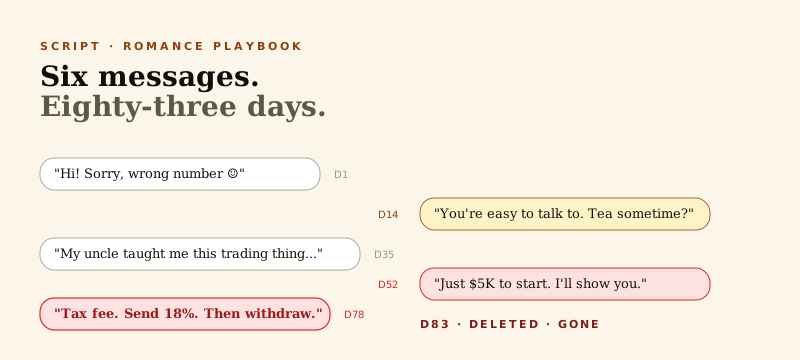
One of the most common current initiation tactics is the "wrong number" text — a message clearly meant for someone else that opens a conversation. The simplicity is deliberate: it feels like genuine human error, it creates an immediate conversation hook, and it requires no profile vetting from the target. It's a cold contact mechanism that bypasses the skepticism people apply to unsolicited dating app messages.
The Grooming Timeline Phase by Phase
Intensive Contact Establishment
High-frequency messaging. Good morning and good night messages every day. Quick, attentive responses at all hours. Expressing genuine interest in the target's daily life, opinions, and feelings. The goal is to establish a communication pattern where the target comes to expect and value daily contact. Moving off the initial platform to WhatsApp or Telegram happens quickly — removing platform safeguards and moderators from the relationship.
Emotional Depth Development
Conversations move to deeper topics: life goals, past relationships, family, dreams, disappointments. The operator shares manufactured vulnerability — personal losses, loneliness, difficult past relationships — that mirrors what the target has revealed. Emotional mirroring creates a sense of being truly understood. Expressions of developing feelings. The target begins to feel genuinely known.
Future Anchoring
Discussion of a shared future together. Plans to meet — always upcoming, always specific, always with a reason it can't happen just yet. The "relationship" is given a sense of trajectory and permanence. Declarations of love. Discussions of what life will look like together. This phase anchors the victim's emotional investment in a future outcome, making the idea of losing the relationship psychologically costly.
Isolation Reinforcement
Scammers proactively work to minimize the influence of the victim's social network. Expressions of concern about people in the victim's life who "don't seem supportive." Subtle suggestions that certain friends or family members don't want the victim to be happy. Framing the relationship as something private and special that outsiders wouldn't understand. This is deliberate social engineering to reduce the likelihood that someone outside the relationship notices warning signs.
Financial Introduction
The first financial ask arrives in a frame that makes saying yes feel like an act of caring, not a transaction. A medical emergency. A business crisis with a time-sensitive resolution. Customs fees on a package being sent to the victim. An investment opportunity the scammer wants to share. The ask is proportioned to what the operator knows the target has. It is presented as temporary — a loan, not a gift. See the full breakdown of how crypto romance scams work.
Psychological Techniques Used
Romance scam playbooks draw on established psychological manipulation principles, applied systematically:
- Love bombing: Overwhelming attention, affection, and validation in the early stages creates a dependency on the emotional state the scammer produces. When that state is later threatened (by doubts, by conflict), the target is motivated to restore it.
- Reciprocity: Operators make the target feel they owe something — not financially, but emotionally. The scammer has shared so much vulnerability, given so much time and attention, expressed so much love. Saying no to a financial request feels like a betrayal of that investment.
- Urgency manufacturing: Financial asks are always time-sensitive. The window to act is always closing. Urgency suppresses deliberate evaluation and bypasses the considered decision-making that might trigger skepticism.
- Social proof fabrication: Friends of the persona who appear to validate the relationship. Children or family members who are mentioned and then "interact" with the target. Creates a social context that makes the relationship feel embedded and real.
- Intermittent reinforcement: Attention is not constant — it varies in intensity. Periods of intense connection followed by brief distance create an anxious attachment dynamic. The target works to restore the high-attention state, which makes them more compliant to requests.
The Ask: How Financial Requests Are Introduced
The first financial request is the most carefully scripted moment in the playbook. It is never framed as "give me money." Common framings include:
"I would never ask if I had any other option, and I'll pay you back as soon as..." (temporary/loan framing)
"I found this incredible investment opportunity and I want us to do it together..." (shared future framing)
"There's a customs hold on a package I sent you — I just need the fee cleared to get it released..." (gift framing)
If the first request succeeds, subsequent asks escalate in size and frequency. Each resolved crisis is followed by another. The escalation is gradual enough that each individual ask seems proportionate to the relationship — but the cumulative total can reach tens of thousands of dollars before the pattern is recognized.
When victims become suspicious or cut contact, some operations switch to a secondary scam. A "lawyer," "investigator," or "recovery specialist" contacts the victim claiming they've identified the person who scammed them and can help recover the funds — for a fee. This is the same operation, running a second extraction. Any unsolicited contact from someone claiming to be able to recover your funds is a scam. Legitimate investigators like Wallet Witness do not cold-contact victims.
How to Recognize You're Inside a Script
- The relationship escalated to deep emotional intimacy unusually fast — within days or weeks
- They are always available to message but can never meet in person or do an unfiltered live video call
- The persona involves a profession that explains being abroad and unavailable: military, oil rig, international doctor, architect
- They moved you off the original platform (dating app, LinkedIn) to WhatsApp or Telegram quickly
- They subtly discourage you from discussing the relationship with friends or family
- They have a specific reason they can't receive money directly — needs crypto, wire to a specific account, or payment via gift cards
- A planned in-person meeting has been delayed multiple times with specific but always-changing reasons
- Reverse image search of their profile photo returns results under a different name
- When you've expressed doubt, they responded with hurt feelings, declarations of love, or a guilt-inducing narrative — not by addressing your concern directly
What to Do If You Suspect You're Being Groomed
- Do a reverse image search immediately. Save their photos and search via Google Images or TinEye. If the photo appears under different names, you have your answer.
- Request a specific live video verification. Ask for a video call where they hold up a specific number of fingers or a piece of paper with your name on it. This is nearly impossible to fake with pre-recorded or filtered video.
- Stop all financial transfers now. Regardless of the urgency of the current crisis narrative.
- Do not confront the scammer directly about your suspicions. This triggers scripted responses designed to restore your trust — or activates the secondary scam. Stop transferring money without explanation if needed.
- Save all evidence before doing anything else. Screenshots of every conversation, every financial transaction, every profile detail. Read our guide on gathering transaction evidence.
- Talk to someone outside the relationship. The isolation the scammer cultivated was intentional. Breaking it is the first step to clarity.
- If you've already sent crypto, report it and get a forensic trace started. The longer you wait, the more the funds move.
Frequently Asked Questions
How do romance scammers choose their victims?
Romance scam operations use data scraping, platform targeting, and behavioral screening to identify high-value targets. They look for signals of emotional availability (recent divorce, bereavement), financial capacity (professional profiles, property ownership), and social isolation. Dating apps, LinkedIn, Facebook, and Instagram are primary hunting grounds because users self-disclose precisely the information scammers need.
Do romance scammers use scripts?
Yes. Organized operations — particularly those in Southeast Asia — operate with detailed scripts covering every stage from introduction through financial extraction. Scripts include standard personas, backstory libraries, responses to challenges, and escalation protocols. Individual operators manage multiple victims simultaneously using these materials.
Why can't victims recognize they're being scammed while it's happening?
Because the emotional relationship is real, even when the person behind it isn't. Weeks of genuine investment create authentic emotional bonds. The psychological difficulty of acknowledging fabrication is compounded by the scammer's deliberate isolation of the victim. This is not a failure of intelligence — it's the intended outcome of a professional manipulation system.
Can the funds from a romance scam be traced?
Yes. All cryptocurrency transactions are recorded on a public blockchain. A forensic investigator can trace every wallet your funds passed through, identify exchange deposits, and connect your case to patterns from other victims. Romance scam operations frequently reuse wallet infrastructure — your case may link to a known criminal network already under investigation.
Already Lost Funds to a Romance Scam?
We trace fund flows on-chain, identify where your crypto went, and produce forensic reports that law enforcement can act on. Free consultation — no obligation, no recovery guarantees, just honest answers about what your case looks like.