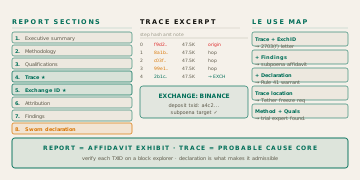
Detectives are increasingly receiving private blockchain forensic trace reports — from victims, attorneys, or contracted forensic investigators — and finding themselves uncertain how to use what is on the page. The reports are technical, dense, and structured for court use, not for fast operational reading. This guide walks through what each section of a typical report means, how to use it to advance a case, and what to look for when assessing whether the report supports the legal process you are about to draft.
This is written for working small-agency detectives and prosecutors. If you are a victim or attorney looking to understand what to expect when you commission one of these reports, see our piece on hiring a blockchain forensic investigator.
Whether and how a private forensic report can be used in your jurisdiction's process — and what authentication, hearsay, or expert qualification rules apply at trial — should be confirmed with your prosecutor. The references to evidence rules in this article are general and directional only.
A complete forensic report is the document that turns a "the victim says her crypto was stolen" complaint into probable cause for a preservation letter, subpoena, or seizure warrant. The report does most of the work of the affidavit; the detective's role is to read it, attach it, and use it to drive process.
Contents
The Standard Sections of a Forensic Report
A complete blockchain forensic trace report typically contains the following sections, in roughly this order:
| Section | What It Contains | Why It Matters |
|---|---|---|
| Executive Summary | One-page bottom line: what was traced, what was found, where the funds are now | Read this first; it is the answer to the case |
| Methodology | How the investigator did the work — tools used, data sources, techniques applied | Establishes the report's reliability for court |
| Qualifications | Investigator's CV, certifications, prior court appearances | Establishes admissibility of the expert's testimony |
| Subject Identification | Specific assets, wallet addresses, transaction hashes, time period analyzed | Defines the scope of the analysis |
| Transaction Trace | Step-by-step chain of custody from origin to current location, with every hop's TXID, amount, and timestamp | The factual core of the report; this is what supports probable cause |
| Exchange Identification | Which centralized exchange holds or held the funds, with deposit transaction details | Identifies the legal process target |
| Attribution Evidence | Wallet clustering, address labels, OSINT links, off-chain corroboration | Links wallets to real-world identities |
| Findings and Conclusions | The bottom-line investigative conclusions in plain language | What the detective and prosecutor will quote in the affidavit |
| Sworn Declaration | Signed statement under penalty of perjury attesting to methodology, accuracy, and qualifications | Makes the report admissible as an affidavit exhibit |
| Exhibits / Appendix | Block explorer screenshots, transaction graphs, raw data tables | Supports the trace narrative with primary evidence |
Methodology and Qualifications
These two sections are short and easy to skim, but a good prosecutor will check them carefully before relying on the report. Look for:
- Named tools used (block explorers, commercial forensic platforms, OSINT databases)
- Specific techniques (transaction graph analysis, wallet clustering, address heuristics, deposit-address pattern analysis)
- Investigator credentials — relevant certifications, experience years, prior testifying experience
- Prior court qualifications and Daubert challenges, if any
If methodology is vague ("we analyzed the blockchain") or qualifications are missing or unverifiable, the report's evidentiary weight is diminished. A real report names tools, techniques, and credentials specifically.
The Transaction Trace
The transaction trace is the factual core. It is usually presented as a table or numbered list of hops, each with:
- Step number (origin = 0; each subsequent hop incremented)
- Sending address
- Receiving address
- Transaction hash (the unique on-chain identifier — verify on a block explorer)
- Asset and amount
- Timestamp (UTC)
- Notes — flags such as "exchange deposit address," "mixer entry," "bridge transaction"
The trace ends at the current location of the funds. That is the most important data point in the entire report. If the trace ends at an exchange deposit address — start drafting the preservation letter immediately. If it ends at a mixer entry, the trace is technically complete but recovery is more difficult. If it ends at a self-custodial wallet not associated with any service, the holder is the suspect or someone the suspect controls.
For a full picture of what tracing involves on the methodology side, see how blockchain investigators trace crypto.
Exchange Identification
This section maps a destination wallet address to a known centralized exchange (e.g., "Address TXM0...f9d2 is a Binance deposit address controlled by Binance Holdings Limited. Funds were deposited at TXID abc123... on 2026-04-20 at 14:32 UTC.").
Use this section to:
- Identify the exchange to send your 2703(f) preservation letter
- Determine US vs. foreign jurisdiction (drives whether you can compel production via standard subpoena or whether you need MLAT)
- Identify the deposit transaction hash and amount that the exchange will use to map the address back to a customer account internally
Attribution Evidence
Attribution evidence connects an anonymous wallet address to a real-world identity or entity. Common attribution signals in a report:
- Wallet clustering — multiple addresses controlled by the same entity, identified through co-spending, reuse patterns, or shared exchange deposits
- Address labels — labels assigned by commercial forensic providers based on prior intelligence (sanctioned addresses, scam-tagged addresses, exchange-tagged addresses)
- OSINT correlation — wallet addresses posted publicly on forums, social media, fundraising sites, or NFT marketplaces tied to a known identity
- Behavioral fingerprints — distinctive transaction patterns linking wallets to a single operator
Attribution is rarely 100% certain at the wallet level. The report will (or should) qualify confidence levels. Strong attribution warrants direct legal process; weaker attribution informs the investigation but should be corroborated.
Findings and Declaration
The findings section restates the report's conclusions in plain language. It is the section most likely to be quoted in an affidavit. Look for specific, falsifiable statements such as: "Funds totaling 47,500 USDT-TRC20 stolen from victim wallet TJ8x...c4a1 on 2026-04-15 were transferred through eight intermediate wallets and reached Binance.com deposit address TXM0...f9d2 on 2026-04-15 at 16:42 UTC."
The sworn declaration converts the report from an investigator's work product into evidence. It is signed under penalty of perjury and contains the investigator's attestation to methodology, qualifications, and findings. The declaration is what makes the entire report attachable as an affidavit exhibit.
How to Use Each Section in Your Case
| Action | Sections Used |
|---|---|
| Send a preservation letter | Exchange Identification + Trace (current location) |
| Draft a subpoena | Exchange Identification + Trace + Findings (for affidavit support) |
| Draft a Rule 41 seizure warrant | Trace + Exchange Identification + Findings + Declaration (attached as exhibit) |
| Submit a Tether freeze request | Trace (current location) + Findings (criminal nexus) |
| Coordinate with federal partners | Executive Summary + Findings (for briefing) |
| Prepare for trial | Methodology + Qualifications + Declaration (for expert witness foundation) |
Report Quality Red Flags
Not every report you receive will be reliable. Red flags that should make you slow down before relying on a report:
Quality Red Flags
Reports from recovery scammers occasionally cross detectives' desks. Common pattern: victim was scammed once, then "hired" a recovery service that produced a forensics-styled document for the victim to present to police. These documents can look superficially professional but lack methodology, contain fabricated wallet labels, or assert findings the actual on-chain data does not support. Verify any flagged trace independently on a block explorer before drafting process. See legitimate vs scam recovery services for the broader pattern.
FAQ
Need a Forensic Report for Your Case?
Wallet Witness produces court-ready forensic trace reports for active LE investigations — methodology, qualifications, trace, attribution, and sworn declaration in a single document. We work directly with detectives and prosecutors. LE inquiries are prioritized.
Request a Forensic Report