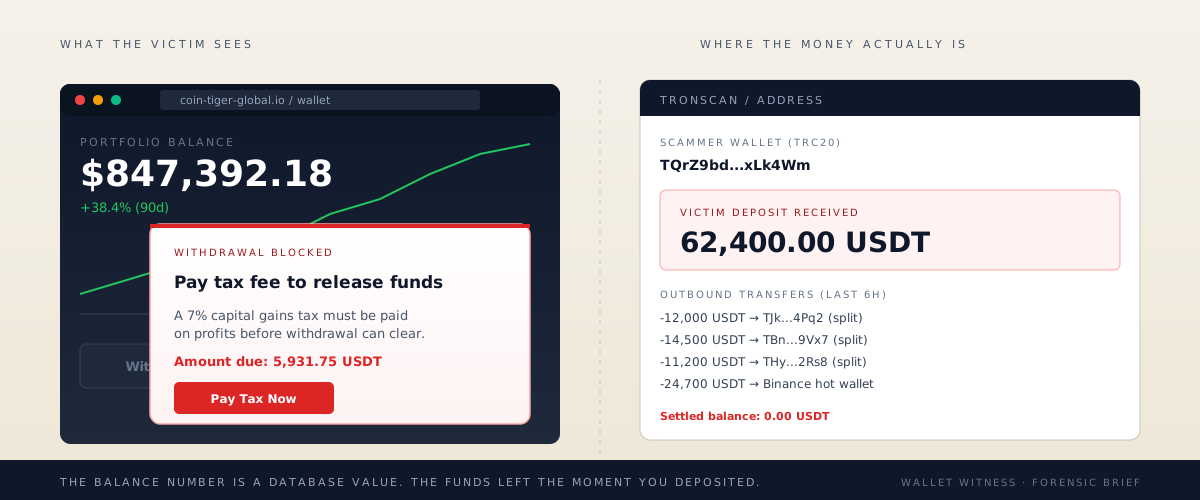
Is it a scam? Yes. Every time. No legitimate crypto exchange — Coinbase, Kraken, Gemini, Binance.US, none of them — ever asks you to deposit additional funds in order to withdraw your existing balance. The "withdrawal tax" framing is the standard back-half of a fake-exchange scam (usually attached to a pig-butchering operation), and it is documented in hundreds of California DFPI Scam Tracker entries and tens of thousands of FBI IC3 complaints.
Why are they asking? Because the deposit cycle is over and the extraction cycle has begun. The fake platform showed you a balance that grew dramatically; now the operator monetizes the back half by inventing one fee after another. Tax is the most psychologically effective framing because it sounds externally imposed. The escalation is the product.
What is recoverable? On-chain reversal is impossible. Forensic attribution is realistic — tracing your deposits through the operator's USDT-TRC20 wallets to the off-ramp exchange (most commonly Binance, HTX, OKX, or KuCoin in an Asia-Pacific region) and producing the evidence package law enforcement and civil counsel need to subpoena. Recovery itself is rare; no honest investigator will guarantee it.
In This Article
- Why you are reading this (and what just happened to you)
- How the "pay tax to withdraw" pattern actually works
- Named fake platforms doing this in 2026
- The fee escalation ladder: how much you will be asked for
- What is actually happening inside the "exchange"
- Why the balance you see is always fake
- Where your money actually went (and when)
- The on-chain trace after the deposit
- What your realistic options are now
- What you should NOT do (recovery scam warning)
- Frequently asked questions
Why You Are Reading This (And What Just Happened to You)
You probably found this article by typing some version of "fake crypto exchange wants me to pay tax to withdraw" or "do I really have to pay capital gains before withdrawing crypto" or "my exchange is asking for an AML deposit before I can take my money out" into a search engine, while a chat window is open on the other monitor with someone telling you the payment is urgent and the IRS is involved and the funds will be locked permanently if you do not move fast.
I am going to give you the honest answer in one sentence, because you do not have time for buildup: the platform is fake, the balance you see is a database value with nothing behind it, the "tax" is not a tax, and paying it will not unlock anything because there is nothing to unlock.
That is hard to read. You almost certainly already suspected it or you would not have searched, but reading it cold from someone with no incentive to lie to you is different from suspecting it. Take a minute. Then keep reading, because what comes next matters more than the tax fee they are pressuring you to pay.
The single most important action right now is to stop sending money. Whatever you have already lost is lost; that fact will not change in the next twenty-four hours. What can change is how much more you lose. The fee they are asking for is not the last fee. Once it clears, the next one is invented — "anti-money-laundering deposit," "anti-terrorism financing clearance," "wallet upgrade," "membership tier unlock." The escalation is the actual business model. Your balance is the bait. The fees are the product.
This article will walk through exactly how the scam works mechanically, who is running it, what happens to the money on the blockchain after you deposit, and what your realistic options are. I am a working blockchain forensic investigator; I see this pattern in roughly four out of every five pig-butchering intake calls I take. None of what follows is theoretical.
If the platform is currently pressuring you with a deadline ("you have 24 hours or the funds are forfeited," "the IRS lien activates tomorrow," "the account locks at midnight"), the deadline is fake. It exists to prevent you from doing exactly what you are doing right now — pausing and Googling. Close the chat tab. Take a walk. Tell one person in your real life. Then come back and read the rest of this.
How the "Pay Tax to Withdraw" Pattern Actually Works
Every fake-exchange tax scam I have worked follows the same six-phase arc. The specific platform name, the specific dollar amounts, and the specific impersonated authority change. The structure does not.
Phase 1: The introduction
Almost no victim finds the fake platform on their own. The platform is introduced to them by someone who has already invested months building trust — a romantic match on Hinge or Tinder, a "wrong number" WhatsApp text that turned into a friendship, a LinkedIn connection who positioned themselves as a successful trader, an old friend whose account has actually been compromised, a Telegram or WeChat investment group. The platform is presented as the introducer's "personal advantage" or "uncle's trading desk" or "regulated Asian alternative to Coinbase." This is the broader pig butchering scam wrapper that contains the tax-fee pattern.
Phase 2: The first deposit
The victim sends a small amount — typically $500 to $2,000 — usually as USDT on Tron or Ethereum, sometimes BTC, occasionally a domestic ACH wire to an intermediary "account." The platform shows the deposit credited within minutes. The introducer walks the victim through a tutorial "trade" that immediately shows a small profit. Sometimes the victim is even allowed to make a small initial withdrawal — a few hundred dollars — to prove the platform "works." This is the most important confidence step in the entire scam. The withdrawal is real; the operator funds it out of their own pocket. Everything that comes after is the return on that investment.
Phase 3: The growth period
Over the following two to eight weeks the victim deposits progressively larger amounts. The "trades" the platform displays are always profitable. The dashboard shows the balance climbing — $5,000 to $25,000 to $80,000 to $200,000 and up. The introducer is in constant contact, congratulating, encouraging, and gently suggesting larger positions to "lock in the opportunity." Many victims at this stage are encouraged to borrow against home equity, take 401(k) early withdrawals, or pull from retirement accounts because the displayed returns make the borrowing cost look trivial.
Phase 4: The first withdrawal attempt
At some point — either because the victim wants to take profits, or because the introducer signals "now is a good time to take some off the table to convince your spouse" — the victim initiates a withdrawal. This is the moment the scam pivots. The withdrawal does not process. Instead, the platform displays a notice that some preliminary requirement must be met before withdrawal can clear.
Phase 5: The first fee
The first fee is almost always framed as a tax — "7% capital gains tax on profits," "15% withholding required by Treasury," "IRS clearance fee," "Singapore Monetary Authority tax assessment," or some variant. The amount is calculated as a percentage of the displayed (fake) balance, which is why victims with larger balances are quoted larger fees. The platform's "support" team confirms by chat that the payment is regulatory and external to the platform itself. The introducer expresses sympathy and may even claim to have already paid their own tax to release their funds.
Phase 6: Escalation and collapse
The victim pays the tax. The withdrawal still does not process. A second fee appears — "anti-money-laundering verification deposit," typically in a larger amount. Then a third — "anti-terrorism financing clearance." Then a fourth. The introducer is increasingly absent or claims to be "fighting with their lawyer to help you fix this." Eventually one of two things happens: the victim runs out of money to send and the introducer disappears, or the platform itself "goes offline for maintenance" and never returns. The site is sometimes recycled under a new name two weeks later targeting a different victim pool.
If you recognize yourself anywhere in phases 4 through 6, you are not the first person this has happened to and you will not be the last. The pattern is industrialized. The bigger question is what comes next, which is the rest of this article.
Named Fake Platforms Doing This in 2026
The California Department of Financial Protection and Innovation Crypto Scam Tracker is the most comprehensive public registry of fake-exchange scams in the United States. Hundreds of platforms are documented; the DFPI adds new ones every month as victim complaints come in. Below is a representative sample of platforms that have appeared in 2024-2026 DFPI tracker entries and matched victim cases I have worked or reviewed. None of these platforms are affiliated with any legitimate brand whose name they may resemble.
| Platform Name (Reported) | Fee Framing Used | Typical Victim Pattern |
|---|---|---|
| Coin Tiger Global | "Capital gains tax," "AML verification deposit" | Knockoff of a legitimate exchange name; introduced via WhatsApp investment group; fees scaled to displayed balance |
| BiFinance / BitFinanceX variants | "Withdrawal tax," "treasury clearance fee" | Brand-confusion with legitimate Bitfinex; introduced via dating-app match; balance escalates to six figures before withdrawal attempt |
| ProBit Global (knockoff sites) | "Anti-terrorism financing fee," "membership tier upgrade" | Sites mimicking legitimate ProBit domain; targeted at Korean- and Chinese-speaking U.S. residents through translated trading groups |
| MetaBitex / TopBitex / PrimeFex | "Personal income tax," "withdrawal clearance bond" | Generic "international exchange" framing; introduced via LinkedIn or Telegram; complete site shutdown after extraction |
| "OKX Global" / "Binance International" clones | "KYC verification deposit," "IRS clearance fee" | Domain-squatted clones of legitimate global brands; victim believes they are using a real exchange's "international tier" |
| BTC-Top / BTCTopAsia | "Liquidity unlock fee," "AML margin deposit" | Marketed as "high-frequency arbitrage platform"; introduced via "uncle in finance" cover story; multi-stage fee cycle |
| App-store-distributed wallets (various) | "Wallet upgrade fee," "security deposit" | Apps that briefly appear in Apple App Store or Google Play before takedown; same backend as web-based sites |
The DFPI tracker, the FTC Consumer Sentinel network, and the FBI's IC3 complaint database log dozens of new variants weekly. The brand name does not matter as much as the pattern. Any platform that meets the following criteria should be treated as a fake-exchange scam regardless of how legitimate the site looks:
- You were introduced to it by someone you met online — on a dating app, a "wrong number" message, a social media DM, or a translated investment group.
- The platform displays U.S. branding or claims U.S. regulatory status but you cannot find it on the FinCEN MSB Registrant Search or any state money-transmitter list.
- Deposits are routed to a personal wallet address (USDT-TRC20, USDT-ERC20, or BTC) rather than to a named, KYC-verified business custody account.
- Withdrawals require an upfront fee deposit before they will clear.
- The "support" team responds only via live chat or Telegram, never by phone, and the company has no verifiable physical address or registered officers.
If you are unsure whether a platform you are using is real, the knowledge-base article on how to tell if a crypto exchange is legitimate walks through the standard verification steps. The short answer: if a real exchange's name is not on Coinbase / Kraken / Gemini / Binance.US level lists, and you cannot independently verify its registration through a government regulator's site, treat it as fake.
The Fee Escalation Ladder: How Much You Will Be Asked For
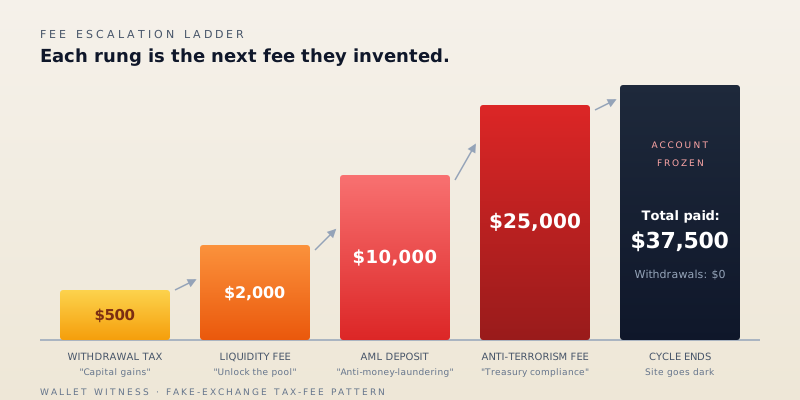
Once the first "tax" payment lands, the escalation is mechanical. The cycle has a documented shape in the cases I have seen across the last two years, and the same shape appears in DFPI tracker entries and IC3 complaint summaries. The fees do not have to be invented in this exact order, but the sequence below is the most common.
Fee 1: Withdrawal tax / capital gains
Typically 5% to 15% of the displayed balance, framed as either a capital gains tax owed to the IRS, a withholding tax owed to a foreign regulator, or a transaction tax owed to the exchange's "regulatory wrapper." Dollar amounts range from a few hundred to tens of thousands depending on how large the platform has shown the fake balance to grow. This is the gateway fee — the one that "tests" whether the victim will pay.
Fee 2: Liquidity unlock / pool unfreezing
Framed as a one-time charge to "release" the victim's tokens from a liquidity pool, margin account, or "cold storage migration." Typically 2x to 4x the first fee. The framing is engineered to sound technical and make the victim feel they are now closer to actually receiving their funds.
Fee 3: AML / anti-money-laundering verification deposit
This is the fee where most victims start to question the cycle, which is why it is framed as a refundable deposit — "your AML compliance deposit will be returned with your withdrawal." It never is. Typical size: 10% to 25% of the displayed balance, often the single largest single demand in the cycle.
Fee 4: Anti-terrorism financing / Treasury clearance
The most aggressive framing. The victim is told their account has been flagged for "structuring" or has tripped a Bank Secrecy Act review, and that a "Treasury compliance bond" must be paid before the funds can be released to a U.S. bank. Sometimes accompanied by a fabricated official-looking PDF letter on counterfeit Treasury or FinCEN letterhead. The framing weaponizes the victim's fear of being criminally implicated.
Fee 5: KYC verification / account audit
A final smaller "verification deposit" supposedly required to prove the victim's identity matches the account. Often used when the victim has expressed doubt and the operator wants to extract one final payment before disappearing.
Fee 6+: Insurance, membership upgrade, wallet repair
Whatever the operator can still extract. Increasingly small as the victim's resistance grows. The cycle typically ends when the victim refuses to send more, at which point the chat goes silent and the site goes offline. Occasionally a "recovery agent" appears within days — this is the secondary scam, discussed below.
In cases I have worked or reviewed, total amounts paid during the fee-escalation cycle alone typically run 1.5x to 4x the original deposit. A victim who deposited $20,000 over two months and was shown a $200,000 "balance" frequently ends up paying $30,000-$80,000 in fees on top of the original $20,000 before the cycle collapses. The fees are not an accident; they are the actual monetization.
What Is Actually Happening Inside the "Exchange"
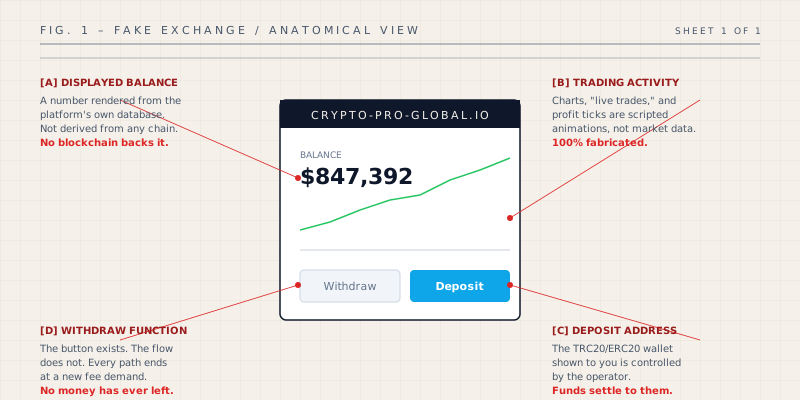
To understand why the fees never unlock anything, you need to understand what a fake exchange actually is. It is not a broken legitimate platform. It is not a real exchange that froze your funds. It is a frontend — a web app and sometimes a mobile app — whose only real interactions with the blockchain are inbound. Money flows in. Money never flows out, because there is no mechanism on the platform that would cause it to flow out.
The displayed balance is a database value
The number you see on the dashboard is not derived from any blockchain. It is a row in a database the operator controls. When you "deposit," the operator's backend increments that row. When the platform "executes a trade for you," the operator increments the row again. None of these actions touch a blockchain. The balance is the most flexible variable in the entire system; the operator can show you any number they want, because the number does not have to balance against anything.
The trading activity is animation
The candlestick charts, the "live trades" ticker, the order book that updates every few seconds, the profit notifications — all of it is scripted. Some platforms pipe in real market data from a public API to make the surface look authentic; the part that matters (your trades, your fills, your P&L) is generated entirely by the platform's own code. Your "open positions" do not correspond to any real positions anywhere. The market exists; your participation in it does not.
The deposit address is the only real link to the blockchain
When the platform shows you a "deposit address" to send USDT or BTC to, that address is a real wallet on a real blockchain, controlled by the operator. The funds you send are the only thing that meaningfully exists. Everything that happens after the deposit is the operator's choice of which database number to show you, and whether to invent a fee to extract more.
The withdraw function exists but does not complete
The "withdraw" button on the dashboard works in the sense that clicking it triggers some response. The response is never a transaction broadcast to the blockchain. The response is an alert dialog telling you a fee must be paid, a verification must be completed, or a manual review is required. The flow has no terminal state that ends in "funds released," because there are no funds. There is only the deposit-side architecture and the database number. This is the same mechanic explored in the related article on cannot withdraw crypto from a platform.
Why the Balance You See Is Always Fake
The most painful moment for many victims I work with is when the realization lands that the $200,000 or $500,000 or $1.4 million the platform displayed was never anything real. It is not "stuck." It is not "frozen pending review." It is not "held by the platform until the fee is paid." It never existed.
This is the hardest part of the conversation in an intake call, because the displayed number has months of emotional weight attached to it — the daydreams about what the money would do, the conversations with a spouse about "our retirement plan," the promises to children about college tuition, the resignations from jobs that were going to be funded by the imminent withdrawal. The number was the entire reason for the relationship, the months of grooming, and the cumulative deposits.
And the number was nothing. Not "almost nothing." Not "discounted by some recovery factor." Nothing. There was never a position. There was never a trade. There was never a profit. The deposits were never invested. The growth was theater.
I am not telling you this to be cruel. I am telling you this because the very next decision you make is going to be shaped by whether you have internalized this fact. If you still believe, somewhere in the back of your mind, that the balance is "really there" and you just need to find the right combination of fees and persistence to unlock it, you are going to keep paying. If you accept that the balance was never real, you can stop sending money and start on the only path that has any chance of producing a non-zero outcome: forensic attribution of where your actual deposits went, and the law-enforcement and civil paths that flow from that attribution.
Where Your Money Actually Went (And When)
Your actual deposits — the ones you sent from Coinbase, Kraken, your self-custody wallet, or your bank wire — went somewhere very specific, and the trail is permanent on the blockchain. Here is the typical timeline I see in cases.
T+0: The deposit lands at the operator's collection wallet
Whatever address the platform showed you to "deposit," that address is the operator's. The most common chain is Tron (USDT-TRC20) because the fees are negligible and the volume of legitimate USDT-Tron activity makes scam laundering harder to single out at a glance. Second most common is USDT-ERC20 (Ethereum). BTC and other chains appear but are less common because they are harder for the operator to off-ramp in Asian markets.
T+15 minutes to T+6 hours: Consolidation and fragmentation
The operator does not leave funds in the deposit-receiving wallet. Within minutes to hours, the funds are typically forwarded to a consolidation address that aggregates deposits from many victims, then split (a technique called a "peel chain") into smaller amounts and routed through one to three intermediate hops. The fragmentation pattern is designed to make the funds harder to follow at a glance, though it is trivially reconstructible by any competent blockchain analyst with cluster heuristics.
T+2 to T+24 hours: Off-ramp at a centralized exchange
The final hop is almost always a deposit at a centralized exchange — most commonly Binance, HTX, OKX, KuCoin, or Bitget, typically through an account registered in the Asia-Pacific region. The operator either withdraws to fiat through the exchange's local-currency withdrawal rails, or moves the funds to an over-the-counter broker for cash conversion. By the time most victims realize they are in a scam, the funds have already cleared the off-ramp.
The role of Tether
Because USDT is the dominant currency of pig-butchering and fake-exchange operations — roughly 84% of pig-butchering transaction volume by some estimates — Tether Limited has become the single most important freeze counterparty in the recovery picture. Tether has frozen over $4.4 billion in USDT across 2,300+ cases through 2025 and 2026, including individual seizures specifically tied to pig butchering of $225M, $344M, $61M, and $50M. A timely freeze request supported by an on-chain trace and law-enforcement coordination can sometimes catch funds at the off-ramp. Reporting your case to recovery channels for stolen USDT while the funds are still in motion is the highest-value action available to most victims.
The On-Chain Trace After the Deposit
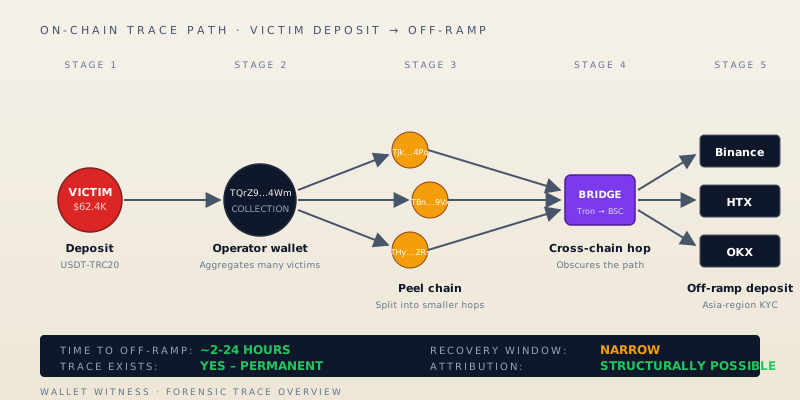
The trace work is mechanical. A forensic investigator pulls every transaction hash you can document — from the exchange where you bought the crypto, from your wallet's outbound history, from the screenshots of the fake platform if they show deposit addresses — and follows the funds forward across each hop using blockchain analytics tools.
What an investigator delivers in a typical case:
- Full hop-by-hop trace from every deposit you made to the off-ramp wallet where the funds settled.
- Clustering analysis of the operator's collection wallets — the same wallets receive deposits from many other unrelated victims, which is what supports federal aggregation of these cases.
- Off-ramp identification — the named centralized exchange and (where attainable) the deposit address at that exchange that received the funds.
- Attribution evidence package — a formal written report with on-chain references suitable for IC3 supplementation, law enforcement subpoena support, civil litigation, and Tether or exchange freeze requests.
What an investigator does not deliver: a guarantee that the funds will be recovered, an estimate of recovery percentage in your specific case, or a "we will get your money back" promise of any kind. The trace is the trace. What law enforcement and counsel do with it depends on factors outside the investigator's control — whether the off-ramp exchange responds to a U.S. subpoena, whether the operator's downstream wallets get sanctioned, whether the case aggregates with enough other victims to clear federal prosecutorial thresholds. For more on what the trace report itself contains, see how to read a forensic trace report.
The realistic posture is this: the on-chain evidence is the necessary precondition to any recovery action, but it is not itself a recovery. Without the evidence, no recovery path is even theoretically available. With the evidence, the path exists but it is narrow, slow, and uncertain. The honest framing is the only useful framing.
What Your Realistic Options Are Now
The realistic action set after a fake-exchange tax-fee scam comes down to five things, in roughly this priority order.
1. Stop the bleeding
Pay no more fees. Refuse every demand the platform or the introducer makes, no matter how it is framed. If the introducer is still in contact with you, do not announce that you have figured out the scam — that just makes them disappear faster and accelerates evidence destruction. Simply tell them you cannot send any more for the moment and that you need to consult a tax professional or attorney before paying the next fee. Buy yourself time.
2. Preserve everything
Screenshots of the platform dashboard at multiple times (especially the displayed balance and any fee-demand modal). Full chat history with the introducer — do not delete the conversation, do not block the contact, do not delete any messages. Every transaction hash from your wallet or exchange outbound. Every deposit address the platform showed you. Bank wire records if any wires were involved. Save all of this in a folder, with a written timeline of what happened on which date. The first 72 hours after realization is when evidence is most complete; that window closes fast. The knowledge-base article on gathering transaction evidence is the checklist for this.
3. File the federal and state reports
File at IC3.gov (FBI Internet Crime Complaint Center) regardless of dollar amount. File at ReportFraud.ftc.gov (FTC). Submit the platform to the California DFPI Crypto Scam Tracker even if you do not live in California — the DFPI accepts cross-jurisdictional reports and is one of the most active state-level databases for fake-exchange documentation. File a local police report so you have a report number for any insurance, bank, or civil action. The walkthrough at how to report a crypto scam to the FBI covers the IC3 submission in detail.
4. Notify your bank if wires were involved
If you sent funds via U.S. bank wire to an intermediary (some scams route deposits through "facilitator" bank accounts before converting to crypto), your bank may be able to attempt recall within 24-72 hours of the wire. Recall success is rare past that window but worth attempting if you are still inside it. See the related piece on bank wire crypto scam refund attempts for the mechanics.
5. Engage forensic attribution if the loss is material
If the total loss (deposits plus fees) is above roughly $5,000-$10,000, professional forensic attribution becomes economically rational. The deliverable is the evidence package described in the trace section above; the goal is to give law enforcement, civil counsel, or Tether's compliance team something concrete to act on within the window where action is still possible. The honest piece on whether you can get crypto back after being scammed is the realistic framing of what attribution delivers and what it does not.
For families dealing with this on behalf of a parent or relative, the companion article on parent scammed by crypto: how to help walks through the specific dynamics of taking over a case when the victim is still partly in denial.
What You Should NOT Do (Recovery Scam Warning)
The single most important warning in this entire article: within hours to days of you posting about your scam anywhere public — Reddit, Twitter, a Telegram support group, even a comment on a YouTube video about pig butchering — you will be contacted by someone claiming they can recover your funds.
This is the secondary scam. It is its own industry. The pitch usually arrives via Telegram, WhatsApp, Instagram DM, or unsolicited email. Common variants include:
- The "recovery agent" or "asset retrieval specialist." Claims a guaranteed-recovery process for a fee paid upfront in crypto.
- The "ethical hacker" or "white hat." Claims they can directly "hack back" your stolen funds from the scammer's wallet for a percentage cut.
- The "blockchain attorney" or "crypto lawyer." Has no verifiable bar membership; claims they can file a lien on the scammer's wallet that will force a return.
- The "exchange insider." Claims to work at Binance / OKX / HTX and can release the scammer's frozen account for a "processing fee."
- The "fellow victim" referrer. Pretends to be another scam victim who recovered their funds and wants to "share the contact." The contact is the scammer.
None of these are real. Every single one is the same operator network or a partner network running the secondary extraction. The signatures of recovery scams: they contact you first, they guarantee outcomes, they ask for upfront fees, they have no verifiable U.S. business presence, and they want you to act fast. The piece on legitimate vs. scam recovery services walks through the verification checklist, and the companion article on a recovery service contacted me covers the specific scripts to watch for.
Legitimate forensic investigators do not contact you first. You contact them. Anyone who reaches out unsolicited claiming they can recover your funds is running the same scam from a different angle. If you take nothing else from this article, take that. The knowledge-base article on scam identification covers the verification patterns in depth.
Other things to avoid
- Do not pay any more fees to the original platform, no matter what the introducer says about how this one is "definitely the last one."
- Do not engage with anyone who guarantees a recovery percentage or quotes you a fixed recovery amount before doing any actual trace work.
- Do not pay anyone in crypto upfront for "recovery services." Legitimate professional fees flow through real bank rails, not USDT-TRC20 deposits.
- Do not delete the chat history, the platform screenshots, or the introducer's contact info, no matter how much you want the reminder gone. This is evidence.
- Do not assume your case is too small to matter. Cumulative reports to IC3 against the same operator wallet are how federal aggregation happens. A $3,000 loss is a node in the case file even if it is not individually pursuable.
Frequently Asked Questions
For the broader scam wrapper that contains this pattern, see pig butchering scam recovery. For the post-incident framework that applies across all crypto scams, see what to do after a crypto scam. For the realistic recovery framing, see can you get crypto back after being scammed.
Need the trace done? Start with a free scoping call.
If a fake exchange is demanding tax or AML fees before releasing your balance, the path forward is forensic attribution — tracing your deposits through the operator's wallets to the off-ramp exchange where action might still be possible. We will scope the trace and tell you honestly what an evidence package can and cannot achieve in your specific case. Initial assessments are free and we respond within 24 hours.
Start a Free Case Review