In This Article
A scam crypto investment platform convinced you to wire money from your bank to buy cryptocurrency. Now you know it was a scam and you want to know if your bank can get that money back. Here is the honest answer — including what most bank representatives won't tell you upfront.
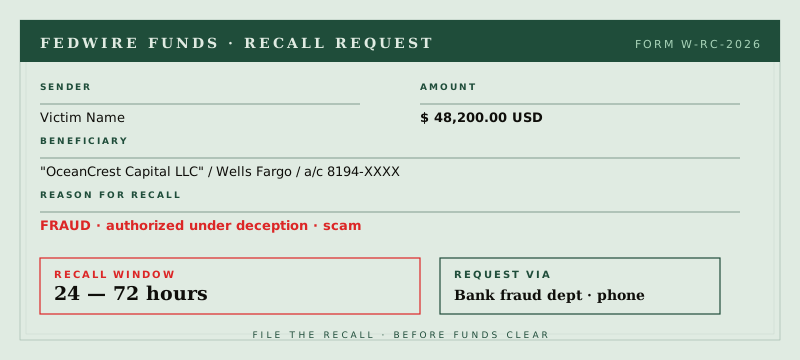
Wire recall success drops dramatically with every hour that passes. If this happened in the last 24 hours, call your bank's fraud department right now — before finishing this article. Use the information here when you call.
The Honest Answer
Wire recalls are possible within a very narrow window — typically same-day or within a few hours of sending. After the receiving bank has processed the wire and converted it, the bank-level recall option closes. If the funds have already been converted to cryptocurrency and moved on-chain, bank recovery is effectively off the table and blockchain forensics becomes your primary recovery path. Speed determines which options you have.
The Wire Recall Window
Highest chance of recall
The wire may still be in process. Your bank can transmit a SWIFT cancellation or CHIPS reversal request before the receiving bank has fully processed the funds. Same-day action has the highest success rate.
Recall still possible, lower success
Your bank can still transmit a recall request, but the receiving bank has likely already posted the funds. Recall at this stage is a voluntary request to the receiving institution — they can accept or reject it. Many crypto-adjacent banks reject these.
Recall unlikely, crypto likely on-chain
Most crypto exchange accounts convert incoming wires to cryptocurrency within 24–48 hours. Once on-chain, the wire recall path is closed. Focus shifts to blockchain forensics and legal recovery options.
Bank route closed — on-chain recovery only
The blockchain forensic trace is your primary option. Identify where funds went on-chain, which exchange received them, and what legal mechanisms can compel that exchange to act.
What to Tell Your Bank Right Now
Call the bank's wire transfer fraud line — not general customer service, not a branch. Have the following ready:
- The exact wire amount and date/time sent
- The beneficiary bank name, routing number, and account number
- The wire confirmation or reference number
- A clear statement: "I was the victim of a wire fraud scam. I am requesting an immediate wire recall to the sending bank."
- Documentation of the fraud if you have it — screenshots of communications, the scam platform name
Ask specifically for:
- A wire recall or cancellation request to be transmitted immediately
- A fraud case number for your records
- The name and direct contact for the fraud department agent handling your case
- Whether the bank can contact the receiving institution's compliance department directly
Use the words "wire fraud" explicitly. This triggers a different escalation path than a general dispute. If the first representative tells you wire recalls are impossible, ask to speak with the wire transfer fraud team specifically. Branch staff and general customer service often don't know the actual recall process.
What Your Bank Can Actually Do
Transmit a recall request: Your bank can send a message through SWIFT or the CHIPS network requesting the receiving bank return the funds. This is the primary recall mechanism.
Contact the receiving bank's compliance team: If the wire went to a known crypto exchange, your bank's fraud team may have existing relationships or contact protocols with major exchanges' compliance departments.
Document the fraud for your investigation file: A formal fraud report from your bank can be submitted alongside your IC3 complaint and supports any civil legal action you pursue.
What banks cannot do: They cannot freeze funds already on-chain, cannot force a cryptocurrency exchange to reverse a transaction, and cannot unilaterally reverse a wire that the receiving bank has already processed and converted. The further along the process, the less power your bank has.
What Regulation E Covers (and Doesn't)
Regulation E governs electronic fund transfers and provides consumer protections for unauthorized transactions from deposit accounts. Here's the critical distinction for crypto scam victims:
Reg E covers: Debit card transactions and ACH transfers where you did not authorize the transaction. If someone made an unauthorized ACH withdrawal from your account, Reg E provides strong protections.
Reg E does not fully cover: Wire transfers (governed by UCC Article 4A), and — crucially — transactions you initiated yourself, even under false pretenses. Most crypto scam wire transfers fall into the "authorized but fraudulently induced" category, which significantly limits your Reg E protections.
For the full breakdown of bank-level recovery options including credit card chargebacks, see our guide on crypto chargebacks through your bank. If you also used a credit card for any part of the investment, the chargeback options are different and potentially stronger — check that guide for your full picture.
When the Bank Route Closes: On-Chain Recovery
If the wire has already been converted to cryptocurrency and moved on-chain, the recovery path shifts entirely. This is where blockchain forensics begins:
- On-chain trace. A forensic investigator follows the fund flow from the exchange account that received your wire through every subsequent blockchain transaction. Every hop is permanently recorded. See how forensic investigators trace stolen crypto.
- Exchange attribution. The trace identifies which regulated exchange or wallet service ultimately holds the funds. If it's a cooperative, regulated exchange, there are legal options.
- Civil legal action. With a documented forensic trace, attorneys can issue civil subpoenas to exchanges for KYC data on the scammer's account. This is the primary litigation pathway for large crypto fraud losses. See blockchain forensic evidence in federal civil litigation.
- Law enforcement referral. A forensic report attached to an IC3 complaint gives federal agents the specific documentation needed to issue legal process to exchanges themselves. See does reporting to the FBI actually help for realistic expectations.
For what recovery actually looks like across scenarios, see can you get crypto back after being scammed and realistic recovery timelines.
Reporting Requirements
- Local police report. File a police report in your jurisdiction. This is often required by your bank's fraud investigation process and establishes an official record.
- IC3.gov. File with the FBI's Internet Crime Complaint Center. Include the wire amount, the receiving bank and account information, the scam platform name, and any cryptocurrency wallet addresses you have. Use our IC3 filing guide.
- FTC at ReportFraud.ftc.gov. Consumer wire fraud reports.
- FinCEN if the receiving bank looks suspicious. If the wire went to an unregulated or foreign entity, a FinCEN suspicious activity report may be appropriate.
Frequently Asked Questions
Can I reverse a bank wire sent to a crypto scam?
Sometimes — but the window is very narrow. Same-day action has the highest success rate. After funds are received and converted to cryptocurrency, the bank-level recall option closes and on-chain forensics becomes the primary recovery path.
What does Regulation E cover for crypto scam wire transfers?
Regulation E covers unauthorized electronic transfers. Most crypto scam wires are classified as "authorized but fraudulently induced" because you initiated them yourself, which significantly limits Reg E protection. Wire transfers are primarily governed by UCC Article 4A, not Reg E.
What's the fastest way to attempt a wire recall?
Call your bank's wire fraud line immediately. Have ready: the exact amount, beneficiary bank and account number, date/time sent, and your confirmation number. Use the words "wire fraud" and request an immediate recall request to be transmitted to the receiving bank.
What if the wire already converted to crypto — is it too late?
The bank recovery path closes, but blockchain forensics opens. Once on-chain, every transaction is permanently recorded. A forensic trace follows the trail to identify where funds went, supporting civil litigation and law enforcement action.
Should I file a police report for wire fraud to a crypto scam?
Yes — file a local police report, an IC3 complaint, and an FTC report. A police report documents the fraud officially and is often required by your bank's fraud investigation process before they open a formal dispute.
Wire Sent to a Crypto Scam? We Trace What the Bank Can't Reach
If the bank recall window is closed, on-chain forensics is your path. We trace the fund flow, identify where your money went, and provide the documented evidence needed for legal recovery options.