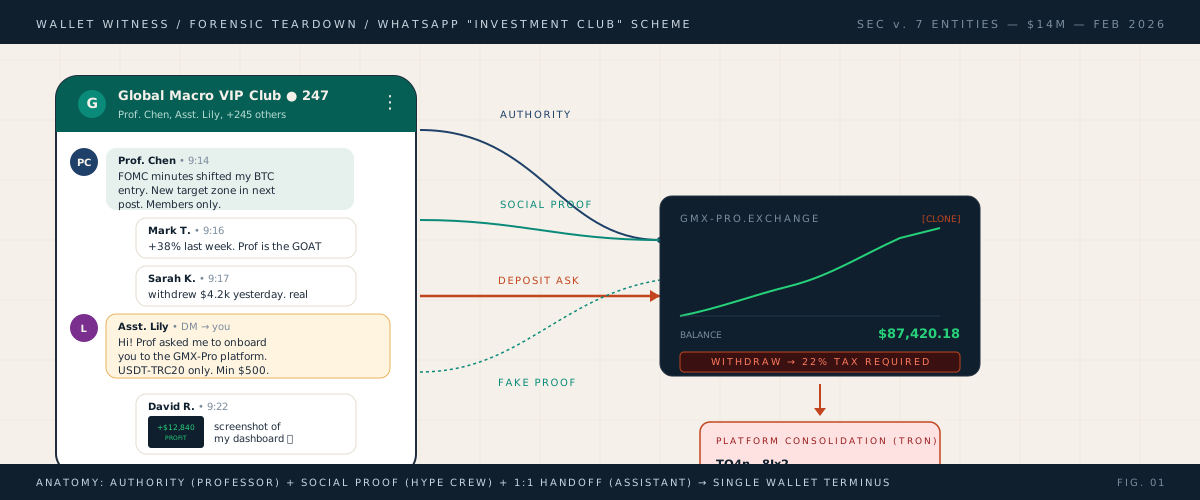
What it is: A coordinated investment fraud delivered through WhatsApp groups. A fabricated "professor" persona posts daily market commentary, an "assistant" handles each victim one-to-one, and a fake exchange platform shows real-time fake profits. Withdrawals trigger an escalating series of "tax" and "verification" fees designed to extract every additional dollar before the platform disappears.
What just happened: In December 2025 the SEC charged 7 entities and several associated individuals for a coordinated $14M WhatsApp investment club scheme. The Commission obtained an asset freeze. This is the most prominent U.S. enforcement action against the pattern to date and it confirms the typology as a recognized standalone fraud category.
Why this is not pig butchering: No romance. No one-on-one trust building over weeks. The mechanism is group peer pressure plus fabricated authority. Time to first deposit is 7 to 21 days, not 4 to 12 weeks. The recruitment script, the on-ramp persona, and the daily content cadence are different. The laundering pipe on the back end often converges with pig butchering and points to the same SE Asia compounds, but the front end you experience as a victim is a different script.
Stop responding to the assistant. Do not send any more USDT. Do not pay the "withdrawal tax" or the "anti-money-laundering verification fee." Screenshot everything before you leave the group. Jump to What to do if you are in one of these groups right now.
In This Article
- Why I'm writing this one
- The SEC action: $14M, 7 entities, December 2025
- How the funnel actually works: ad to deposit
- The four roles in every WhatsApp investment club scam
- Why this is not pig butchering (even though it looks similar)
- The "professor" persona: why it works
- The hype crew effect: how fake members create pressure
- Where the money actually goes on-chain
- What to do if you're in one of these groups right now
- What to do if you already deposited
- Why recovery is hard but forensic tracing still matters
- Frequently asked questions
Why I'm Writing This One
I have written about pig butchering, about Telegram USDT scams, about crypto romance fraud. There is a reason I am writing a dedicated piece on the WhatsApp investment club: it is a distinct fraud pattern that gets misclassified as pig butchering every single week, and that misclassification matters both for what you do next and for how the case is investigated.
The intake call usually starts the same way. The victim says, "I was in a WhatsApp group with a professor. He posted market analysis every morning. His assistant Lily helped me sign up on a platform called Goldman-Capital-Pro or BlackRock-Asia or GMX-Pro. I made $40,000 in three weeks. Now they want a tax to withdraw and I've sent another $80,000 trying to release my balance." That is not a romance scam. The victim never spoke to a fake girlfriend. They were never asked to fly to Hong Kong. The whole interaction happened in a group chat with twenty other "members" chiming in, and a polite assistant texting them through the deposit flow.
That script — group plus professor plus assistant plus fake exchange — is its own thing. The SEC's December 2025 enforcement action against seven entities is the most public confirmation yet that U.S. regulators view it as its own thing. The CFTC has issued advisories warning about exactly this pattern. The Washington Department of Financial Institutions has a public alert titled around the "professors" investment-club typology. New Zealand's Financial Markets Authority warned about a WhatsApp investment-club operation branded TXEX. BlackRock has issued repeated statements that they do not recruit investors through WhatsApp. The pattern is internationally documented and converging into a single recognized fraud category.
This article is the field guide I give to victims and to attorneys when they call me about one of these cases. It covers the SEC action, the funnel mechanics, the four roles in the operation, where the money actually goes, and what you can realistically do at each stage. It does not promise recovery. It explains what is achievable, which is meaningful forensic work that supports civil and law-enforcement action even when recovery itself is unlikely.
The SEC Action: $14M, 7 Entities, December 2025
In December 2025 the U.S. Securities and Exchange Commission filed an emergency action against seven entities and a set of associated individuals for running a coordinated WhatsApp-based investment scheme. The Commission alleged that the defendants defrauded U.S. retail investors of approximately $14 million through unregistered offers of securities tied to fake trading platforms, used fictitious credentials for a series of "professor" personas, and orchestrated WhatsApp groups in which sock-puppet members posted fabricated profit screenshots to drive deposits from real investors. The Commission obtained an asset freeze and additional emergency relief as part of the action.
What is significant about the case is not the dollar figure on its own — $14M is a fraction of what these operations extract from U.S. victims in any given month. What is significant is the structure of the enforcement: seven entities charged as a single coordinated scheme. That naming pattern reflects what investigators have known for some time, which is that these are not lone operators. They are organized operations running multiple parallel WhatsApp groups under different brand names, with shared back-end infrastructure, shared treasury wallets, and shared sales scripts. The SEC's seven-entity framing maps cleanly onto the back-end consolidation pattern I see in case work.
The SEC action sits inside a broader 2024-2026 regulatory pattern. The CFTC has issued repeated advisories on messaging-app investment fraud, including warnings specific to encrypted group chats. The CFTC's consumer guidance is unambiguous: legitimate registered investment advisers do not solicit retail investors through WhatsApp groups, do not direct deposits to personally provided wallet addresses, and do not require "tax" payments to release withdrawals. State-level enforcement has also been active. The Washington Department of Financial Institutions issued a 2024 alert specifically naming the "professors" pattern as a high-risk fraud typology and has issued cease-and-desist orders against named operators. California, Texas, and several other state securities regulators have brought parallel actions.
Internationally, the pattern is just as visible. New Zealand's Financial Markets Authority warned the public about a WhatsApp-based investment club operating under the TXEX brand. Canadian provincial securities commissions have issued multiple warnings. UK FCA has flagged similar operations. The U.S. Federal Trade Commission's Consumer Sentinel data shows messaging-app-initiated investment fraud as one of the fastest-growing fraud categories. Investor.gov publishes ongoing alerts on group-chat investment fraud as a gateway typology and is the SEC's consumer-facing portal for the latest case docket. Investors should treat the convergence of regulator warnings as the strongest possible signal that this is its own recognized fraud category.
Major asset managers including BlackRock, Vanguard, Fidelity, and Schwab have all published public statements that they do not solicit individual investors through WhatsApp groups, do not run "exclusive" messaging-app investment clubs, and do not employ portfolio managers who teach "classes" via group chat. Any outreach claiming such affiliation is a scam. BlackRock specifically has been impersonated heavily because of brand recognition; the firm has issued repeated investor advisories.
How the Funnel Actually Works: Ad to Deposit
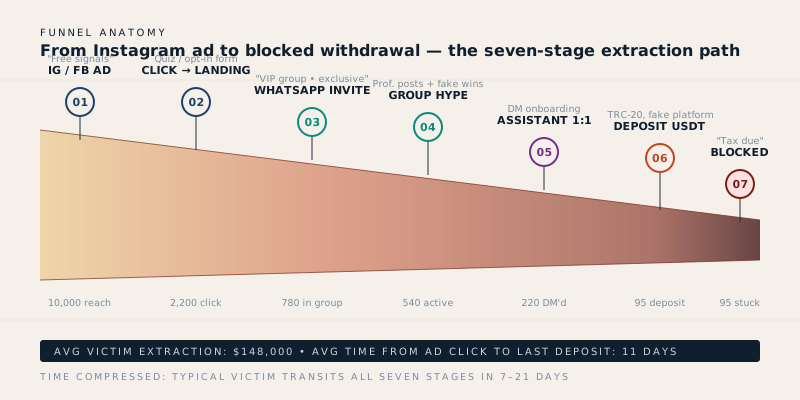
The WhatsApp investment club is a sales funnel. That framing matters because it tells you the operation is engineered, not improvised. There is a top-of-funnel acquisition step, there are intermediate engagement steps, there is a conversion step, there is a retention step (yes, even in fraud), and there is an extraction step. Every part of the script has been tested across thousands of victims and is now standardized.
Stage 1: The social-media ad
The funnel almost always starts with a paid ad on Instagram, Facebook, TikTok, or sometimes YouTube. The creative is usually a screen-recorded "trading dashboard" with green candles climbing in real time, voiced over by a young woman or a stock-AI voice promising a free signals group, a free educational course, or access to a portfolio manager's daily takes. Targeting is usually broad demographic (35-65, English-speaking, interest categories around investing or retirement), and the ad spend is high enough that researchers and journalists have repeatedly documented Meta's ad platform serving these creatives for weeks at a time before takedown.
Stage 2: The landing page and opt-in
Clicking the ad sends you to a sparse landing page with a quiz or an opt-in form. The form asks for your phone number under the framing that the "free signal group" will be sent via WhatsApp. The quiz often pretends to qualify you as "serious" or "eligible" for the group, which is a classic conversion-funnel technique to manufacture exclusivity. The phone number is the only thing the operator actually needs.
Stage 3: The WhatsApp invite
Within minutes to hours you receive a WhatsApp message from the "assistant" with a group invite link. The group already has 100 to 500 members. The group name is usually some variant of "VIP Global Macro Club," "Goldman BTC Signal Group," "BlackRock Asia Exclusive," or similar. The name is selected to imply institutional pedigree without actually claiming a real entity affiliation that would be cleanly libelous.
Stage 4: Group hype and credibility
This is the longest stage and the one that does the real work. For 5 to 14 days you observe the group from inside. The professor posts a daily morning "market open" analysis at 8 or 9 AM in your timezone. The post is two or three paragraphs of generic macro commentary mixed with a specific BTC or ETH price target. Other members — almost all sock puppets — reply throughout the day with screenshots of their alleged winnings, polite emoji reactions, and questions phrased to extract from the professor an answer that sounds like institutional-grade insight.
The cadence is engineered to reward attention. You see "Mark T." post a screenshot of a $4,200 withdrawal. You see "Sarah K." thank the professor for a call that was up 38% in a week. You see the group ask follow-up questions and get serious-sounding answers. You are conditioned to view the professor as a real authority and the group as a real community of beneficiaries. The fact that none of those names have any verifiable identity outside the group never registers, because the group itself is the social proof.
Stage 5: The assistant 1-to-1
At some point in week one or week two, the assistant DMs you directly. Her message is warm, professional, and personalized: "Hi! Prof Chen mentioned you joined recently and asked me to help onboard you to the platform when you're ready. No rush, just let me know." You are now in a private conversation with someone presenting themselves as the professor's administrative support, and the rest of the conversion happens here.
The assistant walks you through signing up on a website you have never heard of — some variant of an exchange-looking domain, often impersonating a real brand by one or two letters. She walks you through KYC (often a real-looking flow that uploads your ID to the operator's archive). She tells you the minimum deposit and gives you a USDT-TRC20 address to send to. This is the conversion moment.
Stage 6: The deposit and the "winning" trade
You send the first deposit, usually somewhere between $500 and $5,000. The assistant celebrates with you, tells you to wait for the professor's next signal, and walks you through the first "trade" on the platform. The trade wins. Your balance increases by 20 to 40 percent within a few hours. The assistant suggests you scale up. You deposit again, often at the urging of the professor's group post about a "limited window" on the next signal. The platform shows growing profits in real time. The dashboard is convincing because it is the operator's software and it can show whatever number they want.
Stage 7: The withdrawal block
You try to withdraw. This is when the extraction phase begins. The platform tells you that your withdrawal triggers a tax (usually 15 to 25 percent of the balance), an anti-money-laundering verification fee, a margin-account release fee, a credit-score check, or some combination thereof. The amount required is always almost exactly what you would need to deposit to receive your apparent balance. The assistant becomes urgent and helpful, offering to walk you through the additional payment. If you pay, the next withdrawal triggers another fee. The cycle continues until you stop paying. At that point the platform stops responding, the assistant goes silent, and the WhatsApp group typically removes you within hours or days.
Real exchanges do not require deposit of additional capital to release your existing balance. Ever. Not for taxes, not for AML verification, not for "margin release," not for "credit checks." If a platform tells you that you must deposit more money to withdraw what you already have, it is a scam. The mechanic is universal across every variant of fake-platform fraud, including pig butchering and Telegram investment scams.
The Four Roles in Every WhatsApp Investment Club Scam
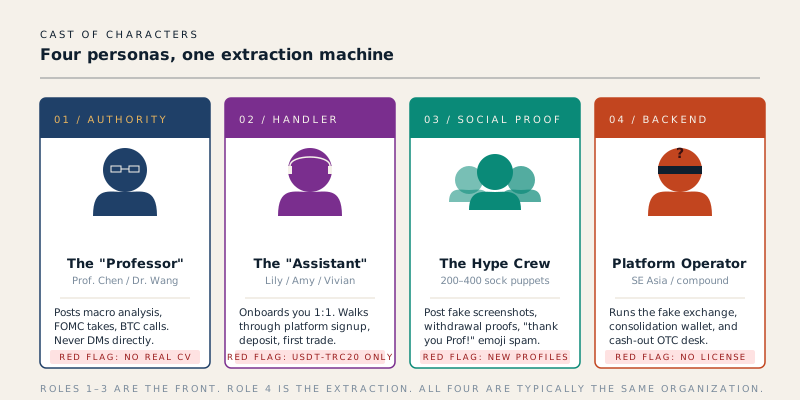
The operation has a recognizable cast. Once you can identify the four roles, the entire pattern collapses into something obvious. Each role is a different worker, often a different shift, sometimes operating from the same compound floor, but the role assignments are consistent across operations because the script has been refined.
Role 1: The Professor (authority)
The professor is the figurehead. The persona is almost always a middle-aged Asian male, usually photographed in a suit, sometimes in front of a Bloomberg-style screen, with a name like Prof. Chen, Dr. Wang, Professor Liu, or a Western surname like Anderson borrowed from a real academic. The stated credentials are typically "former finance professor at HKUST," "ex-partner at a Hong Kong hedge fund," or "portfolio manager at a Singapore family office." None of it is verifiable, and that is intentional: the persona is supposed to feel just credible enough that nobody bothers to check, while leaving no actual identity to subpoena.
The professor never appears on live video, never participates in spontaneous unscripted conversation, never DMs members directly, and never publishes anywhere indexed. The posts are pre-written and copy-pasted across multiple parallel groups by whoever is running the shift. The voice is consistent because the script is consistent.
Role 2: The Assistant (handler)
The assistant does the actual conversion work. The persona is almost always presented as a young female, named Lily, Amy, Vivian, Jessica, or some variant chosen for friendliness and non-threateningness. The profile picture is a stock photo or a stolen Instagram image. The conversation style is warm, polite, slightly deferential to the professor, and helpful with technical questions about the platform.
The assistant is the relationship the victim remembers most. She is the one who texted at the right time, walked through the deposit, congratulated you on the first winning trade, and stayed online when the platform started showing the withdrawal block. The assistant's job is to keep you depositing. She earns a percentage commission on every victim she closes, which is part of why the extraction phase is so aggressive. The persona is shared across multiple victims simultaneously; the same WhatsApp number that texted "you" is on twenty other victim conversations the same day.
Role 3: The Hype Crew (social proof)
The hype crew is the group's population of fake members. Estimates from operator chat-log leaks and academic research put the typical group composition at 20 to 60 percent sock-puppet accounts, with high-effort operations approaching 80 percent. The sock puppets post on a schedule. They congratulate the professor on calls that worked. They share fake withdrawal screenshots. They ask leading questions that prompt the professor to deliver pre-written content. They greet new members. They emoji-react. They build the appearance of a thriving community of real investors who are visibly benefiting from the professor's guidance.
The hype crew is the most operationally important role even though it gets the least individual attention. Without social proof, the professor is just one stranger on the internet making claims. With social proof, the professor is a verified authority backed by a community of grateful members. The psychology is the same as a restaurant with a line out the door versus an empty one; humans use the behavior of other humans as a strong default signal of quality. The hype crew weaponizes that default.
Role 4: The Platform Operator (backend)
The platform operator is the entity that built and runs the fake exchange dashboard, the consolidation wallet, the cash-out routing, and the OTC desk relationships on the back end. The operator is the only role you never meet. The operator is also the role that holds your money, makes the actual extraction decisions, and disappears the platform when the operation rotates to a new brand. The operator is almost always organizationally connected to a compound facility in Cambodia (Sihanoukville, Bavet, Poipet), Myanmar (KK Park, Shwe Kokko, Tachileik), Laos (Bokeo Province), or the UAE. The same compound infrastructure that runs pig butchering operations runs investment-club operations; the front-end scripts differ but the back-end laundering is shared.
The platform operator's presence is visible on-chain. Every victim deposit flows into the operator's consolidation wallet within hours. That consolidation wallet is the forensic chokepoint, which is what makes the investigation feasible even though the operator is invisible to the victim. For more on the laundering pipeline shared across these operations, see Tron USDT tracing for law enforcement.
Why This Is NOT Pig Butchering (Even Though It Looks Similar)
I want to be direct about this because the misclassification matters. Pig butchering and the WhatsApp investment club share back-end infrastructure, share USDT laundering routes, often share operators, and end in the same fake-platform withdrawal block. They are different fraud patterns and they should be treated as different fraud patterns when you are reporting, when you are investigating, and when you are filing.
| Dimension | Pig Butchering | WhatsApp Investment Club |
|---|---|---|
| Initial contact | Unsolicited "wrong number" SMS, dating app match, LinkedIn connection | Paid Instagram/Facebook/TikTok ad, opt-in funnel, WhatsApp group invite |
| Trust mechanism | One-on-one relationship over weeks: romance, friendship, business mentor | Group peer pressure plus fabricated authority figure |
| Time to first deposit | 4 to 12 weeks (sometimes 6 months) | 7 to 21 days |
| Persona presented to victim | One scammer (the "girlfriend" or "mentor") | Three plus visible personas (professor, assistant, hype crew) |
| Investment pretext | "I'll show you how I make money" — introduced organically late | Investment is the explicit reason the group exists from day one |
| Romance / intimacy element | Central | None |
| Platform branding | Often a generic-looking custom platform | Often impersonates a major brand (BlackRock, Goldman, JPMorgan) |
| Withdrawal block mechanic | Tax / verification fee on apparent profits | Tax / verification fee on apparent profits (same) |
| On-chain laundering | USDT, Tron rails, SE Asia OTC off-ramps | USDT, Tron rails, SE Asia OTC off-ramps (often shared infrastructure) |
The two patterns converge on the back end and diverge on the front end. For investigators, that means the on-chain trace work is similar but the evidence preservation, the IC3 narrative, the SEC complaint framing, and the civil action vectors are different. For victims, it means the recognition signal is different: if you are reading the romance-scam tells in a pig-butchering article and concluding "that's not me, I was never in love with anyone," you may miss that the WhatsApp investment club is the version of the same problem you are actually living through. The mental model needs to be specific.
If your case has a romance element, my pig butchering scam recovery deep-dive is the right reference. If your case is the professor-and-assistant-and-group pattern, this article is.
The "Professor" Persona: Why It Works
The professor is the most psychologically engineered role in the operation. The choice of an academic credential rather than, say, a hedge fund partner credential is deliberate. Academia carries a specific kind of trust signal in the retail investor mind. A professor is supposed to be a teacher, not a salesman. A professor is supposed to publish, to be cited, to operate inside an institutional framework. A "former finance professor at Hong Kong University of Science and Technology" sounds like someone who decided to share their wisdom with regular people, which is exactly the framing the operation needs.
Why a middle-aged Asian male, specifically? Three reasons. First, the target demographic for U.S. retail investment fraud skews older and Western, and the professor persona benefits from a slight cultural othering that makes the credentials harder to instinctively verify (you are unlikely to call HKUST's registrar office to confirm). Second, the operations themselves are run primarily by Mandarin-speaking organized crime networks staffed by trafficked Chinese-language speakers; the persona reflects the talent pool. Third, the Asian-finance-expert archetype carries a positive halo in retail investor culture around currencies, commodities, and global macro trades, which is the content the professor produces.
The content the professor posts is engineered to feel insider without committing to anything checkable. A typical morning post reads something like:
"Good morning members. Overnight the FOMC minutes confirmed the dovish tilt I called Tuesday. BTC found support exactly at the 61.8% retracement I flagged in the chart yesterday. My institutional desk is positioning long into Thursday's CPI print, target zone $112,400 with stop at $107,200. New members: review the pinned message before requesting a 1:1 with Lily. Today's signal will be posted at 14:00 ET. Trade safe."
Every element of that paragraph is engineered. The FOMC reference establishes macro literacy. The specific retracement number sounds technical. The price targets are precise enough to feel committed but loose enough to be defended either way. The mention of "my institutional desk" implies access. The pinned-message gate manufactures process. The scheduled signal creates anticipation. The "trade safe" closer is the only language a real professor might actually use, and its presence sells the rest of the paragraph as authentic.
None of it is original analysis. The content is rotated across a stable of professor personas running parallel WhatsApp groups under different brand names. The same morning post, with minor variations, appears in twenty groups simultaneously. The operator's shift workers copy-paste from a central content pool.
The Hype Crew Effect: How Fake Members Create Pressure
The hype crew is what makes the rest of the operation work. Without the group's apparent population of grateful, profitable members, the professor would just be a stranger with a Telegram-style price target list. With the crew, the professor is the leader of a community visibly benefiting from his guidance, and the victim's decision to deposit becomes the decision to join rather than the decision to trust an outsider.
The compositional anatomy
Academic research and operator chat-log leaks suggest typical group composition runs 20 to 60 percent sock puppets on entry-tier operations, with higher-effort schemes pushing to 80 percent or more. The crew accounts share a few recognizable traits when you look for them: profile pictures that reverse-image-search to stock photo libraries, account creation dates clustered tightly within the few weeks before the campaign launch, message histories visible only inside this single group, and posting patterns that follow a daily rhythm (peak activity at the professor's scheduled post times, near-zero activity at other hours).
The choreography of fake proof
Crew posts are scripted. A daily rotation typically includes:
- The screenshot post. One or two members per day post screenshots of their "dashboard," usually showing a large green number and a withdrawal confirmation. The screenshots are templated images generated from the platform's admin panel, identical in layout because they came from the same backend.
- The thank-you post. Crew members post "thank you Prof Chen, withdrew $X today" messages calibrated to the dollar amounts the operator wants victims to start aspiring to.
- The leading question post. A crew member asks a question phrased to extract a specific pre-written content block from the professor ("Prof, can you explain why the 200-day MA matters here?"). The question primes the professor to perform expertise and primes new members to consume that expertise as authentic.
- The new-member welcome. Crew members greet new arrivals enthusiastically, which both legitimizes the group and signals to the new member that other members are paying attention to who joins.
- The urgency post. Closer to scheduled signal times, crew members post "is it 14:00 yet??" messages to manufacture anticipation around the professor's next call.
Why peer pressure works without romance
Pig butchering uses the trust generated by an intimate one-on-one relationship to drive deposits. The investment club substitutes a different and arguably more efficient psychological mechanism: social proof at scale. The victim is not being persuaded by one trusted person; they are being shown that two hundred apparent peers have already made the decision they are considering, and that those peers are visibly happy with the outcome. The decision to deposit becomes a decision not to be the outlier who missed it. That mechanism does not require weeks of romantic grooming. It can compress to days.
This is the structural reason the investment club is faster and scalable in a way pig butchering is not. Pig butchering requires a roughly one-to-one ratio of scammer-hours to victim, sustained over weeks. The investment club uses a one-to-many ratio: one professor and one assistant can carry hundreds of victims in parallel because the social proof is generated by automated and semi-automated sock-puppet activity. The unit economics are very different, which is why this pattern has been growing in volume share against pig butchering in 2024-2026.
Where the Money Actually Goes On-Chain
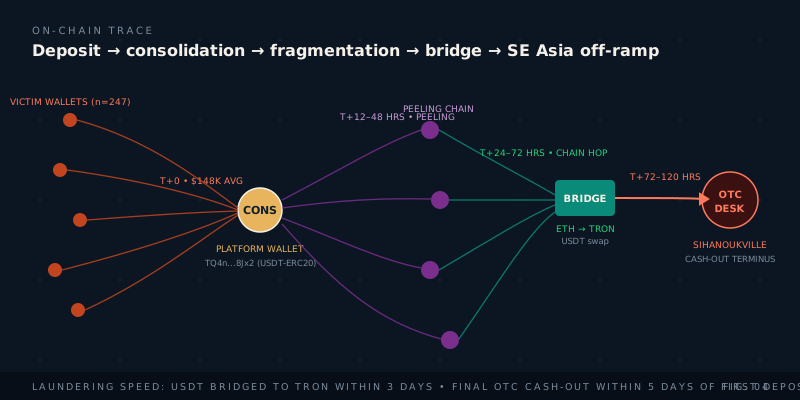
This is the part of the investigation I do every week. The deposit you sent to the assistant's "company wallet" address has a documented on-chain path, and the path is structurally similar across hundreds of victims of the same operation.
Hop 1: Deposit to campaign intake
The wallet address the assistant gave you is typically a campaign-specific intake wallet. It exists to receive deposits from a defined cohort of victims (often the population of one WhatsApp group, or a small set of related groups) and rarely has a long activity history. From your perspective the deposit looks like "I sent USDT to my new account." From the chain's perspective the deposit landed at a wallet that has, over the past few weeks, received many incoming transfers from many unrelated source wallets, all of which match the demographic and amount profile of investment-club victims.
Hop 2: Sweep to consolidation wallet
Within hours, the campaign intake wallet sweeps its balance to a larger consolidation wallet that aggregates funds from multiple campaign intakes operated by the same back-end. This is the forensic chokepoint. The consolidation wallet receives funds from many parallel campaigns, holds substantial balance, and is the address an investigator anchors the rest of the trace to. Because the consolidation wallet aggregates across the operator's full customer base, it is also the address that ties multiple SEC, CFTC, and state-level enforcement actions to a single operator network.
Hop 3: Fragmentation and peeling
From the consolidation wallet the operator initiates a peeling chain: a series of partial transfers that "peel" small fragments off the main balance into intermediate wallets, layering the trail and complicating naive transaction-graph analysis. The fragmentation pattern is recognizable to investigators because the layering is templatized; the same operator uses the same peeling depth, similar amounts, and similar time spacing across campaigns.
Hop 4: Bridge to Tron USDT
The peeled fragments converge at a bridge or DEX swap that converts Ethereum-based USDT (or wrapped equivalents) to Tron-based USDT. Tron is the dominant cash-out rail for this category of fraud for three reasons: fees are negligible (so the operator can move large amounts cheaply), background USDT volume on Tron is enormous (which camouflages the laundering inside legitimate volume), and the Tron ecosystem has a long-established OTC desk culture in the operating jurisdictions. The bridge transaction is where the trace usually crosses from chain to chain, but it does not break: cross-chain attribution is standard work for any forensic investigator with current tooling.
Hop 5: OTC desk cash-out
The final hop is to an OTC desk operating out of or near the compound jurisdiction — commonly Sihanoukville (Cambodia), the Myanmar-Thai border region, or the UAE. The OTC desk converts USDT to local fiat (yuan, Thai baht, Khmer riel, dirham) in cash or to bank wires that re-enter the formal financial system at a downstream institution. From the victim's perspective the money is gone at this point. From the investigator's perspective, the trace is complete and the destination cluster is documentable evidence.
The full pipeline from your deposit to the OTC cash-out typically completes in 3 to 7 days. That window is the operational reason early reporting matters. Funds that are still mid-pipeline can sometimes be frozen at a centralized exchange or via Tether's contract-level freeze authority. Funds that have completed the OTC cash-out are functionally outside the recoverable perimeter and the work shifts entirely to attribution and law enforcement. For the recovery mechanics around frozen USDT specifically, see stolen USDT recovery.
What an investigator produces is a written evidence package: the deposit transaction hash, the campaign intake wallet, the sweep to the consolidation wallet, the peeling chain, the bridge transaction, the Tron-side wallet, and the OTC cash-out terminus, with confidence ratings on each attribution. That package is what supports a Tether freeze request, an exchange subpoena, an SEC or CFTC complaint augmentation, an IC3 escalation, and a civil pleading against named individuals where attribution permits. It is not a guarantee of restitution.
What to Do If You're In One of These Groups Right Now
This is the most useful section if you are reading this article because something feels off about a WhatsApp group you joined recently but you have not yet deposited or have just deposited and are nervous. The window in which you can avoid the worst outcome is narrow; it closes when you either send the first material deposit or when the "tax to withdraw" phase begins.
If you have not deposited yet
- Stop responding to the assistant. Do not engage in the small talk, the "tell me about your investment goals" conversation, or the platform walkthrough. The walkthrough is the conversion ramp; once you finish it you have deposited.
- Do not click any platform links from the assistant. Do not register on the website. The KYC upload alone hands your identity documents to the operator.
- Reverse-image-search the professor's profile photo. If it returns a stock photo library or a stolen LinkedIn picture, you have your answer.
- Search the professor's claimed credentials. Real finance professors are indexed: Google Scholar profiles, university faculty pages, published papers. If the professor is "former HKUST faculty" and HKUST's archived faculty pages do not list them, the credential is fabricated.
- Search the platform domain on Investor.gov and the SEC's litigation releases. If the platform or the affiliated entities show up in a recent enforcement action, you have direct confirmation. If they do not, that does not prove legitimacy; many platforms operate for months before getting named.
- Leave the group. Save your evidence first (next checklist).
- Report the group to WhatsApp. Use the report-group function. WhatsApp's moderation is imperfect but each report contributes to platform-level signal.
- Report the social media ad that recruited you. If you remember the ad creative or the landing page URL, report to Meta or TikTok. These platforms have been criticized publicly for slow takedown; the more reports, the faster the response.
Evidence to save before you leave
- Screenshots of the group, including the member count, the group description, and several days of the professor's posts
- The professor's WhatsApp profile (number, profile photo, "about" text)
- The assistant's WhatsApp profile and the full DM history with her
- The platform website URL and screenshots of the registration flow and the dashboard
- The original social media ad creative and the landing page URL, if you can find them in your browser history or in Meta's ad library
- Any wallet addresses the assistant gave you for deposits, even if you have not yet sent
- Your phone's WhatsApp chat export for the group (Settings → Chats → Export Chat)
For the broader recognition framework see our knowledge base on scam identification and our companion piece on can you get crypto back after being scammed.
What to Do If You Already Deposited
If you have already sent USDT to the assistant's wallet address, the timeline shifts. The most important things to do, in the first 72 hours, are these:
Hour 0 to 6: Stop the bleeding
- Do not send another transaction. Not for the "withdrawal tax," not for the "AML verification fee," not for anything. Every additional transfer compounds the loss and the "winning" balance you see on the platform is not real.
- Do not log into the platform again. Do not click any platform links. Some operations install browser-side tracking or session-hijacking elements; assume the platform is hostile end to end.
- Preserve all evidence before you delete or block anyone. Use the evidence list above. The assistant's phone number, the group's full export, the deposit addresses, the platform URL, and your wallet's transaction history are the forensic minimum.
- Document every deposit transaction hash. From your sending wallet's explorer view, save the hash, the destination, the timestamp, and the amount for each transfer.
Hour 6 to 24: Report
- File at IC3.gov. The FBI's Internet Crime Complaint Center is the primary federal portal. Include the deposit addresses, transaction hashes, the WhatsApp group name and number, the assistant's contact info, and the platform URL. See our guide on how to report a crypto scam to the FBI for the full IC3 procedure.
- File with the SEC. Use the SEC's tips and complaints portal at sec.gov/tcr. Reference the investment-club typology and any platform branding (especially if the platform impersonates a real registered firm). The SEC's December 2025 action shows the Commission is actively prosecuting this category.
- File with the CFTC if the platform claimed any commodity-derivatives or futures activity (oil, gold, BTC perpetuals). The CFTC's complaint portal is at cftc.gov.
- File with your state attorney general or state securities regulator. Many states have brought parallel actions and state agencies have faster turn-around on consumer-facing relief than federal agencies do.
- File with the FTC. ReportFraud.ftc.gov captures the consumer-protection side and feeds Consumer Sentinel, which informs the broader law-enforcement picture.
- Notify any exchange where you bought the USDT. If the chain of custody runs through a U.S. exchange (Coinbase, Kraken, Crypto.com), notify their compliance team in writing.
Hour 24 to 72: Engage forensic counsel
If the loss is material (typically $5,000+), engage an independent blockchain forensic investigator. The trace work is time-sensitive because funds may still be in transit through the consolidation, peeling, and bridge stages. A trace initiated within 72 hours has a meaningfully higher chance of identifying still-frozen-eligible balances than one initiated weeks later. The deliverable is the evidence package described above. Investigators provide this work through engagements like digital asset tracing and crypto scam investigation.
For the broader post-incident framework that applies regardless of which scam variant you fell into, see our knowledge base on what to do after theft and our piece on legitimate crypto recovery vs scam services. Do not engage anyone who reaches out to you offering guaranteed recovery for an upfront fee. That outreach is itself a fraud, and recovery-scam targeting of investment-club victims is now its own industry.
Within hours to days of your first IC3 filing or your first post about your loss on social media, you will start receiving DMs and emails from "recovery agents" promising to retrieve your stolen funds for a fee. These are universally fraudulent. Legitimate forensic investigators do not cold-DM victims, do not promise guaranteed recovery, and do not require large upfront fees billed as "hacker fees" or "exchange release fees." Do not engage.
Why Recovery Is Hard But Forensic Tracing Still Matters
I will be direct about this: the realistic recovery rate for WhatsApp investment club losses is low. The funds move quickly, the consolidation wallets sit at the back end of a multi-hop laundering pipe that often crosses chains, and the final OTC cash-out commonly lands in jurisdictions where U.S. asset recovery has limited reach. The base-rate expectation should be that most of the money is gone. Anyone selling you a different expectation is selling you a story.
That does not mean the forensic work is pointless. The opposite is true. The work is valuable for four specific reasons that are usually not explained clearly to victims.
1. Aggregation amplifies any one case
The SEC's December 2025 action was not built on a single victim's complaint. It was built on a pattern of complaints and on-chain evidence that consolidated across many parallel victims into a coherent picture of seven coordinated entities. Your individual case may not, on its own, justify a federal investigation. The same case as one of two hundred similar cases tied to the same consolidation wallet is part of the aggregated record that drives enforcement. Filing your case, even if recovery never materializes, contributes to the aggregation that makes the next enforcement action possible.
2. The Tether freeze pipeline is real and growing
Tether has frozen multi-billion-dollar volumes of USDT at the contract level across thousands of cases tied to investment fraud, often in cooperation with law enforcement. Where your funds remain identifiable at an address Tether is willing to freeze, the contract freeze is functionally a permanent immobilization that can later be released to victims through a remission process. The window for that intervention is narrow and depends on the freeze landing before the operator cashes out, which is part of why early action matters. For mechanics see stolen USDT recovery.
3. Civil action against named individuals is sometimes viable
When forensic attribution identifies a specific operator individual, sometimes through KYC traces at the off-ramp exchange, sometimes through pattern matching against known clusters, the civil track opens up. John Doe pleadings, Section 1782 discovery actions targeting foreign exchanges, and asset freezes can occasionally produce restitution in cases with sufficient documentation and a named defendant. For the broader question of civil action, see our piece on can you get crypto back after being scammed.
4. The evidence package is a permanent record
Even when immediate recovery is not possible, a well-built evidence package preserves the case for the future. Operators get arrested years later. Compounds get raided. Jurisdictions update mutual legal assistance treaties. Asset seizures that complete in 2028 sometimes distribute back to victims through the DOJ's remission process or through Tether's release-to-victim mechanism. The cases that participate in those distributions are the ones with documented forensic records on file. Without the record, you are not in the pool.
For the broader honest framing on what is and is not achievable, our companion analysis on can you get crypto back after being scammed walks through the realistic recovery channels and our piece on Tron USDT tracing for law enforcement covers the rails investigators actually use.
Frequently Asked Questions
Lost USDT to a "professor" in a WhatsApp group? Start with a free scoping call.
If you deposited to a fake platform after recruitment through a WhatsApp investment-club group, we will scope the trace from the deposit address through the consolidation wallet, the peeling chain, the bridge to Tron USDT, and the off-ramp terminus. Initial assessments are free and we respond within 24 hours.
Start a Free Case Review