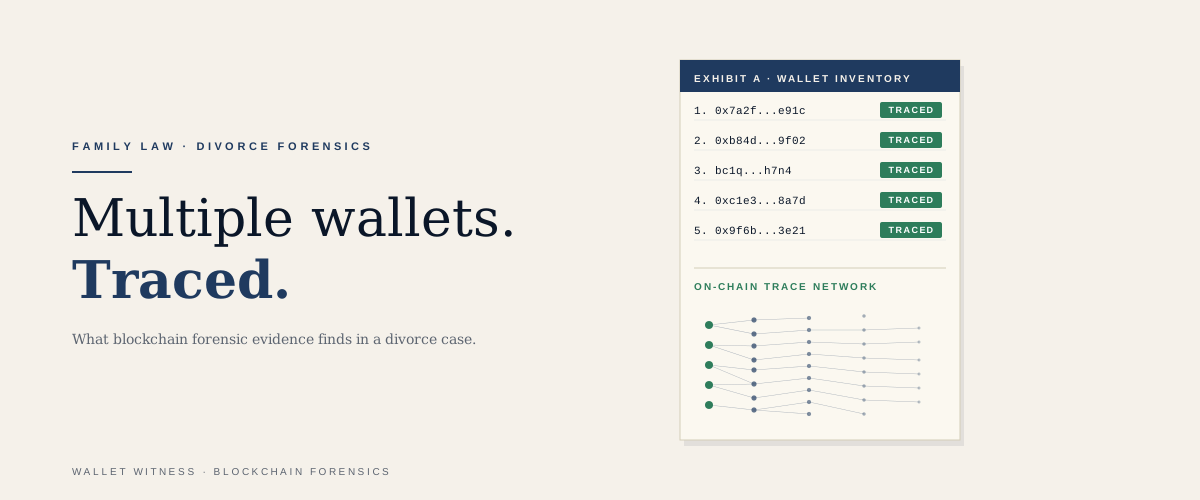
The short version. Engage a blockchain forensic specialist when you have at least two concrete on-chain signals in the file — a hardware wallet device found at the marital home, a Form 8949 line on a prior joint return, an unexplained bank-to-Coinbase transfer pattern, a spouse who used to work at Kraken, a lifestyle that does not match the disclosed W-2. One signal you can usually run through interrogatories and an exchange subpoena. Two or more and standard discovery will leave the asset class invisible.
Why early matters. The cheapest, highest-leverage moment is before you draft your first set of interrogatories — a 30-minute scoping call shapes the discovery requests so subpoena returns come back already pointed at the right wallets. The most expensive moment is two weeks before trial when a settlement just collapsed.
What you get. A written forensic report you can put under a custodian-of-records affidavit, an exhibit-ready wallet map keyed to the dates your jurisdiction cares about, and a declarant who has been through a Daubert challenge before. Most files settle on the report. The ones that do not go to a 1-day testimony engagement.
In This Article
- Why I’m writing this for the attorney, not the client
- Five signals a divorce file needs a crypto forensic expert
- Introducing the engagement to your client without alarming them
- How the work fits the litigation calendar
- What the report looks like and how courts receive it
- From artifact to bank account: the evidence pipeline
- Forensic accountant + blockchain specialist: why you probably need both
- Common mistakes attorneys make in crypto cases
- When you don’t actually need a crypto expert
- Frequently asked questions
Why I’m Writing This for the Attorney, Not the Client
Most of what I write on this site is for the spouse who suspects something. This piece is different. I’m writing it for you — the family-law attorney who has had at least one case in the last year where the word "crypto" came up and you weren’t totally sure what to do with it. Maybe the husband’s 1040 had the digital-asset box checked "yes" for three years running and the disclosure schedule said zero. Maybe the wife’s credit-card statement had a $90 Ledger Shop charge from 2021 that nobody mentioned. Maybe a child casually said "dad has that little USB thing with the screen on it" during a parenting interview.
Honestly, the question I get asked more than any other from family-law counsel is not can you trace it. It’s do I even have enough to justify bringing you in. So I want to answer that question first, before anything else, because the wrong answer in either direction costs your client real money. If you under-engage, the asset class stays invisible and the equitable distribution is just wrong. If you over-engage, you spend $8K of marital funds chasing a $4K position and the judge looks at you sideways at the next status conference.
A quick note on what I do. I’m an independent blockchain forensic investigator. I work mostly on civil matters — divorce, partnership disputes, victim cases, the occasional bankruptcy — and I’ve sat for depositions and given trial testimony enough times to have an honest sense of how courts receive this kind of evidence. I’ve been the called expert; I’ve also been the rebuttal expert against another investigator’s report. The view in this article is the view from that seat.
Five Signals a Divorce File Needs a Crypto Forensic Expert
Let’s do the threshold question. When does the file actually warrant a specialist? My working rule is two or more of the following signals. One can usually be handled through normal civil discovery and a Coinbase subpoena. Two or more and you have a structural problem that interrogatories alone won’t reach.
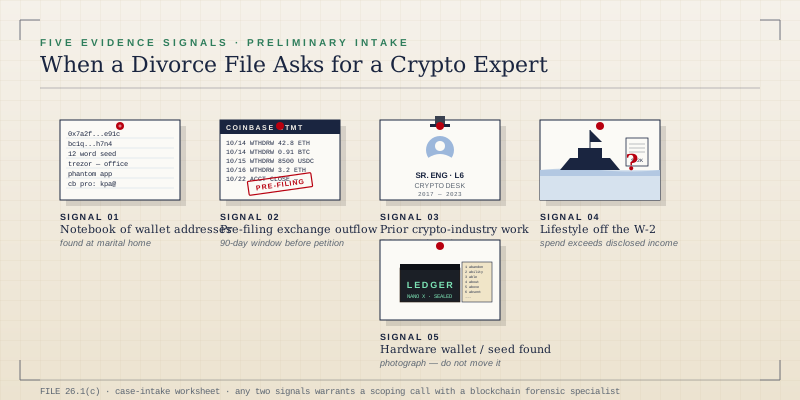
1. A physical artifact in the marital home
A Ledger box. A Trezor in a drawer. A notebook page with 12 or 24 single English words written in a column — that is almost always a BIP-39 seed phrase. A sticky note on a monitor with a hex string starting 0x. Any of these things, even if the spouse claims they’re "old" or "empty," is a signal. Wallets do not behave the way an old checking account does. A wallet from 2017 that was "forgotten about" might hold a 14 ETH balance because the spouse moved it into staking in 2021 and the ledger entry just sat there earning yield.
2. A pre-filing exchange outflow pattern
This is the one I get most excited about because it is also the cleanest dissipation evidence in the case file. Subpoena the spouse’s known Coinbase, Kraken, or Gemini account — even just the one you already have line of sight to from a credit-card welcome email — and look at the 90 days before the petition. If you see large crypto withdrawals to external addresses inside that window, especially if they cluster, you have a story worth telling. Not necessarily concealment in the criminal sense, but at minimum an unusual pre-filing movement of marital assets out of a custodial venue and into self-custody.
For the legal hook on dissipation specifically, I’ve written a longer piece on crypto dissipation claims in divorce that walks through the framing. The signal at this stage is just: large withdrawal close to filing means you almost certainly need someone who can follow those addresses.
3. Prior crypto-industry employment or technical sophistication
If the spouse worked at Coinbase, Kraken, Anchorage, Fireblocks, Galaxy, a crypto-native VC, an Ethereum core protocol team, a Solana DAO, a Bitcoin mining operation, or a derivatives venue like Deribit, you should treat the entire crypto question as serious by default. Same goes for tech-adjacent roles — senior engineers at FAANG often hold meaningful equity in tokens through grants, hackathon prizes, or early-cap-table positions in token-issuing portfolio companies.
This is also the population where token grants and RSU-equivalent equity instruments live. A senior engineer at a 2021-vintage crypto startup may have received a token grant worth nothing at vesting that is worth seven figures today. That instrument is not on any W-2, it’s not on a brokerage statement, and the spouse is often genuinely unsure whether they have to disclose it. (For the record: yes, they do.)
4. Lifestyle materially inconsistent with disclosed income
The classic forensic-accountant flag, transposed onto a crypto context. Disclosed AGI of $140K. Mortgage on a $2.4M home. Boat in dry storage. Three international trips a year. Two cars over $80K. The W-2 doesn’t support the burn rate, and the savings account doesn’t either. Where is the money coming from? In 2018 the answer was probably an offshore account or undisclosed business income. In 2026 the first hypothesis I’d test is undisclosed crypto, often in the form of liquidated long-term positions or DeFi yield being drawn down piecemeal.
5. A digital-asset checkbox "yes" on a prior 1040
Since the 2020 tax year, Form 1040 has carried a digital-asset question right under the name and address block. If the box is checked "yes" on a prior joint return, there was at least one taxable crypto event that year — sale, exchange, receipt as payment, mining, staking, airdrop. If the box is checked "yes" and the disclosure schedule is silent on crypto, you have a representation problem on the record. Look also for Form 8949 attachments. Form 8949 entries are dispositions; the basis trail behind them tells you the spouse’s acquisition history.
For the deeper version of the red-flag list, see my longer write-up on hidden crypto assets in divorce. The five signals above are the ones I’d weight most heavily at intake.
Introducing the Engagement to Your Client Without Alarming Them
This part nobody talks about and it’s genuinely awkward. You’ve identified two signals. You think the file needs a specialist. Now you have to tell your client that you want to spend $5,000 of their money on a thing they’ve never heard of, in a case where they’re already terrified about money.
The framing that works best, in my experience, is to treat it as you would any other forensic accountant or business valuator. You’re not telling them their spouse is a criminal. You’re telling them there is a category of marital asset that doesn’t show up on bank statements, that you have specific reasons to think exists in their case, and that has a known cost to investigate. You’re proportioning the spend to the likely exposure. That’s a conversation an attorney has every week about depositions, vocational evaluators, custody evaluators, and forensic accountants. This is the same conversation.
A few things I’d avoid in that first conversation:
- Don’t promise the client a number. You don’t know the number yet. The investigator doesn’t either, until they trace.
- Don’t use the word "recovery." This is a documentation engagement, not a recovery engagement. What we produce is evidence; what your client recovers depends on the court’s remedy. Promising recovery is what bad recovery-scam outfits do, and it makes the client’s expectations wrong from day one.
- Don’t frame it as "catching" the spouse. Most clients are not in a punitive headspace; they’re in a survival headspace. Frame it as completing the asset inventory.
- Be honest about the floor and ceiling. Some files end up with the investigator confirming there’s nothing material there, and that’s a useful answer too — it lets you stop spending on that line and focus on the rest of the case.
One useful move: the scoping call itself. Most reputable blockchain forensic investigators (I do this; so do most of my peers) will do a 30-minute scoping call free of charge. You can sit in on it with the client. The investigator looks at what’s known, asks pointed questions, and gives you a preliminary view on whether there’s anything to chase. Cost: zero. Value: it converts an abstract worry into a concrete go / no-go decision.
If you want to get a feel for how the relationship typically structures, I’ve written about engaging an independent investigator for digital asset tracing on the services side, and a longer companion piece on how blockchain forensic evidence is presented in civil litigation.
How the Work Fits the Litigation Calendar
The single biggest mistake I see — and I see it constantly — is the late engagement. Counsel calls me three weeks before trial because mediation collapsed and now the spouse’s undisclosed crypto exposure is suddenly the unknown that needs to be quantified by Monday. That call is fine. I’ll take it. But the work product I can produce in three weeks under rush conditions is meaningfully less useful than the work product I could have produced if I’d been brought in eight months earlier.
Here’s how the engagement should sequence against a typical family-law calendar:
Before initial discovery (the cheap and highest-leverage moment)
A free scoping call. The investigator looks at what you already have — tax returns, intake notes, anything the client brought in — and gives you targeted feedback on what to ask for in your first set of interrogatories and document requests. This is the moment where I can save you the most time by telling you to specifically request every wallet address ever controlled, every exchange account ever opened, every NFT wallet, every API key issued, and screenshots of any portfolio-tracker apps (Zapper, DeBank, Zerion, Step Finance) on the spouse’s phone — rather than the standard "all crypto assets" line that produces zero useful information.
After your first subpoena returns
When the Coinbase or Kraken response comes in, send it to the investigator. The withdrawal-address list is the single most important field, because every one of those addresses is a starting point for downstream tracing. The investigator produces a written preview — usually a few pages — identifying which destinations are other exchanges (subpoena targets), which are self-custody, which are bridge contracts to other chains, and which are anything more interesting (mixers, gambling sites, suspect counterparties). That preview lets you scope your second wave of subpoenas intelligently. I covered the subpoena side of this in civil subpoena for crypto exchanges in divorce.
Before your expert disclosure deadline
Full forensic report. Methodology section, attribution, trace, current holdings, valuation at the dates your jurisdiction has identified. This is the document that has to land before disclosure cutoff so the report itself can be designated. Aim to commission it 6 to 10 weeks before the deadline; complex multi-chain files can take longer.
Before mediation
A short summary memo, 2 to 4 pages, suitable to disclose to opposing counsel as part of pre-mediation positioning. You don’t typically share the full report at this stage — you share enough to make clear the asset inventory is now adversarial-grade. Most cases I’ve worked settle here. The other side’s counsel reads the summary, calls their own forensic person to validate, and the spouse’s posture changes because the gap between "maybe they have something" and "here are the wallets, the balances, and the dates" is enormous.
At deposition and trial
If the case proceeds, the investigator is deposed and then testifies. For deposition prep, expect to spend a session walking through likely cross on the heuristic basis for each wallet attribution, the limitations of clustering, and how the report handles ambiguity. For more on what the underlying expert report looks like procedurally, see Rule 26 expert report for cryptocurrency cases.
Engaging the investigator after mediation collapses is almost always too late to use the work to influence settlement, which is where most of the leverage is. The full report takes 4 to 10 weeks to produce under non-rush conditions. If trial is six weeks out and you don’t have one yet, you are now choosing between a rushed report or no report. Both options are worse than the version of this case where you scoped at intake.
What the Report Looks Like and How Courts Receive It
So what does the actual deliverable look like? Let me describe a typical mid-complexity report so you have a mental model.
The document opens with a qualifications section — the investigator’s background, certifications (CCI, CFE, CCFI, the relevant industry credentials), prior expert testimony engagements, and any peer-reviewed publications or industry presentations. This is the section that does the Daubert work upfront, before the methodology even begins.
Then a methodology section. This explains, in language a non-technical reader can follow, the underlying premises of blockchain forensic analysis: that the chains examined are public ledgers; that transactions are immutable once confirmed; that wallet clustering relies on well-published heuristics like common-input ownership (introduced in Meiklejohn et al., "A Fistful of Bitcoins," 2013, and used continuously by Chainalysis, TRM Labs, Elliptic, and federal law enforcement since); that attribution is probabilistic, not absolute, and the report says so explicitly; that the tools used are the same tools used by FinCEN, the IRS-CI, the FBI, and the major exchanges’ compliance teams.
Then the actual analysis. Source data list. Wallet table with the attribution heuristic for each address. Trace narratives for each material outflow from disclosed accounts. Current holdings table with USD valuation as of the relevant dates. Appendices with transaction hashes, screenshots of relevant block explorer views, and a glossary.
On admissibility specifically: blockchain forensic methodology has been received by federal and state courts under Daubert in dozens of reported decisions across criminal and civil contexts since roughly 2016. The methodology rests on testable, peer-reviewed heuristics with known error properties, used by a defined community of practitioners, and is generally accepted within that community. Family courts that have considered the question have generally admitted the testimony, and I haven’t personally seen a Daubert challenge succeed against a properly drafted methodology section — though the bar is higher in the federal civil context than in many state family courts, and a thin methodology section is genuinely vulnerable. I wrote a longer treatment of this in Daubert standard and crypto forensic testimony for attorneys who want to see the case-law architecture.
One caveat worth flagging. Family court judges vary widely in their comfort with this evidence. A bench judge in a metropolitan jurisdiction who has seen crypto cases for five years now will engage with the report on its substance. A bench judge in a rural circuit who has never seen one will sometimes ask the investigator to back up and explain "what is a wallet, exactly," on direct examination. That is not a failing of the methodology; it’s a function of where the legal system is. Your job, working with the investigator, is to anticipate where on that spectrum your judge sits and tune the testimony accordingly. For more on what a courtroom-ready engagement actually feels like, see our expert witness services page.
From Artifact to Bank Account: The Evidence Pipeline
Here’s the full pipeline, end to end. This is what you’re actually buying when you engage the specialist.
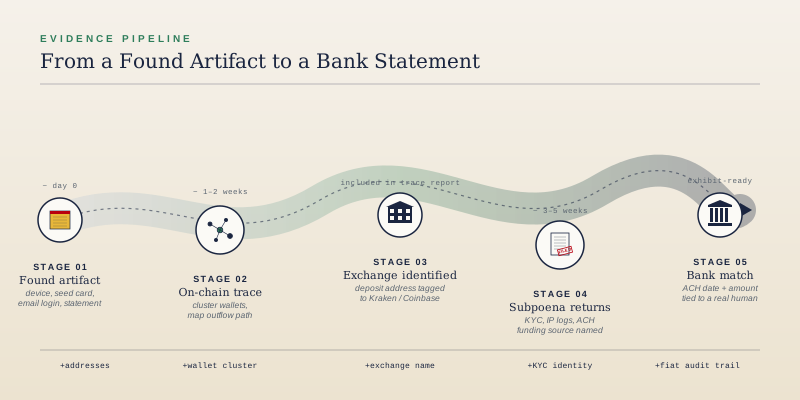
The starting point is always something pedestrian. A hardware wallet device in a drawer. An email login someone forgot to delete. A 1099-MISC from a staking platform in a shoebox of tax documents. A line item on a credit-card statement from the Ledger Shop. The investigator does not need much; one thread is usually enough to start pulling.
From there, the on-chain trace begins. Each known address is examined: what wallets did it transact with, what consolidation patterns are visible, what other addresses share funding sources or behavior that suggest common control. Wallet clustering expands one address into a network of likely-related addresses. Heuristics are documented; ambiguity is acknowledged in the report.
Exchange identification is the inflection point. When a traced address is identified as the deposit address of a centralized exchange — Kraken’s tagged deposit cluster, say, or a Coinbase customer-specific deposit address — you now have a real subpoena target. This is the moment the on-chain layer hands off to the legal-process layer.
The exchange’s subpoena response brings back KYC: name, address, government ID on file, phone number, login IP history, ACH funding source if any. That funding source is the bridge to the fiat world. The bank account that funded the exchange deposit is, almost always, in the spouse’s name. Suddenly you can put the wallet, the exchange account, the IP address of the spouse’s home or office, and the bank account funding the whole pipeline together in front of the judge as a single exhibit. The story is no longer abstract; it is a documentary chain of custody.
That’s the work, end to end. Every step is verifiable by an opposing expert; the chain doesn’t care who looks at it. That verifiability is the reason the methodology survives Daubert.
Forensic Accountant + Blockchain Specialist: Why You Probably Need Both
I want to address something straightforwardly, because there’s sometimes a turf question here and I don’t want to dance around it. If you already have a forensic accountant on the case, do you still need a blockchain forensic specialist? In most files with meaningful crypto exposure, the answer is yes, and the reason is that they do different work.
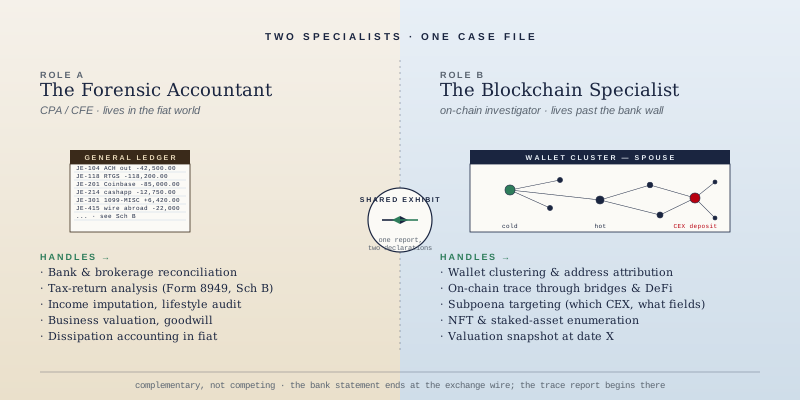
A forensic accountant (typically a CPA, often with a CFE or CFF credential) lives in the fiat world. They reconcile bank and brokerage accounts, analyze tax returns, build lifestyle audits, impute income, value businesses, and translate the financial picture into the categories the court needs for equitable distribution. They are excellent at noticing the $40,000 ACH out of the joint checking account that landed at Coinbase. What they cannot typically do — and most are the first to admit this — is follow what happened after the $40,000 hit the exchange. The exchange’s subpoena response is in a format that requires on-chain interpretation, and the trace through self-custody, DeFi protocols, and cross-chain bridges is its own discipline.
The blockchain forensic specialist starts past the wall. They take the exchange’s response, extract the withdrawal addresses, run the trace, cluster the spouse’s wallets, enumerate current holdings, identify NFT and staked positions, and produce a valuation snapshot. Their report sits adjacent to the forensic accountant’s and is typically incorporated by reference. In the contested files I’ve worked, the two reports often end up as exhibits in the same binder — the accountant’s exhibit covers the fiat side, the blockchain specialist’s covers the on-chain side, and the narrative the court sees is continuous from the W-2 to the wallet.
A small number of forensic accountants are now adding genuine blockchain forensic skill in-house, which is great. If you have one of those people available, by all means use them for both. But more often what I see is a forensic accountant who claims crypto capability based on having taken a CryptoCurrency 101 webinar, and that’s usually visible the first time the trace gets cross-examined. The honest credentialing question to ask is: how many on-chain trace reports have they personally authored, and have they testified as a blockchain expert under Daubert before? If the answer is "a few" or "not yet," that’s a case for the second specialist.
Common Mistakes Attorneys Make in Crypto Cases
I’m going to be more direct here than I am usually, because if any of these resonate, fixing them costs you nothing and helps your next case immediately.
Asking for "all cryptocurrency" in document requests
That phrase produces nothing. The spouse’s counsel objects to vagueness, or the spouse responds "none" in good faith because their hot wallet feels like "just an app, not really crypto." The fix is granular requests: every wallet address ever controlled across every chain, every exchange account ever opened including ones closed during the marriage, every NFT wallet, every staking deposit, every active DeFi position, every API key issued to any third-party service, every browser extension wallet (MetaMask, Phantom, Rabby, Coinbase Wallet, etc.), every hardware wallet device by manufacturer and serial number, every seed-phrase backup whether physical or digital, and screenshots of every portfolio-tracker app installed on any device.
Trusting the spouse’s self-reported wallet list
The spouse hands over three addresses and signs a representation that those are all of them. You file it and move on. The investigator runs the trace and finds two additional wallets that exhibit common-input clustering with the disclosed three but were not on the list. The spouse’s representation is now false, and depending on how it was structured, may be a discovery sanction issue. The point is: don’t close the wallet inventory based on the spouse’s disclosure alone. The whole reason to do the trace is to verify it.
Missing the NFT and staked-asset layer
I see this constantly. The wallet inventory captures ETH and stablecoins, the report values them, and everyone moves on. Meanwhile the wallet holds a Lido stETH position worth $180K, two CryptoPunks worth $90K each, and an Uniswap V3 LP position worth $40K. None of those are visible if you only look at the spot token balances. I wrote a separate piece on NFTs in divorce and the "hidden" asset class that covers this in more depth.
Accepting "I lost it" without forensic verification
"I lost my seed phrase." "The wallet was hacked." "The exchange went bankrupt." These claims show up in disclosure responses and they need to be tested against the on-chain record. Did the wallet’s addresses continue transacting after the date the spouse claims to have lost access? If yes, the claim is demonstrably false. I covered the specific framing of this scenario in when your spouse says they lost the crypto.
Using the wrong valuation date
Crypto volatility makes this question existential rather than academic. Same 12 ETH valued at the date of separation versus the date of trial can differ by a factor of two or more. Your jurisdiction has rules; some are flexible. If you don’t flag the valuation-date question early, you can lose meaningful value to a date that defaults badly for your client. I wrote about the date-selection question specifically in crypto valuation date in divorce.
Failing to preserve before the spouse moves the funds
This one is the most painful. The petition is filed. The spouse’s lawyer tells them not to move anything. The spouse moves $200K of ETH that night through a bridge to a Solana wallet they didn’t disclose. By the time discovery responses are due, the trail is still followable but the on-ramp window is closed. A temporary restraining order or a preservation letter served on every identified exchange account in the first 30 days after filing is worth its weight. The legal mechanics are not different from a fiat-asset preservation order; the targets are just different.
When You Don’t Actually Need a Crypto Expert
I’m going to spend a section telling you when not to hire someone like me, because the version of this article that doesn’t do that is just sales copy.
There are real categories of crypto-touched divorce cases where bringing in a blockchain forensic specialist is overkill, and where the additional cost is genuinely not proportionate to the asset class at issue. The honest list, from my own intake notes:
One disclosed Coinbase account, $20K balance, no signals
The spouse has one custodial account, they’ve disclosed it, the subpoena confirms it, the balance is fully visible, and there are no other signals (no hardware wallet, no notebook, no tech employment, no lifestyle gap, no Form 8949 indicating sales). This is a forensic accountant case at most, often just a verified-balance case. The marginal value of running a full trace report on $20K is negative.
Stablecoins in a known on-ramp account being used for ordinary spending
If the only crypto activity is small USDC balances on Coinbase or Cash App used essentially as a remittance rail, with all flows visible in subpoena returns, you don’t need a blockchain trace. You need bank-style accounting, which is what your forensic accountant already does.
The asset class is genuinely de minimis compared to other marital property
$15K of disclosed crypto in a marital estate that includes $4M in real estate and $2M in retirement accounts — even if there’s another $15K hidden, the cost-benefit on the engagement doesn’t work. There are exceptions (if the hidden $15K is dissipation evidence, the value is in the inference, not the dollars), but as a general rule, proportion matters.
The spouse is genuinely cooperative and producing wallet-level data
Occasionally — not often, but occasionally — the spouse just hands over a complete inventory including read-only API keys to every exchange and the public-key view of every self-custody wallet. The investigator’s job in that case becomes verification rather than discovery, which is faster and cheaper. A 1-hour engagement to spot-check the disclosed inventory against on-chain reality is often enough.
You have a defensive disclosure question, not a discovery question
If you represent the spouse who has the crypto and the question is how to disclose it properly, that’s a different engagement — usually faster and cheaper than the discovery side. I’ve written about that posture in defensive crypto disclosure in divorce. Bringing in a forensic specialist on the disclosure side is often the right move; it just doesn’t look like the discovery-side engagement and shouldn’t be priced like one.
The general principle: the engagement is justified when there’s a real probability the hidden or unverified crypto exposure is large enough to change the distribution outcome by more than the cost of the engagement plus a margin. When that math doesn’t pencil out, skip it. I’d rather you call me about your next case than spend your client’s money on a case that doesn’t need it.
Frequently Asked Questions
Have a Divorce File With a Crypto Question?
Wallet Witness works directly with family-law counsel on blockchain forensic engagements — scoping calls, subpoena targeting, written reports, depositions, and trial testimony. The first 30-minute scoping call is free; we will tell you honestly whether the file needs us. See our divorce crypto forensics service page for the engagement structure, or start a conversation below.
Start a Free Case ReviewFurther reading (off-site): the ABA Section of Family Law publishes CLE materials on digital assets in matrimonial practice; the Uniform Law Commission maintains RUFADAA and related model legislation on fiduciary access to digital assets; the American Academy of Matrimonial Lawyers publishes practitioner guidance in the Journal of the American Academy of Matrimonial Lawyers. For the underlying clustering literature, see Meiklejohn et al., "A Fistful of Bitcoins" (IMC 2013), which remains the canonical reference for the common-input ownership heuristic still used in every modern blockchain forensic tool.