In This Article
Family-law attorneys mostly accept by now that crypto is a marital asset class. What I still get asked constantly is the practical part: how do you actually compel exchange records in a divorce? The confusion usually comes from a few places. Civil and criminal subpoena practice get conflated. Exchange compliance teams operate slightly differently than traditional banks. And most family-law attorneys have just never served a subpoena on Coinbase before.
The mechanics aren't complicated, but they are exchange-specific. This article walks through the family-law civil subpoena process for the major U.S.-regulated exchanges, what to ask for, how the exchanges actually respond, and what to do with the returns once you have them.
Civil vs. Criminal Exchange Subpoenas
The first thing to clarify: most published guidance on subpoenaing crypto exchanges describes the criminal-discovery context, federal grand jury subpoenas, search warrants, MLAT requests for offshore exchanges, and the like. That guidance is partly applicable to family-law practice and partly not. The differences worth understanding:
Issuing authority
Civil family-law subpoenas are issued under the state's rules of civil procedure, usually by attorney signature or by court order. Criminal subpoenas are issued under federal or state grand jury authority. The mechanics of issuance, service, and enforcement differ.
Scope
Civil subpoenas in family-law cases must be reasonably scoped to the divorce proceeding. Overbroad requests can be quashed. Criminal subpoenas have broader latitude based on probable cause or grand jury authority.
Notice
Civil subpoenas usually require notice to the account holder, your spouse, before they're served on the exchange. The notice gives the spouse the opportunity to object. Criminal subpoenas often don't require advance notice and may be served under seal.
Exchange treatment
Exchanges have separate compliance workflows for criminal LE requests and for civil discovery. Civil requests are handled by the exchange's legal team, often via a designated portal or email address. Criminal requests are handled by the LE response team. Misrouting a request can add weeks to response time.
For criminal-discovery context, which differs in important ways, see our companion article on how to subpoena Coinbase, Binance, and Kraken. The article you're reading now focuses specifically on the family-law civil process.
What Records to Request
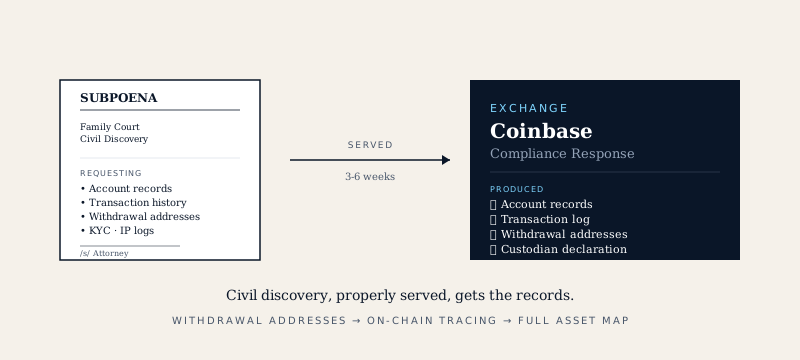
A standard civil subpoena to a crypto exchange in divorce should request the following categories of records, scoped to the period from the date of marriage through the present:
- Account opening records and KYC documentation. Every account ever opened in the spouse's name, including alternate email addresses or phone numbers used. The opening records identify the account itself and link it to the spouse's identity.
- Complete transaction history. All deposits (fiat and crypto), all withdrawals (fiat and crypto), all trades, all transfers. Dates, amounts, counterparty addresses for crypto withdrawals, bank account information for fiat transfers.
- Current and historical account balances. Periodic balance snapshots if available, plus the current balance as of the production date.
- Withdrawal address records. Every cryptocurrency address the account has withdrawn to. This is the single most useful field for downstream forensic tracing.
- Deposit address records. Every cryptocurrency address that has deposited into the account. Often reveals which other wallets the spouse controls.
- Login records and IP logs. Login dates, IP addresses, device identifiers if available. Useful for establishing who was actually using the account and from where.
- Account closure records. If the account has been closed, the date of closure, the reason, and the final balance disposition.
- Communications between the account holder and the exchange. Support tickets, email correspondence, in-app messages.
- Internal compliance flags or reviews. Many exchanges produce these on request and they can reveal whether the account was flagged for suspicious activity, AML review, or freeze actions.
- Custodian-of-records affidavit or declaration. A signed certification authenticating the production for trial use.
If you can only get one category of records, get the withdrawal address records. Every crypto withdrawal from a centralized exchange goes to a specific blockchain address. Once you have those addresses, a forensic investigator can trace the funds to their current location, identify other wallets the spouse controls, and find assets that exist nowhere on the exchange's books.
Need On-Chain Tracing of Subpoena Returns?
Wallet Witness traces withdrawal addresses from exchange subpoena returns to their current destinations and produces a complete asset map for divorce proceedings. Free initial scoping call.
Start a Free Case ReviewExchange-by-Exchange Response Patterns
Each major U.S.-regulated exchange has its own service procedure, response timeline, and quirks worth knowing.
| Exchange | Response Pattern |
|---|---|
| Coinbase | Designated legal portal for civil subpoenas. Response time usually 3 to 4 weeks. Produces complete transaction history, KYC records, IP logs, and withdrawal addresses. Includes custodian-of-records declaration on request. |
| Kraken | Service via designated agent. Response time usually 3 to 5 weeks. Strong production quality; custodian declaration available on request. |
| Gemini | Service via designated agent. Response time usually 2 to 4 weeks. Production includes detailed transaction history and authentication. |
| Binance.US | Service via designated agent. Response time variable, often 4 to 8 weeks. Production may require additional follow-up to capture all requested fields. |
| Crypto.com | Service via designated agent. Response time usually 4 to 6 weeks. Production quality is generally good for U.S. accounts. |
| Cash App (Block, Inc.) | Service on Block legal department. Response time usually 4 to 6 weeks. Bitcoin-only; production includes transaction history and IP logs. |
| Robinhood | Service via designated agent. Response time usually 3 to 5 weeks. Crypto trading records produced alongside securities trading. |
| PayPal / Venmo | Service via PayPal legal. Response time usually 4 to 6 weeks. Crypto holdings are exchange-custodied and identified separately from fiat. |
Each exchange publishes a law-enforcement / legal-process guide that specifies the exact service method, format requirements, and contact information. Confirm the current version before serving, contact details change.
How to Serve the Subpoena
The standard service procedure for civil subpoenas to U.S.-regulated exchanges:
- Confirm the registered agent for service of process. Most exchanges use CT Corporation, CSC, or a similar registered agent service. The exchange's legal-process guide identifies the current agent.
- Provide notice to opposing counsel. Required under most state rules, opposing counsel gets a copy of the subpoena before service, with time to object.
- Serve the subpoena. Service may be by personal delivery to the registered agent or by certified mail, depending on the rules of your jurisdiction.
- Send a courtesy copy to the exchange's legal portal or email. This accelerates response time because the exchange's compliance team gets visibility into the request alongside their official channel.
- Track the response deadline. Standard is 30 days from service. If the exchange doesn't respond within that window, follow up directly with the legal contact before pursuing enforcement.
- Pay any required fees. Some exchanges charge a per-account or per-record fee for production. Confirm in advance.
Authentication for Trial Use
If the case settles based on the subpoena returns alone, which is the common outcome, authentication is rarely needed. If the case proceeds to a contested hearing or trial, the exchange-produced records must be authenticated before they can be admitted as exhibits.
The standard authentication is a custodian-of-records affidavit or declaration from the exchange, attesting that the produced records are true and complete copies of the exchange's business records, made and kept in the regular course of business, by a person with knowledge of the events recorded. Most major exchanges include this affidavit in the subpoena response if requested.
If the exchange doesn't include the affidavit by default, request it explicitly in the subpoena. Obtaining a custodian declaration after the fact is possible but adds delay. For more on the broader admissibility of crypto records and forensic analysis in litigation, see our piece on blockchain forensic evidence in federal civil litigation.
When the Spouse Used an Offshore Exchange
If the spouse used Binance global, Bybit, OKX, KuCoin, MEXC, or another offshore exchange, civil subpoena options are limited. These exchanges don't have U.S. registered agents and generally don't respond to U.S. civil process from family-law courts.
The workarounds:
Subpoena the U.S. exchange that funded the offshore account
Most spouses who use offshore exchanges fund them by sending crypto from a U.S.-regulated exchange. The U.S. exchange's withdrawal records identify the destination address, and that destination address is almost always an offshore exchange's deposit address. The deposit address can be analyzed and traced even without exchange-side cooperation.
Forensic on-chain analysis
Even without exchange records, on-chain analysis can establish the existence of holdings and transactions. The deposit address at the offshore exchange shows incoming flows; later withdrawals show outgoing flows. The forensic report becomes the substitute for the exchange records that can't be obtained.
Letters rogatory or international discovery
For high-stakes cases, formal international discovery via letters rogatory may be available. This is expensive, slow, and rarely used in family-law practice. Most cases proceed on on-chain analysis alone when the spouse used an offshore exchange.
Combining Subpoena Returns with On-Chain Tracing
The full power of a crypto subpoena is realized when the exchange records are combined with on-chain forensic analysis. The workflow:
- Receive subpoena returns, exchange records identify accounts, transaction history, and withdrawal addresses.
- Forensic investigator extracts withdrawal addresses, every crypto address the spouse withdrew to becomes a starting point for downstream tracing.
- Outbound tracing from each withdrawal address, the investigator follows funds through later transactions to identify the spouse's full wallet network.
- Cluster analysis, wallets that share funding patterns, timing, or transactional behavior with the known addresses are identified as likely under the spouse's control.
- NFT and DeFi position discovery, once the wallet network is mapped, NFT holdings, DeFi deposits, and staking positions can be enumerated.
- Final asset map, the report combines exchange-side records with on-chain findings to produce the complete picture of the spouse's crypto holdings, wherever they're now.
The subpoena alone tells you what the spouse held at the exchange. The subpoena plus tracing tells you what the spouse holds today, including everything in self-custody, on offshore exchanges, and in DeFi positions. For broader context on the tracing methodology, see how blockchain forensic investigators trace crypto.
Need to Combine Subpoena Returns with On-Chain Tracing?
Wallet Witness extracts and traces withdrawal addresses from exchange subpoena returns and produces a complete asset map for divorce proceedings. Free initial scoping call.
Start a Free Case ReviewFrequently Asked Questions
Civil subpoenas are one piece of family-law crypto discovery. For the broader discovery framework, interrogatories, document requests, court-ordered wallet disclosure, see hidden crypto assets in divorce. For the asset class most often missed in subpoena requests, see NFTs in divorce. For valuation of holdings once identified, see crypto valuation date in divorce.
Need this work done?
If you or your attorney need a forensic trace, evidence package, or expert-witness report for a divorce case involving hidden or disputed crypto, see Divorce & Family Law Crypto Forensics for what the engagement covers (both sides represented).