In This Article
The valuation date question is the single most consequential strategic decision in dividing crypto in a divorce. Bitcoin can move 30% in a quarter. Ethereum can move 50%. A volatile altcoin can move 200% or lose 80% in the same window. The dollar value applied to a fixed holding of cryptocurrency depends entirely on the date you point at on the price chart, and that decision can swing distribution by hundreds of thousands of dollars.
Most family-law attorneys treat valuation date as a procedural footnote — they default to whatever their state's standard practice is and move on. For traditional assets like a brokerage account or a house, that default is usually fine. For crypto, the default is often the most expensive choice. This article is for the attorney who wants to pick the date intentionally and defend the number when the other side challenges it.
Why Valuation Date Matters More for Crypto
Three properties of cryptocurrency make valuation date selection unusually consequential:
Volatility
Major cryptocurrencies routinely move 20% to 50% within a single quarter. Smaller assets move much more. A two- or three-year divorce timeline can include multiple bull and bear cycles, with the asset's dollar value swinging by orders of magnitude across the candidate dates.
Asymmetric incentives
The party holding the crypto wants the valuation date that produces the lowest dollar value. The party not holding the crypto wants the date that produces the highest. Because the asset itself has not changed — the holding is the same number of coins — the dispute is purely about which date to choose. There is no underlying valuation methodology to argue about, just the date.
The asset can be moved or sold mid-proceeding
Unlike a house, which sits in place during the proceeding, crypto can be sold, moved, staked, or converted at any time. The holding at the trial date may not be the same as the holding at the filing date. This adds a second dimension to the analysis: not just "what was the price on date X" but "what was the actual holding on date X."
The Four Candidate Dates
In nearly every divorce, four dates are the realistic candidates for crypto valuation:
| Candidate Date | Strategic Significance |
|---|---|
| Date of Separation | Captures the value when the parties' financial lives effectively split. Often favored when crypto has appreciated significantly post-separation through one spouse's continued management. |
| Date of Filing | Captures the value at the formal start of the proceeding. Default in many jurisdictions. Often the cleanest evidentiary anchor because it coincides with mandatory disclosures. |
| Date of Trial | Captures the value as of the actual division. Default in some jurisdictions. Most current value but exposed to mid-proceeding market swings and potential dissipation. |
| Court-Ordered Intermediate Date | A specific date the court selects in the interest of fairness — often used when the standard date produces an inequitable result. Common when crypto has experienced extreme volatility during the proceeding. |
Each date can favor either spouse depending on which way prices moved. The strategic question is not which date is "correct" — there is no universally correct date — but which date is most defensible in your specific jurisdiction given your specific facts.
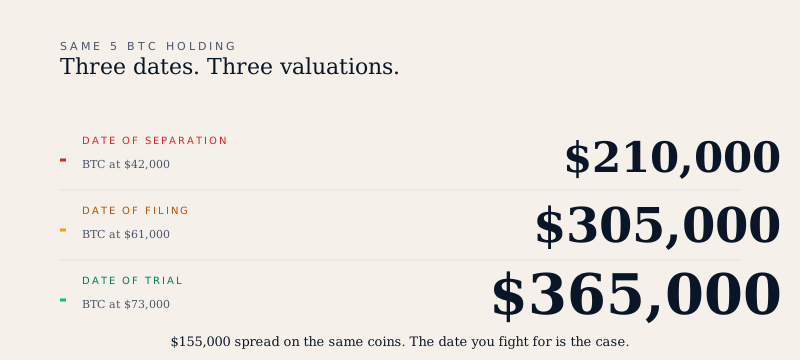
Bitcoin holding: 5 BTC, undisputed. Date of separation: BTC at $42,000 (5 BTC = $210,000). Date of filing: BTC at $61,000 (5 BTC = $305,000). Date of trial: BTC at $73,000 (5 BTC = $365,000). The same 5 BTC produces three different dollar values spanning $155,000. The party not holding the crypto wants $365,000. The party holding it wants $210,000. The court picks the date.
How State Rules Differ
State rules for marital asset valuation date fall into roughly three categories:
Date-of-separation states
States like California treat the date of separation as the default for marital asset valuation. The party seeking a different date carries the burden of arguing for it. For appreciating crypto, the party not holding the asset has incentive to push for a later date. For depreciating crypto, the holding party benefits from the default.
Date-of-filing states
Many states use the date of filing as the marker. This date has the advantage of coinciding with the financial disclosure obligation, so the disclosed balances and the valued balances naturally align.
Date-of-trial states
Other states use the date of trial as the default. This date captures the most current value but is exposed to mid-proceeding volatility and to the possibility that the party in possession sells, moves, or otherwise alters the holdings.
Discretionary jurisdictions
Most states give the court discretion to select an alternative date when fairness requires it. Crypto's volatility is exactly the kind of factual circumstance that justifies arguing for a non-default date. The party advancing the alternative date typically supports the argument with a forensic report demonstrating the swing.
Knowing which category your state falls into shapes the entire valuation strategy. Your forensic investigator should be told the controlling rule before scoping the report so the analysis serves the position you intend to take.
How a Forensic Investigator Helps You Pick
The strategic value of forensic involvement on valuation date is twofold: (1) producing the dollar values at every candidate date so the parties and the court can see the actual stakes, and (2) building the evidentiary foundation for whichever date your client argues for.
A typical multi-date crypto valuation report includes:
- Holdings inventory at each candidate date. The number of coins, tokens, and NFTs at each date — which may differ if the spouse transacted during the proceeding.
- Price reference for each asset at each date. Documented from a defensible source (CoinMarketCap, CoinGecko, exchange rate sheets).
- Dollar value at each date, computed as holdings × price.
- Activity log showing any transactions between dates that affected holdings.
- Volatility commentary describing the price movement between dates and any unusual market conditions on the candidate dates themselves.
With this report in hand, your argument for a specific date becomes evidentiary rather than rhetorical. You are no longer arguing "the date should be X because X" — you are arguing "the date should be X because the report demonstrates that Y date produces an inequitable result for these specific reasons, supported by these specific numbers."
Need a Multi-Date Crypto Valuation Report?
Wallet Witness produces evidentiary valuation reports across separation, filing, and trial dates with documented price references and full holdings reconciliation. Free initial scoping call.
Start a Free Case ReviewChoosing the Price Reference Source
For the major cryptocurrencies — Bitcoin, Ethereum, the top-50 by market cap — there is a relatively narrow band of acceptable price references. The standards used in forensic practice include:
Time-weighted average across major exchanges
The 24-hour TWAP across the largest U.S. exchanges (Coinbase, Kraken, Gemini) for the date in question. This is the most defensible approach because it averages out short-term price differences between venues and reflects fair market value rather than a single instantaneous quote.
Published index closing price
The closing price reported by CoinMarketCap, CoinGecko, or similar reputable index for the date. This is widely used and easily verified by opposing counsel and the court.
Exchange-specific spot price at end of day
The closing price on Coinbase or Kraken at 23:59 UTC on the date. Useful when the crypto in question was actually held on that exchange and could have been liquidated at that price.
For less-liquid altcoins, the choice of price reference becomes more contentious. Thin trading volume can produce wildly different prices on different exchanges. The report should document the chosen reference and explain why it is appropriate for the specific asset.
For NFTs, valuation methodology is fundamentally different — see NFTs in divorce for the trait-comparable approach used for non-fungible assets.
Multi-Asset and Multi-Date Valuations
Most crypto holdings of any size include multiple assets — Bitcoin, Ethereum, stablecoins, altcoins, NFTs, DeFi positions. Each has its own price history. The complexity of the valuation grows quickly with the number of assets and the number of candidate dates.
A typical real-world report covers something like:
- 2.5 BTC, valued at three dates ($105,000 / $152,500 / $182,500)
- 40 ETH, valued at three dates ($120,000 / $160,000 / $180,000)
- $50,000 USDC (stable, no date variance)
- 1 NFT (separately valued by trait-comparable method)
- An Aave deposit position (valued at the deposit balance plus accrued interest at each date)
- A Uniswap V3 LP position (valued by underlying token composition at each date)
The total marital crypto value at each date is the sum of every asset's value at that date, with the activity log explaining any inter-date changes (deposits, withdrawals, conversions, sales). This produces a clean side-by-side comparison the court can use to make an equitable date selection.
Defending the Number Under Cross
If the case goes to a contested hearing on valuation, opposing counsel will challenge the report in predictable ways:
Challenge to the price reference source
"Why CoinMarketCap and not Coinbase?" The defense is that the chosen source is widely accepted, easily verifiable, and consistent with industry practice. Documenting the same reference across all assets in the report defends against accusations of cherry-picking.
Challenge to the holdings inventory
"How do you know my client held exactly 5 BTC on that date?" The defense is the on-chain record itself — the wallet's balance on the date is publicly verifiable and reproducible by anyone with the address.
Challenge to the date selection itself
"Why should the court use the date of filing rather than the date of trial?" This is properly an argument made by counsel, not the investigator, but the report should provide the data each side needs to make its argument.
Challenge to the methodology
"Has this method been used in other cases?" Yes — every blockchain forensic investigator and every crypto-savvy forensic accountant uses some variation of this approach. The methodology is consistent with industry standards used by Chainalysis, TRM Labs, and federal agencies. For the broader admissibility framework, see our overview of the Daubert standard for crypto forensic testimony.
Challenge to the investigator's qualifications
"What are your credentials?" The investigator should have a clearly stated background, prior published forensic work, and demonstrable independent expertise. For more on what makes a forensic investigator qualified for litigation, see our companion article on blockchain forensic expert witness work.
Need an Evidentiary Valuation for Your Crypto Divorce Case?
Wallet Witness produces multi-date, multi-asset valuation reports with full price references, holdings reconciliation, and methodology defense. Free initial scoping call.
Start a Free Case ReviewFrequently Asked Questions
Valuation date is one strategic dimension of crypto in divorce. For the discovery side — finding the assets to value in the first place — see hidden crypto assets in divorce. For the procedural side of compelling exchange records that support the valuation, see civil subpoenas for crypto exchanges. For the dissipation analysis when holdings drop between dates, see crypto dissipation claims.
Need this work done?
If you or your attorney need a forensic trace, evidence package, or expert-witness report for a divorce case involving hidden or disputed crypto, see Divorce & Family Law Crypto Forensics for what the engagement covers (both sides represented).