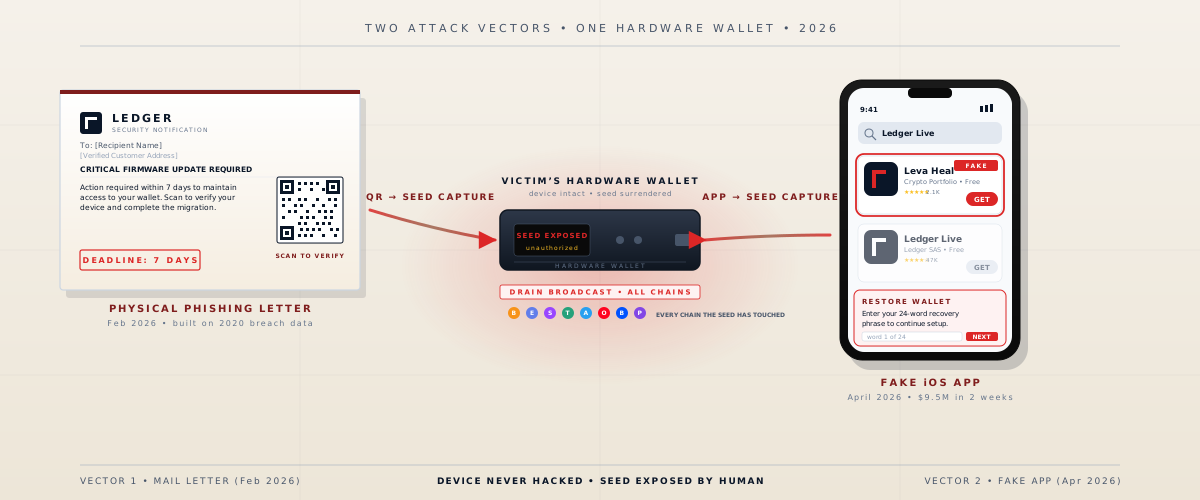
What is happening: Two parallel attacks have hit hardware-wallet holders in 2026. In February 2026, Ledger and Trezor customers across multiple countries began receiving physical mail letters with company branding, a fake recall or security-upgrade pretext, and a QR code linking to a seed-capture site. In April 2026, a fraudulent iOS app called Leva Heal impersonated Ledger Live on the official Apple App Store, drained an estimated $9.5 million from 50+ victims, and remained live for roughly two weeks before takedown.
Why both work: The hardware itself was never the vulnerability. Attackers compromised the trust signals around the device: a physical letter with the right brand, an App Store listing that looked like the real Ledger Live, support DMs that mimicked the manufacturer. In every case the victim, not the device, surrendered the 24-word recovery seed.
Why now: The mail attack is built on the 2020 Ledger data breach, which exposed roughly 270,000 customer postal addresses. The dataset still circulates on criminal markets six years later. The App Store attack is the latest in a multi-year pattern that includes the 2023 Ledger Connect Kit supply chain hack ($600K), the 2025 Trust Wallet Chrome extension supply chain attack ($7M+), and a steady drumbeat of fake wallet apps removed by Apple and Google.
In This Article
- If you have a Ledger or Trezor, read this before you do anything else
- The 2026 mail letter campaign: how it works
- The letter attack flow step by step
- Why the 2020 Ledger breach made the 2026 attack possible
- The fake "Leva Heal" Ledger Live app: $9.5M in 2 weeks
- The fake app attack flow
- Why Apple approved a fake wallet app in the first place
- The trust signals attackers exploit
- Other 2026 hardware wallet attack vectors to know about
- What to do if you entered your recovery phrase anywhere
- What to do if your hardware wallet was drained
- How forensic investigators trace hardware wallet drains
- Frequently asked questions
If You Have a Ledger or Trezor, Read This Before You Do Anything Else
This is the most important sentence in the article: Ledger and Trezor will never ask you for your 24-word recovery phrase. Not by mail, not by app, not by email, not by support chat, not by Discord, not ever, for any reason whatsoever. There is no firmware update that needs it. There is no security check that needs it. There is no compensation program that needs it. There is no migration to a new device that needs it. The phrase exists for one purpose: to restore your wallet on a new device that you, alone, are holding in your hand.
If anything that looks like Ledger or Trezor asks for the phrase, by any medium, the request is fraudulent. Full stop. The packaging may be extraordinary — a Cloudflare-hosted page with a perfect logo, a physical letter on quality paper, an iOS app with five-star reviews. The packaging is what the attackers spent their money on. The underlying request is the only thing that matters, and the underlying request is always fraudulent.
I work blockchain forensic cases for a living. A material share of my hardware-wallet drain intakes in early 2026 trace back to one of two sources: a physical letter the victim received in the mail and scanned the QR code on, or an iOS app the victim downloaded from the Apple App Store believing it to be Ledger Live. Both attacks are easy to fall for in the moment. Both rely on social engineering, not cryptography. Both can be prevented by a single rule: the 24-word seed phrase exists offline, on paper or steel, and goes nowhere else, for any reason, ever.
Skip directly to What to do if you entered your recovery phrase anywhere. Every minute matters. The compromised seed is not just the wallet you "restored" — it is every address on every chain the seed has ever derived. Move whatever you can to a brand new wallet now, and read the rest after.
The 2026 Mail Letter Campaign: How It Works
Starting in early February 2026, hardware-wallet owners across the United States, the United Kingdom, France, Germany, and the Netherlands began posting photos of physical letters they had received in their actual mailboxes. The letters came in white windowed envelopes, the kind a real company uses for printed correspondence. The return addresses varied by batch. Some used a generic European postage code; others mimicked a real Ledger logistics address in Vierzon, France, or a Trezor address in Prague, Czech Republic. The postage was real. The mail was real. Only the content was fraudulent.
The letter itself was, on first read, plausible. It was printed on letterhead with the Ledger or Trezor logo, addressed to the recipient by their full legal name, and cited a security pretext: a "critical firmware vulnerability," a "mandatory device migration," a "recall affecting your specific Nano X serial range." The body explained that the recipient needed to verify their device and re-secure their wallet within a stated deadline — typically seven to ten days — or risk losing access to their funds. A QR code was printed prominently in the corner, with a call to action like "Scan to begin the verification process. Takes 5 minutes."
The QR code resolved to a domain that looked legitimate at a glance. Real cases have included ledger-recovery-v2.com, ledger-security-update.io, trezor-safe5-recall.com, and dozens of permutations that researchers have been tracking continuously since February. The destination site was a near-perfect visual clone of the real Ledger.com or Trezor.io domain — same fonts, same color palette, same illustrations. The site walked the visitor through a multi-step "verification flow" whose only real function was to capture all 24 words of the recovery phrase. As soon as the last word was submitted, the attackers derived the private keys and began emptying every address controlled by the seed.
Reported losses from individual victims of the mail campaign range from a few hundred dollars (someone who had only a token amount on the wallet they restored) to seven figures (someone whose Ledger seed protected a long-term Bitcoin and Ethereum position). The campaign's strength is not its sophistication. It is the unexpected channel. A phishing email feels like phishing. A physical letter, addressed by name, printed on real paper, delivered by a real postal worker, feels like real mail.
The Letter Attack Flow Step by Step
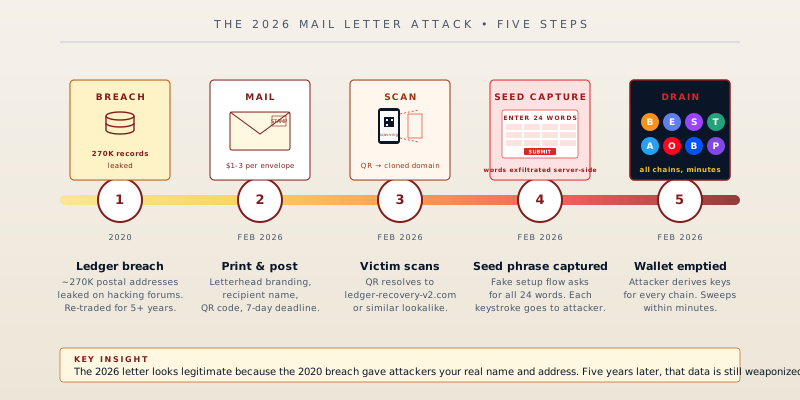
The attack is mechanically simple. Every stage exists because the previous stage made it possible. The 2020 breach gave attackers a list of confirmed hardware-wallet owners with names and home addresses. Bulk-mail logistics gave them the ability to send physical letters at scale for a few dollars per envelope. A cloned website and a wallet-draining toolkit gave them everything else.
- Breach data is acquired. The attacker buys or downloads the leaked Ledger customer dataset from one of several criminal markets where it has been re-bundled and resold since 2020. The data contains full names, postal addresses, email addresses, and phone numbers tied to confirmed Ledger product purchases.
- Letters are printed and posted. A printing vendor (legitimate or otherwise) is paid to produce a few thousand to a few tens of thousands of letters with the Ledger or Trezor logo, the security pretext, and a QR code unique to each batch. The letters are mailed using real postage from a real bulk-mail facility. Cost per envelope including printing and postage is in the range of $1 to $3.
- Victim scans the QR code. The visual brand of the letter, the recipient's correct name and address, and the urgency framing combine to make scanning feel like the obvious thing to do. The QR resolves to an attacker-controlled domain hosted on a mainstream cloud provider with a valid TLS certificate.
- Seed phrase is captured. The site presents what looks like a Ledger Live or Trezor Suite setup flow. After a few benign "verify your device" steps the page asks the visitor to enter all 24 words of the recovery phrase to "complete the migration" or "validate the firmware update." The words are exfiltrated to the attacker the moment they are typed.
- Wallet is drained on-chain. With the seed, the attacker derives the private keys for every address the seed controls on every chain — Bitcoin, Ethereum, every EVM L2, Solana, Cosmos, anywhere the victim has ever used the wallet. Within minutes, automated tooling broadcasts withdrawals consolidating funds into the attacker's collection addresses, then begins the laundering hop sequence covered in my MetaMask was drained — can it be traced.
QR codes are a uniquely effective phishing surface because the destination URL is not human-readable until the camera resolves it — and by then the user is already in scanning posture, ready to tap "open." A phishing URL embedded in a printed letter or a sticker is harder to evaluate than a hyperlink in an email. The same pattern shows up in the parking-meter QR-sticker scam, the restaurant-menu QR scam, and now the hardware-wallet mail scam. If a physical object asks you to scan, the question is always: do I have any reason to trust this physical object?
Why the 2020 Ledger Breach Made the 2026 Attack Possible
In July 2020, a misconfigured API endpoint on Ledger's e-commerce backend was exploited by an unauthorized party. By the time it was discovered and patched, an estimated 1 million email addresses and approximately 270,000 detailed customer records had been exfiltrated. The detailed records included the customer's full name, postal address, phone number, and email — the four fields most directly useful for physical-mail and SIM-swap targeting.
The dataset was first published openly in December 2020 on a hacking forum. It was traded, re-bundled, and resold continuously thereafter. By 2022 the data was available on multiple criminal marketplaces. By 2024 it was free to anyone who knew where to look. In 2026 it has been circulating for almost six years, and the addresses in it have aged: people have moved, sold their homes, died. But a significant fraction of the data remains current. That is what the 2026 mail campaign is built on.
Ledger's response to the original breach was, by general industry standards, reasonably prompt: notification, an investigation, regulatory reporting, hardening of the affected systems. None of that mattered to the long-tail use of the data. A leaked dataset is forever. The fact that the leak occurred in 2020 and the mail campaign is happening in 2026 is not a sign that Ledger has done something wrong now; it is a structural feature of customer breaches in any industry. Once your name and address are in a criminal database, they are in that database permanently, and attackers will revisit the dataset whenever they have a new payload that benefits from physical-mail targeting.
The Trezor side of the campaign is a little different in origin. Trezor (operated by SatoshiLabs) has had its own data exposure events — most notably a January 2024 incident in which a third-party mailing-list provider was compromised and roughly 66,000 Trezor customer emails were exposed. That dataset is more limited in scope (no postal addresses), which is why the Trezor mail letters tend to use generic "valued customer" addressing more often, while the Ledger letters more reliably use the recipient's full name. The attackers will use whatever data they have. The Ledger breach is just the larger source.
The Fake "Leva Heal" Ledger Live App: $9.5M in 2 Weeks
In early April 2026, an iOS app titled Leva Heal was published to the Apple App Store. The name was not random. It was chosen because it satisfied the App Store's name-similarity heuristics while remaining plausibly distinct: "Leva" echoes the visual cadence of "Ledger Live" in a quick glance, and "Heal" suggested a wellness or recovery tool. The app's icon was a near-clone of the Ledger Live icon — same color, same shape, same general silhouette. The category and screenshots positioned it as a cryptocurrency portfolio and hardware-wallet companion.
Victims found the app three ways. The most common was App Store search: typing "Ledger Live" surfaced Leva Heal alongside (and sometimes above) the real Ledger Live, because the fraudulent developer paid for App Store Search Ads against the keyword. The second was through fake "support" channels — Reddit posts, Telegram support DMs, X replies — that linked directly to the Leva Heal listing while claiming to be official Ledger help. The third was through copycat keyword stuffing in the app's metadata that caused it to surface for adjacent queries like "ledger wallet," "hardware wallet app," and "ledger nano companion."
The damage came from the app's first-run flow. After install, Leva Heal presented a setup screen that mimicked the legitimate Ledger Live "Add account" wizard. One of the options was "Restore from recovery phrase," which is a path that does not exist in real Ledger Live for a reason: Ledger Live never asks for your seed phrase, ever, because the seed lives on the hardware device and the app communicates with the device, not with the seed. A user familiar with the real product would have noticed the discrepancy immediately. A first-time user, or a user under stress because they had received a worrying email or a fake support contact, was the target.
Users who chose "Restore" were prompted for all 24 words. Some entered the words directly. Others were walked through a sequence of "verify each word" steps that captured the phrase across multiple screens to feel more secure. The result was the same: the app's backend received the words, the attackers' automation derived the private keys, and the wallet was drained across every chain the seed had ever derived addresses for. The first victims reported losses on April 9, 2026. The app was removed from the App Store on April 23. Funds continued moving on-chain for days afterward as the attackers laundered the proceeds.
The Fake App Attack Flow
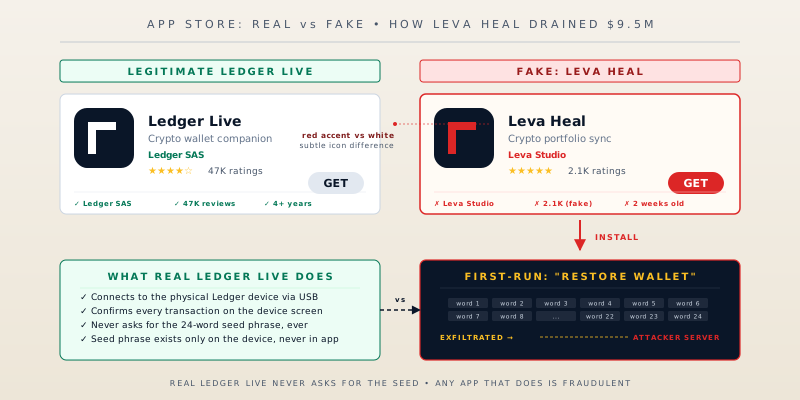
The flow is depressingly streamlined. Each step exists because the App Store environment makes the previous step easy.
- Victim searches the App Store for "Ledger Live." The motivation is usually legitimate: they just bought a Ledger, they are setting it up, they read the quickstart card in the box. Or they have an existing Ledger and need to reinstall the app on a new phone.
- Leva Heal appears in the results. Above, alongside, or visually indistinguishable from the real app. Its icon, screenshots, name styling, and category were all crafted to maximize click-through. App Store Search Ads pushed it to the top of paid placement; copycat keywords pushed it up in organic results.
- Victim downloads and opens the app. The app launches into a setup wizard that visually mimics real Ledger Live. The wizard offers a "Restore wallet" option that the real Ledger Live does not offer.
- Victim enters the 24-word seed. Sometimes directly, sometimes through a "verify each word" sequence across multiple screens. The words are exfiltrated server-side as they are typed.
- Wallet is drained across every chain. Within minutes — sometimes within seconds — the attacker derives private keys for every address the seed has ever used and broadcasts consolidation transactions on Bitcoin, Ethereum, Solana, and any other chain the wallet touched.
The visual differences between Leva Heal and the real Ledger Live were subtle but real. The icon's gradient direction was slightly different. The developer name in the App Store metadata read "Leva Studio" rather than "Ledger SAS." The screenshots had small inconsistencies — a button label that did not match the real product, a transaction list with placeholder data. The reviews were a mix of obvious fakes (five-star, no detail, posted same day) and a small number of real one-star reviews from early victims that were almost certainly being suppressed by the developer through Apple's review-response mechanism. To anyone comparing the listings side by side, the fake was identifiable. To anyone arriving at the App Store with a vague memory of what "Ledger Live" looked like, it was not.
Why Apple Approved a Fake Wallet App in the First Place
This is the question every victim asks within 24 hours of realizing what happened. The honest answer is that Apple's App Review process, while genuinely better than Google Play's review process and dramatically better than the open-distribution model of desktop software, is heuristic, time-pressured, and routinely defeated by techniques the fraud industry has been refining for years.
The Leva Heal developer used a few well-known techniques. Stage-one submission: the version submitted for review was a benign portfolio-tracking app that did not request a seed phrase. The wallet-draining flow was activated by a server-side feature flag after the app passed review, a pattern App Review has been documenting for years but cannot fully eliminate. Keyword cushioning: the app's metadata used a long-tail mix of legitimate-sounding terms ("crypto portfolio," "wallet sync," "trade tracker") plus a smaller embedded set of impersonation-trigger keywords. Paid acquisition: Apple Search Ads against "Ledger Live" pushed Leva Heal to the top of results for users who typed the legitimate product name. Fresh developer account: "Leva Studio" had no prior history, no other apps, no track record — nothing for Apple's reputation systems to flag.
The result is a window. From the moment the fraudulent functionality activates to the moment Apple's takedown is processed, the app is live and harvesting seeds. For Leva Heal that window was about two weeks. For other fraudulent wallet apps removed in 2025 and 2026 the windows have ranged from days to over a month. Apple's app-removal logs published by independent researchers at BleepingComputer, Sophos, and others show this is a recurring pattern, not a one-time failure.
Google Play has the same problem at greater volume. The Android side of the ecosystem has seen multiple drained-wallet incidents involving fake Trust Wallet apps, fake MetaMask apps, fake Phantom apps, and fake Trezor Suite apps in 2024 through 2026. The detection and takedown infrastructure on both stores is fundamentally chasing the attackers rather than blocking them at the front door.
The Trust Signals Attackers Exploit
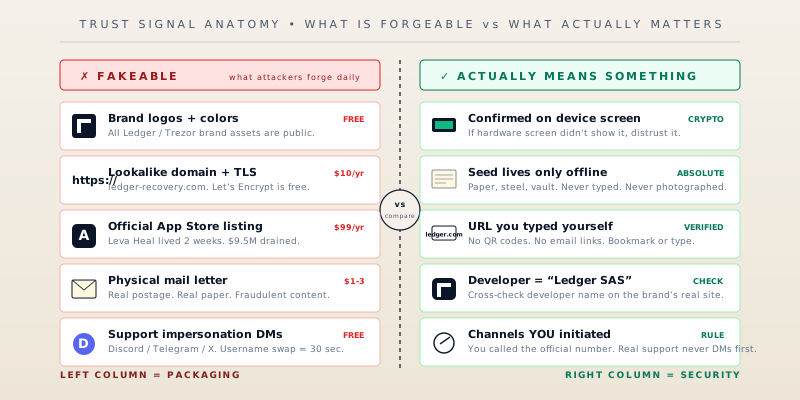
The 2026 attacks are a useful case study in what "trust" actually means online. Most people pattern-match on surface signals, because surface signals are usually correct. When they are not, the consequences are severe. Below is the inventory of trust signals attackers reliably forge, and the inventory of signals that actually mean something.
Signals attackers can fake (easily):
- Brand logos and color palettes. Trivial. Every brand asset Ledger and Trezor have ever published is downloadable.
- Legitimate-looking domain names.
ledger-recovery.com,trezor-safe-update.io,ledger-live-app.net— any composition of brand name plus action word can be registered for $10 a year. - Valid TLS certificates. Let's Encrypt issues free certificates to anyone who proves domain control. A green padlock proves the connection is encrypted, not that the destination is honest.
- App Store presence. Leva Heal proved this. A listing on the official App Store is a weak trust signal, not a strong one, especially for a wallet app.
- Physical mail. Postage costs a few cents per envelope. Brand letterhead is free to design. Real bulk mailers will print whatever you pay them to print.
- Support DMs on Discord, Telegram, X, and Reddit. Impersonating "Ledger Support" or "Trezor Support" takes about 30 seconds. Real support never DMs first.
Signals that actually mean something:
- Transactions you confirmed on your hardware device's own screen. The whole architecture of a hardware wallet exists so that the device, not the host computer or phone, is the source of truth. If a transaction is not displayed and approved on the physical device screen, it is not a transaction you can trust.
- The 24-word seed phrase has never left offline storage. Paper, steel, vault. Not a photo. Not a cloud note. Not typed into anything. Not entered into any "verification" or "migration" flow.
- The domain came from a source you can verify independently. Type ledger.com or trezor.io into the address bar yourself. Do not click links in emails, scan QR codes from letters, or follow DMs to a URL.
- The app came from a verified developer. For Ledger Live the developer is "Ledger SAS" in the App Store metadata. For Trezor Suite the developer is "SatoshiLabs s.r.o." Cross-check the developer name against the company's official site before installing.
- Communications came through a channel you initiated. If you called Ledger support using a number you found on ledger.com, the conversation is probably real. If "Ledger support" called you, DMed you, emailed you, or mailed you, the conversation is suspect by default.
Other 2026 Hardware Wallet Attack Vectors to Know About
The mail letters and the Leva Heal app are not the only 2026 threats to hardware-wallet holders. They are the two most public examples of a wider pattern that has been intensifying since 2023. A short tour of the most consequential incidents:
December 2023: Ledger Connect Kit supply chain attack ($600K)
In December 2023, a former Ledger employee fell victim to a phishing attack that exposed their NPM credentials. The attackers pushed a malicious update to @ledgerhq/connect-kit, a JavaScript library used by many third-party DeFi front-ends to connect to Ledger devices. The compromised library injected a wallet-drainer into any web page that loaded Connect Kit, including major DeFi protocols. Approximately $600,000 was drained across multiple wallets in the window before the malicious version was identified and removed (roughly five hours). The incident was a warning shot: even when the device, the firmware, and the official software are all uncompromised, a supply-chain attack on a single dependency can poison every web surface that integrates with the brand.
2024: Trezor Safe 3 chip vulnerability disclosure
Security researchers at Ledger Donjon published findings in 2024 demonstrating that the secure element in the Trezor Safe 3 had a class of weakness that, with physical possession of the device and substantial laboratory equipment, could potentially be exploited to extract the seed. Trezor responded that the attack required physical custody for an extended period, expert tooling, and conditions that do not represent a realistic remote threat to ordinary users. The episode is useful context for the 2026 attacks because it shows that even the genuine hardware vulnerabilities that have been disclosed require physical attacker access — nothing in the public hardware-wallet vulnerability literature describes an attack that could be executed remotely against an uncompromised device. Every 2026 mass-victim incident has been social engineering against the user, not technical exploitation of the device.
December 2025: Trust Wallet Chrome extension supply chain attack ($7M+)
In late 2025, a Chrome extension impersonating Trust Wallet (and in some variants impersonating Ledger Live web) was published to the Chrome Web Store and downloaded thousands of times before takedown. The extension exfiltrated seed phrases and private keys entered by users into anything resembling a wallet UI. Public estimates put losses above $7 million. The pattern is the same as Leva Heal but on a different distribution surface: an official-looking listing on an official platform that lives long enough to drain whoever installs it.
Ongoing: Ledger and Trezor support impersonation on Discord, Telegram, and X
This vector predates 2026 and will outlast it. Across every chat-based support surface, fraudulent accounts impersonate official Ledger or Trezor support, intercept users asking legitimate troubleshooting questions, and walk them through a "verification" flow that captures the seed. Real Ledger and Trezor support do not DM users first, do not ask for the seed under any circumstance, and do not direct users to verification flows on third-party domains. The signal is simple: if anyone in any chat asks for any portion of your seed phrase for any reason, the conversation is a scam regardless of avatar, username, or apparent credentials.
What to Do If You Entered Your Recovery Phrase Anywhere
If you typed the seed into a letter-linked site, a fake app, a support chat, or any other surface, the seed is permanently compromised. Move funds now. Read the explanation after.
Once a 24-word seed has been exposed to any third party, the wallet is no longer cryptographically yours. The attacker has the same derivation capability you do, on every chain, for every address the seed has ever produced. This is true forever. There is no version of "changing the password" for a seed phrase. The only safe option is to abandon the seed and migrate every asset to a new seed on a new device.
- Generate a brand new seed on a hardware device you trust. Use a different physical device than the one whose seed was compromised. If you cannot get a new device immediately, generate a fresh hot wallet on a clean phone or computer as a temporary destination; treat the hot wallet as temporary cold storage only until the new hardware device arrives.
- Inventory every chain the compromised seed has touched. Not just the main asset. Every L2, every sidechain, every alt-chain. Solana, Bitcoin, Ethereum, Arbitrum, Optimism, Base, Polygon, BSC, Cosmos, Polkadot, anywhere the wallet has ever derived an address. Each chain has its own balances that need to move.
- Transfer everything to the new seed. Start with the largest balances. Pay whatever gas is required. Speed beats fee optimization here — an attacker with the seed is racing you, and most attackers automate the race using mempool monitors that will sweep new deposits to the compromised wallet within seconds.
- Revoke approvals on the compromised wallet. Use revoke.cash or the equivalent. Even after the seed is empty, lingering approvals can drain any future deposits accidentally sent to old addresses.
- Document everything for the investigation. The phishing letter, the QR code URL, the fake app's App Store listing, every screenshot you can take, every email or DM that led you to the scam, the destination address of any asset the attacker captured, and the transaction hashes of your own emergency moves.
- Notify the legitimate manufacturer. Ledger and Trezor maintain abuse-tracking channels that aggregate victim reports. Notification does not recover your funds but it strengthens their ability to push for takedowns and to publish public warnings.
Do not:
- Reuse the compromised seed for anything ever. Not as a backup, not as a "burner," not as a wallet you only deposit small amounts to. Burn the paper backup. The seed is poison.
- Engage with "recovery services" that DM you. Within hours of the drain becoming public on-chain, fake "crypto recovery" services begin contacting victims through Reddit, Telegram, X, and email. They are uniformly fraudulent. Recovery services that contact victims first are the secondary scam. We cover the pattern in wallet drainer attacks and the broader fake-recovery economy.
- Pay anyone who guarantees fund recovery. No legitimate investigator guarantees recovery. The on-chain forensic process produces evidence and attribution, not refunds.
What to Do If Your Hardware Wallet Was Drained
The first 72 hours are the highest-value window for an investigation. After 72 hours the funds have typically completed their first laundering hop and are en route to an off-ramp. After two weeks the trace is still possible but the windows for exchange freeze requests have usually closed. The first week is when documentation and rapid action have the most leverage.
- Document the drain transaction(s) on every chain. Capture the transaction hash, the destination address, the timestamp, the amount, and the chain for every consolidation transaction the attacker broadcast. Screenshots from block explorers are evidence. Save them all.
- File an IC3 report at IC3.gov. Include every transaction hash, every destination address, the phishing letter or app listing that initiated the attack, and any other communications you preserved. See how to report a crypto scam to the FBI for the field-by-field walkthrough.
- File a local police report. Even when local police cannot pursue the case directly, the report is required for insurance claims, civil filings, and downstream federal coordination.
- Notify the manufacturer. Ledger and Trezor both maintain victim-intake channels. They will not recover funds but their abuse data helps coordinate takedown of phishing sites and fraudulent apps.
- If the loss is material, engage an independent blockchain forensic investigator within the first week. The on-chain trace produces the attribution package law enforcement and civil counsel need to subpoena the off-ramp exchange. Independent investigators do not contact you first; you engage them. Anyone DMing you offering recovery is fraudulent.
- If you used the same seed on hot wallets or third-party services, contact those services. Custodial exchanges, staking services, DeFi positions that required signing — any service that has visibility into your addresses should be informed that the wallet is compromised so that they can flag activity.
How Forensic Investigators Trace Hardware Wallet Drains
The investigation of a hardware-wallet drain is structurally the same as any other on-chain trace, but with three useful properties that make the work tractable. First, the attacker typically drains every chain the seed has ever touched within minutes, which produces a synchronized cluster of transactions that can be correlated as a single event. Second, the consolidation pattern is distinctive: dozens of small inputs being swept into a small number of large outputs is a recognizable on-chain signature. Third, the laundering path that follows is reused across cases, which means an investigator who has worked one hardware-wallet drain has already mapped infrastructure that recurs in the next case.
The typical 2026 path looks like this. Funds drain from the victim's addresses into one or more attacker collection wallets on each chain. Within hours, ETH and ERC-20 holdings are bridged or swapped into USDT, almost always on the Tron network because of its low fees and the friction USDT-Tron creates for downstream tracing. Bitcoin proceeds are either swept directly to a centralized exchange or routed through a CoinJoin-style mixer first. The USDT-Tron then either reaches a non-cooperating Asia-Pacific exchange for cash-out or is consolidated into a smaller number of long-lived "treasury" addresses the operation reuses across many victims. See stolen USDT recovery for the deeper teardown of the Tron leg.
Attribution of the operator is sometimes possible. The same collection wallet appearing across multiple independent victim cases is itself evidence; if your case and twenty others reference the same address, the address belongs to an industrial operation rather than a one-off attacker. The off-ramp exchange deposit address is the actionable handle: a centralized exchange holds KYC on whoever controls the depositing account, and a subpoena backed by a forensic report converts the on-chain trace into an identified person. We cover the subpoena mechanics in detail in address poisoning crypto scams (which uses the same trace methodology) and in our service page on digital asset tracing.
Realistic outcomes depend almost entirely on speed and on the off-ramp the attacker chose. Cases where the funds reach a regulated exchange and a freeze request is served within days have the strongest posture. Cases where the funds were fragmented through Tornado Cash, bridged across multiple chains, and cashed out at a non-cooperating venue have the weakest. Most 2026 hardware-wallet drains fall in between: forensic attribution is produced, the operator pattern is documented, the case is referred to federal coordination, and downstream outcomes depend on whether the same operator surfaces in other investigations.
This is also why hardware-wallet drains benefit from coordination across victims. The Leva Heal app's known victims have a shared interest in pooling investigator findings, because the same attacker drained all of them. The mail-letter campaign produces the same consolidation: a single forensic operation can map the entire campaign more efficiently than fifty individual victims commissioning fifty independent traces. If you are a Leva Heal or mail-letter victim, the most useful thing you can do is connect with other identified victims and pursue the case as a group.
Hardware wallets remain the right answer for serious crypto holders. The Ledger and Trezor devices themselves did not fail in any of the 2026 incidents. What failed was the trust environment around them — the mail you receive, the apps you download, the support DMs you read, the websites you visit. The device's security is binary: it works, it has not been remotely broken. Your security depends on never letting the seed leave the physical paper or steel you wrote it on, regardless of what packaging asks for it.
Frequently Asked Questions
Hardware Wallet Drained? Move Now, Trace Next.
If you typed your seed into a letter-linked site or a fake app and your wallet has been drained, the first hour matters. Independent forensic tracing identifies where the funds went, documents the chain of custody, and produces the evidence law enforcement and counsel need to act. Initial case reviews are free.
Start a Free Case Review