In This Article
You signed something. The wallet emptied in one transaction. The shock is real.
This guide explains what just happened on-chain, whether the funds can be traced (yes), what to do in the first hour, and what realistic recovery actually looks like in 2026. The chain is permanent — it remembers everything. That works against you in the moment, but it's also exactly why tracing is possible.
What Actually Happened On-Chain
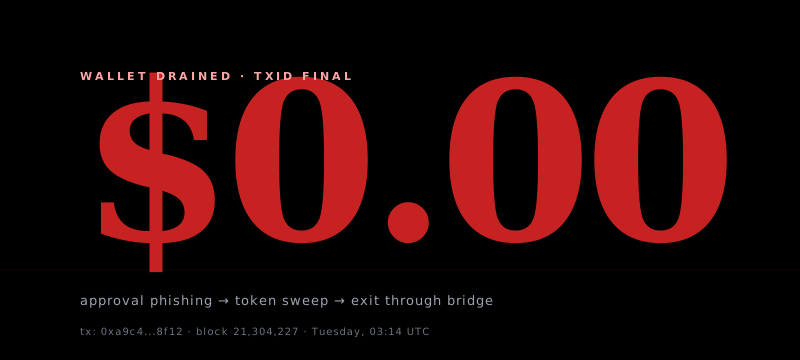
A wallet drainer is a malicious smart contract that, once you sign an approval, has permission to transfer all approved tokens out of your wallet. The drain itself isn't a hack — it's an authorized transaction. You signed the permission. The contract used it.
Most drainer attacks look like this:
- You arrive at a phishing site — usually a fake airdrop claim, a fake mint, or a clone of a real DeFi protocol.
- The site asks you to "connect wallet" and then "claim" or "verify."
- The signature request looks routine. The actual data being signed authorizes the drainer contract to spend your tokens via
approve(),permit(), orsetApprovalForAll(). - Within seconds — sometimes within the same block — the drainer contract executes
transferFrom()on every approved token, sending them to the attacker's wallet.
The signature you saw probably looked harmless. Drainer kits deliberately hide the destructive call inside complex EIP-712 typed data, off-chain Permit signatures (which never even appear as a transaction), or batched calls that obscure what's being approved.
Yes, It Can Be Traced — Here's How
Three pieces of evidence are now permanent and public:
- The drain transaction. Visible on Etherscan (or the equivalent for the chain you used). It shows your wallet, the drainer contract, the assets transferred, the destination wallet, the exact block, and the timestamp.
- The destination wallet. Where your funds went is public. Even if the attacker has moved them already, the path forward is recorded.
- The behavioral pattern. Drainer operators tend to reuse infrastructure — same destination wallets across hundreds of victims, predictable laundering patterns, frequent off-ramps to specific exchanges.
Forensic tracing follows the funds through subsequent hops. The funds typically pass through 2-5 intermediary wallets, sometimes through a mixer, and eventually arrive at a centralized exchange where the attacker tries to convert them to fiat or another asset.
The dominant pattern in 2024-2026 wallet drainer cases involves shared collector infrastructure. Operations like Inferno Drainer (responsible for an estimated $80M+ in losses across 16,000+ victims before its first shutdown announcement, then a relaunch under the same brand), Pink Drainer, and Angel Drainer route victim funds from individual phishing contracts into a small number of central collector wallets — meaning the address that drained your wallet has almost certainly drained hundreds of others. That convergence is itself a forensic asset: the same collector wallet appearing in your case and in dozens of public Scam Sniffer reports is strong attribution evidence, and the post-collection laundering path (typically: collector → fragmented Tornado Cash deposits → fresh withdrawal addresses → cash-out at a non-cooperative exchange) is repeatable enough that an investigator who's seen it once can map it quickly across cases. We cover the cross-validation methodology in detail in OSINT for blockchain forensic investigators.
That exchange touchpoint is where the trace becomes actionable. A centralized exchange has KYC records on the account. A subpoena to the exchange — backed by a forensic report identifying the deposit address — converts the on-chain pseudonymity into a real-world identity. We cover what that looks like in subpoenaing Coinbase, Binance & Kraken for stolen crypto.
What to Do in the First Hour
-
1
Move anything left to a new wallet
If any tokens, NFTs, or ETH (for gas) remain, transfer them to a fresh wallet generated on a clean device. Do not reuse the seed phrase — create a new one. The compromised wallet should be considered permanently unsafe.
-
2
Document the drain transaction
Copy the transaction hash, the drainer contract address, the destination wallet address, the chain, and the timestamp. Screenshot the block explorer page. This is your evidence.
-
3
Revoke remaining approvals
Use revoke.cash or Etherscan's token approval checker to identify and revoke any other approvals on the compromised wallet. The drainer may have approvals on tokens that haven't been drained yet.
-
4
File reports immediately
IC3 (US federal), local police for the formal record, and the destination exchange if the funds have already reached one. Speed matters — exchange cooperation windows close fast.
-
5
Engage a forensic investigator
If significant funds were lost, a forensic trace identifies the destination, documents the chain of custody, and produces evidence law enforcement and exchanges can act on. The earlier this starts, the more options remain open.
Hidden Approvals That May Still Exist
A common second attack vector: the drainer obtained approvals on tokens you didn't realize were approved. These persist on-chain after the initial drain. The attacker can return any time to drain new deposits or tokens you airdrop in.
Categories of approval that often linger:
- ERC-20 approvals. A token-by-token list. Each can be revoked individually.
- NFT setApprovalForAll. A blanket permission for the drainer to transfer all NFTs of a given collection.
- Permit-based approvals (off-chain). EIP-2612 Permits don't always show in approval checkers. The signature itself authorizes a future transfer; you may need to invalidate the nonce.
- Cross-chain approvals. If you signed on Ethereum, the same drainer may have set up approvals on Arbitrum, Optimism, Polygon, or other EVM chains your wallet has touched.
The compromised wallet is unsafe permanently. Even after revoking visible approvals, the seed phrase has been exposed to a phishing site. Treat it as a quarantine address — never deposit anything to it again. Generate a new wallet on a different device for ongoing use, ideally with a hardware wallet for any meaningful balance.
What Realistic Recovery Looks Like
The honest range of outcomes:
Best case: Funds traced quickly to a major exchange before they're cashed out. Subpoena identifies the depositor. Civil case yields a default judgment and exchange-cooperated freeze of remaining assets. Partial-to-full recovery over 6-18 months.
Mid case: Funds traced to an offshore exchange with limited cooperation, or partially mixed. Forensic report supports criminal referral. No immediate financial recovery, but evidence stands ready if the operation is ever shut down.
Worst case: Funds rapidly moved through mixers and converted to assets at non-cooperating venues. Tracing produces evidence but no actionable handle. The forensic record still has value — for tax loss claims, civil proceedings, and pattern-of-conduct evidence in larger investigations.
Most cases land in the middle. Drainer operators are sloppy at scale — they reuse infrastructure, skip on-ramp KYC checks, and eventually touch a regulated exchange. The forensic question is whether your specific case touches an actionable point in that flow.
Preventing the Next One
- Never sign a signature you can't read. If MetaMask or your wallet shows opaque hex data, opaque typed-data, or "this transaction may interact with multiple contracts," reject it.
- Use a hardware wallet for anything you can't afford to lose. A Ledger or Trezor displays the actual transaction details on its screen. You sign on the device, not on a website.
- Use a hot wallet only for hot use. Keep negligible balances in any wallet that connects to dApps. Move assets back to cold storage when not actively trading or interacting.
- Audit approvals quarterly. Revoke anything you don't recognize. If you claimed an airdrop six months ago, the approval is probably still active.
- Bookmark the real URL of every protocol you use. Type-lookup phishing — uniswap.com vs. unisvvap.com — is how most drains begin.
Drained Wallet? Time Is Critical.
We trace drained wallets across chains, identify destination exchanges, and produce forensic reports usable for subpoenas and law enforcement referrals. Free initial review — tell us the transaction hash and we'll tell you what's recoverable.