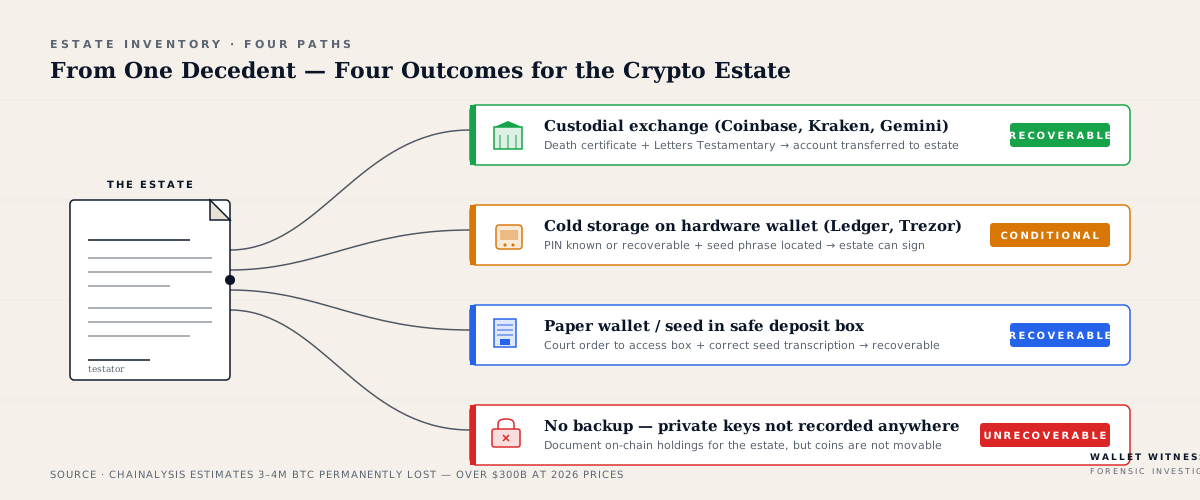
Chainalysis estimates 3 to 4 million Bitcoin — over $300 billion at 2026 prices — are permanently lost to forgotten passwords, discarded hard drives, and dead holders whose keys went to the grave with them. That number rises every year as crypto's first generation ages.
When a crypto holder dies, the executor's problem splits into two parts. Custodial holdings (Coinbase, Kraken, Gemini) are recoverable through standard probate documentation. Self-custody holdings depend entirely on whether anyone can locate the private keys.
A forensic investigator does for crypto estates what a forensic accountant does for traditional estates: identifies what the decedent owned, documents it for the inventory and tax filings, and lawfully accesses what is technically accessible. What never gets recreated is a key that was never recorded. The honest scope is identification, valuation, and lawful access — not the resurrection of lost coins.
In This Article
- Why crypto inheritance is different from any other estate asset
- By the numbers: $300B+ in locked Bitcoin and counting
- The executor's reality: legal authority doesn't recreate a private key
- Custodial vs self-custodial: two completely different recovery paths
- What a forensic investigator actually does for an estate
- Exchange death-claim procedures (Coinbase, Kraken, Gemini, Binance.US, Crypto.com)
- RUFADAA and the legal framework
- When private keys are lost: honest triage
- Cost basis reconstruction for Form 706 and the final 1040
- Working with your probate attorney: the practical workflow
- Frequently asked questions
This article is written for executors, probate attorneys, trust officers, and family members who have just discovered the deceased held cryptocurrency — or who suspect they did and have no idea where to start. It explains the legal framework, the practical exchange procedures, the on-chain attribution work that finds wallets nobody told you about, and the honest limits of what is and is not recoverable when a crypto holder dies. The goal is to make the next 30 to 90 days of the estate administration concrete and actionable rather than overwhelming.
Why Crypto Inheritance Is Different From Any Other Estate Asset
Every other asset in a typical estate has a custodian who answers to the law. A bank holds the deposit account; a brokerage holds the securities; a registrar holds the title to the house; the state DMV holds the title to the car. When the executor presents Letters Testamentary, the custodian transfers control. The executor does not need to know how the bank's vault works.
Self-custodial cryptocurrency has no custodian. The Bitcoin network does not know the holder died. There is no help desk to call. There is no master key. The coins sit at a blockchain address that is controlled mathematically by whoever possesses the private key. If that key existed only in the decedent's head, or only on a hardware wallet whose PIN nobody knows, or only on a slip of paper that was thrown out as junk, then no court order, no Letters Testamentary, no notarized affidavit, and no act of any authority on Earth can move those coins. The blockchain is indifferent to the legal status of the key holder.
This is the central asymmetry. Traditional estate work happens in the gap between the decedent and their custodians, mediated by paper. Crypto estate work happens in the gap between the decedent's legal authority and the cryptographic facts on the chain. Bridging that gap is forensic work, not paperwork. It is also work that has to happen quickly — devices get wiped or sold, papers get cleared out, accounts time out and get archived, and every passing week reduces the discovery surface.
An executor who treats a crypto estate like a brokerage estate — who waits for the routine paperwork process, takes weeks to inventory the home, and assumes everything will surface eventually — will lose evidence. The discovery window matters more in crypto than in any other asset class because the assets are bearer-style and the keys are physical. Once a hardware wallet is reset by a well-meaning relative or a phone is wiped before the SIM is canceled, the holdings on it become permanently inaccessible.
By the Numbers: $300B+ in Locked Bitcoin and Counting
Estimates of how much Bitcoin is permanently lost vary by methodology, but the consensus range from Chainalysis and academic researchers is between three and four million BTC — roughly 17 to 23 percent of the 19.8 million BTC currently in circulation. At Bitcoin prices in the $80,000 to $100,000 range, the locked value sits north of $300 billion. That is a number larger than the GDP of most countries, frozen on a public ledger, visible to anyone, movable by no one.
The composition of those lost coins is informative. A meaningful share are early Bitcoin from 2009 to 2012 mined by hobbyists who treated BTC as worthless and never bothered to back up the wallet files. Another share are coins on hard drives that were thrown out, formatted, or lost. A growing share — the share that matters for probate — are coins held by deceased owners whose keys were never shared with anyone.
The probate problem will get worse, not better, for the next twenty years. The cohort that bought Bitcoin between 2010 and 2017 is now in their forties, fifties, and sixties. Many were sole holders who took operational security seriously enough to never tell a spouse or attorney. As that cohort enters peak mortality years, the volume of crypto entering U.S. probate dockets is rising sharply — and the share where the executor knows nothing more than "they had Bitcoin somewhere" is rising with it.
Estate planners are catching up. Bar associations across the country now publish guidance on crypto-aware wills, and a small but growing number of states have passed digital-asset-specific probate statutes. But the existing wills currently being administered were almost all drafted before crypto was on anyone's mind. The estates being opened in 2026 are being administered against documents drafted in 2010, 2015, 2018 — with no provision for digital assets at all.
The Executor's Reality: Legal Authority Doesn't Recreate a Private Key
Within days of being appointed, an executor with a crypto-holding decedent typically faces some version of the following situation. There is a will, possibly a trust. There are Letters Testamentary or Letters of Administration. There is a probate attorney. There may be vague mentions of cryptocurrency — an offhand comment, an old bank statement showing a Coinbase ACH transfer, a hardware wallet box in a desk drawer, an email reply from "Coinbase Support" two years ago. There is no inventory. There is no list of accounts. There may not even be a list of devices. And the family does not know what they do not know.
The instinct is to call the exchanges. That is a fine first step for the custodial portion. But it solves only the custodial portion, and even there, the executor needs to know which exchanges to call. Coinbase is not going to volunteer the existence of an account because the executor does not know to ask. Kraken does not have a search-by-name function for grieving family. Each platform requires the executor to come in already knowing the account exists.
For the self-custody portion, calling exchanges does nothing. A hardware wallet does not appear on any statement. A paper wallet generates no IRS form. A self-hosted Ethereum address has no support number. The only way to find self-custody holdings is to investigate the decedent's footprint — the bank transfers, the device contents, the paper artifacts, the on-chain attribution — and reconstruct what they did.
Letters Testamentary give the executor legal authority to act on behalf of the estate. They are the document an exchange will accept to transfer a custodial account. They are the document a bank will accept to release statements. They do not give anyone the ability to derive a private key from a missing seed phrase. The legal authority to take possession of an asset is not the same as the technical ability to do so. This is the line that separates traditional probate from crypto probate, and it is the line a forensic investigator works along.
Custodial vs Self-Custodial: Two Completely Different Recovery Paths
The first triage question for every crypto estate is which buckets the holdings fall into. The recovery paths could not be more different.
| Holding Type | Examples | Recovery Path |
|---|---|---|
| Custodial exchange | Coinbase, Kraken, Gemini, Binance.US, Crypto.com, Robinhood Crypto, Cash App | Bereavement / death-claim process. Submit certified death certificate, Letters Testamentary, executor ID. Account contents transferred to estate or liquidated to a designated estate bank account. Typical timeline 4–12 weeks. |
| Custodial brokerage with crypto | Fidelity Crypto, Charles Schwab BTC ETF positions, IRA crypto custodians | Standard brokerage estate transfer process. ETF positions follow normal securities probate. |
| Hardware wallet (cold storage) | Ledger, Trezor, Coldcard, GridPlus, Keystone | Physically locate the device. Recover the PIN (sometimes written, sometimes guessable, sometimes lost). Recover the seed phrase backup (24 words on paper, metal plate, or stored elsewhere). With both, the estate can sign transactions. Without the seed and without the PIN, the device is a brick. |
| Software wallet on phone or laptop | MetaMask, Phantom, Trust Wallet, Exodus, Atomic, Electrum | Locate the device. Recover the password (sometimes saved in browser/keychain, sometimes recoverable through forensic device imaging, sometimes lost). Recover the seed phrase backup. Same constraint as hardware wallets: no seed, no recovery. |
| Paper wallet / metal seed plate | Handwritten seed phrase, BIP39 metal backups (Cryptosteel, Billfodl) | Search safe deposit box (court order may be required), home office, fireproof safe, file cabinets, books on shelves, everywhere. The artifact is small and easy to overlook. With it, recovery is straightforward; without it, the holdings are unmovable. |
| Brain wallet / memorized passphrase | BIP39 25th-word passphrase known only to the deceased | Generally unrecoverable. Some partial-information attacks are possible if the passphrase pattern is partially known, but these are limited. If the passphrase died with the holder, the protected funds are inaccessible. |
| Multisig wallet | Casa, Unchained Capital, custom 2-of-3 setups | Depends on the threshold and the location of the keys. If the decedent held one of three and the other two are with a custodian and a co-signer, recovery is straightforward. If the decedent held two of three, the third key holder cannot move the funds alone. |
| Staked / locked DeFi positions | ETH staked at Lido or Coinbase, locked governance tokens, LP positions | Recoverable if the controlling wallet's keys are recoverable. The protocol does not care about the holder's death — the wallet holding the position must sign to unstake or unlock. |
| NFTs | OpenSea profiles, ENS names, ApeCoin, art NFTs | Visible at the wallet address. Transferable to the estate if keys are recovered. Valuation for probate is often the harder problem than recovery — thin markets, gaps in comparable sales. |
The first question a forensic investigator asks is: what did the decedent's actual setup look like? The answer determines whether the work ahead is largely paperwork (custodial-heavy estates) or largely investigative (self-custody-heavy estates), and how much can realistically be moved into the inventory.
What a Forensic Investigator Actually Does for an Estate
This is where the value of bringing in a forensic investigator early in the probate process becomes concrete. The work breaks into four phases that run partly in parallel with the broader estate administration. Each phase produces a written deliverable that the probate attorney can use directly.
Mapping every signal that suggests crypto was held
The investigator works through the paper, digital, and physical artifacts the decedent left behind. The standard discovery checklist includes the last three to five years of federal tax returns (Form 1040 digital-asset question, Form 8949 dispositions, Schedule 1 crypto income, 1099-B and 1099-MISC from exchanges), bank statements (ACH and wire transfers to and from Coinbase, Kraken, Gemini, Crypto.com, Cash App, Binance.US, Robinhood Crypto), credit card statements (hardware wallet purchases at Ledger, Trezor, Coldcard; subscription payments to crypto services), and email accounts (exchange welcome emails, two-factor backup codes, password resets, wallet recovery instructions).
Physical discovery covers the decedent's home office, safe, safe deposit box (with appropriate court authorization), file cabinets, computer desk drawers, bookshelves (seed phrases are often hidden in books), and any storage units. Hardware wallets, USB drives, old phones, old laptops, and notebooks are all collected for forensic imaging before anything is reset or wiped.
The output of Phase 1 is a written discovery memo identifying every exchange the decedent appears to have used, every wallet address the discovery surfaced, every device that may hold keys, and every paper artifact relevant to attribution. This becomes the working inventory.
Determining which wallets the decedent actually controlled
This is the deepest forensic work and the part most laypeople do not realize is even possible. Once exchange withdrawal addresses are identified (from exchange records the executor has obtained or from on-chain analysis of the deposit-side history), the investigator follows the funds through the blockchain to wherever they currently sit. Wallet clustering heuristics group additional addresses with the initial seed addresses based on common-input ownership and behavioral patterns.
Where exchange records reveal IP addresses associated with the decedent's logins, withdrawal patterns can be cross-referenced against IP geolocation, time-of-day signatures, and counterparty patterns to support attribution of additional wallets that were never directly linked to a known account. Patterns the investigator looks for include consistent gas-payment behavior, repeated small test transactions before large transfers (a common practice for self-custody users), interactions with specific protocols the decedent is known to have used, and timing correlations with bank-statement activity.
The output of Phase 2 is a sworn forensic report listing each wallet address attributed to the decedent, the basis for the attribution, the current holdings at each address, and the confidence level of the attribution. The report is structured to be useful as an exhibit in any subsequent court filing — whether for an inventory amendment, a turnover petition, or, in contested estates, a beneficiary dispute.
Producing the inventory entries the probate court and the IRS need
Each identified holding is documented for two purposes: the probate inventory the executor files with the court, and the tax filings the estate is responsible for. For each wallet address and each token holding, the investigator records the asset type, the quantity, the fair market value at the date of death (with citations to the exchange-rate sources used), the alternate valuation date value if elected (six months after death under IRC section 2032), the cost basis where reconstructable, and the holding period.
Cost basis reconstruction often requires going back through years of exchange records, on-chain transactions, and where available, the decedent's own records. For coins acquired through mining, staking rewards, airdrops, or DeFi yield, the investigator computes basis based on the fair market value at the date of receipt. This work is essential because the heirs receive a stepped-up basis to date-of-death value under IRC section 1014, and clean documentation preserves that step-up while exposing any capital gains the decedent owed at death (which appear on the final Form 1040).
The output of Phase 3 is a formal asset-by-asset valuation memorandum the probate attorney can attach to the inventory filing and the estate tax return, with appendices containing the underlying exchange records and on-chain transaction histories.
Working with exchanges, attorneys, and (where keys exist) executing the transfers
For custodial holdings, the investigator coordinates with the probate attorney on the bereavement-process documentation each exchange requires, monitors the exchange's response timeline, and follows up on stalled requests. Each major U.S. exchange has a different process, different document requirements, and different timelines — institutional knowledge of these processes is part of the value an investigator brings.
For self-custody holdings where the keys have been recovered, the investigator works with the executor and counsel on the secure transfer of holdings to estate-controlled addresses. Best practice is to move funds in stages, with documentation at each step, to a wallet structure that aligns with the will's distribution provisions and the estate's tax planning. The investigator does not custody assets — the keys remain with the executor or a designated estate fiduciary throughout — but provides the technical support for the transfers to be done correctly.
For self-custody holdings where the keys cannot be recovered, the investigator documents the holdings on the inventory as visible-but-unmovable assets, with a clear notation that the keys are not in the estate's possession. This is important for tax purposes (the holdings still count toward the gross estate for Form 706 if the estate is large enough) and for honest accounting to the beneficiaries.
Exchange Death-Claim Procedures
Each major U.S. exchange has documented bereavement procedures, but the requirements and timelines vary. The table below reflects the standard documentation requested by each platform as of 2026. Always verify the current process with the exchange directly before submitting — requirements are updated regularly.
| Exchange | Standard Documentation Requested |
|---|---|
| Coinbase | Certified death certificate; Letters Testamentary or Letters of Administration; government-issued photo ID of the executor; written request signed by the executor; deceased account holder's full legal name and email on file. Coinbase routes the request through its specialized estate team. Funds are typically transferred or sold to a designated bank account; in-kind asset transfer to an heir-controlled wallet is supported in some cases. |
| Kraken | Certified death certificate; court-issued document granting executor authority (Letters Testamentary, Letters of Administration, or equivalent for non-U.S. jurisdictions); government photo ID of the executor; signed instructions specifying disposition. Kraken's process is documented in their Support Center and routed through their account-recovery team. |
| Gemini | Certified death certificate; Letters Testamentary or equivalent; executor government ID; notarized affidavit of authority in some cases; account information on file (full name, registered email). Gemini Trust Company is a New York-chartered trust company with established procedures for fiduciary access. |
| Binance.US | Certified death certificate; court-appointed fiduciary documents (Letters Testamentary or Letters of Administration); executor ID; notarized authorization. Process is initiated through the Binance.US support portal and reviewed by their compliance team. Wind-down implications: U.S. customers should verify current operating status and successor procedures before relying on long timelines. |
| Crypto.com | Certified death certificate; Letters Testamentary or court order naming the executor; executor government photo ID; written request describing the desired disposition. Crypto.com routes estate requests through its support channel and may require additional jurisdictional documentation depending on the executor's residence. |
| Robinhood Crypto | Treated as part of the broader Robinhood account estate process. Death certificate; Letters Testamentary; executor ID; Robinhood's standard estate-transfer paperwork. Robinhood's bereavement team handles securities and crypto positions together. |
| Cash App (Bitcoin) | Bitcoin balances on Cash App are treated similarly to Cash App fiat balances. Death certificate; Letters Testamentary; executor government ID. Cash App's family-access process is initiated through its support channels; balances are typically transferred to an estate account. |
Send the same standard package to every exchange on the suspected list, in parallel, in the first week of administration. Exchanges process estate requests in queues that can take 4 to 12 weeks; serial submission turns a 12-week timeline into a 12-month timeline. The package is the same for every platform: certified death certificate, Letters Testamentary, executor ID, signed authorization. Have the probate attorney prepare the package once and send copies everywhere at once.
RUFADAA and the Legal Framework
The Revised Uniform Fiduciary Access to Digital Assets Act (RUFADAA) is the legal framework that, in nearly every U.S. state, gives executors and other fiduciaries default authority to access the deceased's digital assets including cryptocurrency. RUFADAA was promulgated by the Uniform Law Commission and has been adopted in the substantial majority of U.S. jurisdictions. The statute creates a layered priority system: an online tool provided by the platform (such as Google's Inactive Account Manager or Facebook's legacy contact) controls if the user used it; otherwise the user's will or trust controls; otherwise RUFADAA's default rules apply.
For exchange-held crypto, RUFADAA's significance is mostly procedural. The exchanges are subject to the act in any state that has adopted it, which means they cannot refuse to engage with a properly documented executor request on the grounds that crypto is "different" or that their terms of service override the executor's authority. The act resolves the legal question of access authority. It does not, however, override the platform's right to require the same identity verification it requires of any other request, and it does not create any new technical capability.
RUFADAA does nothing for self-custody holdings. The act is about access to digital accounts — the legal authority piece. It cannot bridge the cryptographic gap. For self-custody, the relevant law is the underlying probate law of the jurisdiction (which gives the executor authority to take possession of the decedent's tangible personal property, including the devices on which keys reside) and the criminal-law exposure of any third party who tries to access those devices without authorization (which is why the executor's role is critical — only the executor has the authority to authorize access to the decedent's devices).
For the full text and adoption status, see the Uniform Law Commission's RUFADAA committee page. State-by-state adoption details are tracked at the same source. Probate attorneys should confirm the current status in the jurisdiction where the estate is being administered, including any state-specific amendments.
When Private Keys Are Lost: Honest Triage
Honesty matters in this section more than anywhere else in the article. There is a recovery industry built on telling grieving families that lost crypto can always be retrieved. It cannot. Some can; some cannot; the difference is not always obvious at intake; and any service promising guaranteed recovery of self-custody holdings without first auditing what the decedent actually left behind is selling something other than forensics.
What is actually possible breaks into three buckets:
Probable recovery
- Hardware wallet present, seed phrase backup found in the home or safe deposit box, PIN known or recoverable from a written record
- Software wallet on an unlocked or recoverable phone or laptop, with the seed phrase or wallet password also locatable on the device or in a password manager
- Paper wallet found and the funds have not been spent (verifiable on-chain)
- Multisig setup where the decedent's key is one of N and the surviving co-signers are accessible
Possible recovery (depends on specifics)
- Hardware wallet present but PIN unknown — partial recovery possible through firmware-level techniques on some older device versions; current Ledger and Trezor devices have stronger protections
- Software wallet on a device with a forgotten password — some recovery is possible through forensic device imaging if the wallet file is intact and the password is partially known or follows a guessable pattern
- Partial seed phrase — if 18 to 22 of 24 words are recovered, brute-force computation of the missing words is feasible; below that, the search space rapidly becomes intractable
- Encrypted backup with partially-known passphrase — depending on the encryption scheme and what is known, may be tractable
Generally not recoverable
- No backup of any kind — seed phrase was memorized only and the holder is gone
- Hardware wallet reset (PIN entered too many times, or device factory-reset by a well-meaning relative)
- Phone or laptop wiped, sold, or destroyed before forensic imaging
- BIP39 passphrase (the optional 25th word) known only to the decedent — without it, even the recovered seed phrase reaches the wrong wallet
- Cloud backup encrypted with a password the decedent never recorded anywhere
Within weeks of news circulating that an estate is dealing with locked crypto, the family will be approached by people claiming to "recover" the funds. They cannot. These contacts are the same recovery-fraud pattern that targets scam victims — second-stage operators looking for upfront fees and then disappearing. A legitimate forensic investigator will scope the case honestly and tell the executor when something is unrecoverable. See how to spot recovery scams for the full pattern. If anyone guarantees recovery of self-custody crypto without first reviewing the actual evidence, treat it as a scam.
For unrecoverable holdings, the work shifts from access to documentation. The wallets remain visible on-chain at the addresses identified during attribution, but the holdings are reported on the estate inventory as encumbered by the missing keys. For the IRS, the question of whether unmovable holdings count toward the gross estate is a legal one that depends on the facts; the prevailing position is that they do, because the estate has the legal right of access even if it cannot exercise it. That conversation belongs with the probate attorney and the estate's CPA, with the forensic report providing the evidentiary foundation.
Cost Basis Reconstruction for Form 706 and the Final 1040
The tax piece of crypto probate is its own discipline. Three returns are typically in play: the decedent's final Form 1040 (covering the period from January 1 of the year of death to the date of death), the estate's Form 1041 (covering income earned by the estate during administration), and, for larger estates, Form 706 (the federal estate tax return, due nine months after death). Each requires different cost-basis information.
For the final 1040, the issue is whether the decedent had unrealized gains that became realized through pre-death dispositions, and whether mining, staking, or DeFi yield income was unreported. A forensic investigator's transaction reconstruction surfaces these items. Pre-death sales, swaps, and DeFi exits all have to be reported as they would for any taxpayer. Failing to report them on the final 1040 creates exposure for the estate.
For Form 1041, post-death income generated by estate-held crypto (staking rewards, DeFi yield, airdrops) is reported as estate income. The estate's basis in the crypto is the date-of-death fair market value (per IRC section 1014), which is also typically the basis the heirs inherit when assets are distributed.
For Form 706, every crypto holding identified during attribution is valued at fair market value on the date of death. Where the alternate valuation date is elected (six months after death under IRC section 2032), values are recomputed. The investigator's documentation of each address, each holding, and each pricing source is what makes the 706 defensible if the IRS examines it. For general guidance on the IRS's treatment of digital assets, see the IRS's digital assets resource page.
One important interaction: the date-of-death valuation establishes the heirs' stepped-up basis. If an heir later sells the inherited crypto, their gain or loss is computed against the step-up, not against what the decedent originally paid. Clean date-of-death documentation is therefore not just a tax-filing requirement — it is a long-running benefit to the heirs that good forensic work preserves and sloppy work destroys.
Working With Your Probate Attorney: The Practical Workflow
The best estate outcomes come from forensic and legal work running in parallel from the first week, not in series with the forensic engagement starting after the inventory deadline has lapsed. The workflow below is what a typical engagement looks like in practice.
- Week 1 — Preservation order. The executor secures the decedent's devices, papers, and documents. Nothing is wiped, sold, given to relatives as keepsakes, or thrown out. Hardware wallets are kept powered-off in a secure location. Phones and laptops are kept in their current state — do not enter wrong PINs or attempt password resets, which can lock or wipe data. The probate attorney issues a written preservation memo to the family.
- Week 1–2 — Forensic engagement and document collection. The forensic investigator is engaged, reviews the will and the executor's appointment, and begins the discovery process. Tax returns, bank statements, credit card statements, and accessible email accounts are collected.
- Week 2–4 — Parallel exchange outreach. The probate attorney prepares the standard estate package (death certificate, Letters Testamentary, executor ID, written authorization) and sends it to every exchange the discovery has identified or suggested. The investigator simultaneously begins on-chain attribution work on any wallet addresses surfaced in the discovery.
- Week 3–6 — Device imaging and key recovery. Hardware wallets and computing devices are forensically imaged. Where keys, seed phrases, or wallet passwords are recoverable from the imaging, they are documented and held by the executor. The investigator does not custody assets.
- Week 4–10 — Inventory drafting. The forensic report is integrated into the probate inventory the executor files with the court. Custodial holdings are listed with their exchange and date-of-death value; self-custody holdings are listed with their wallet addresses and date-of-death value, with a notation indicating whether the keys are in the estate's possession.
- Month 3–9 — Tax filings. The forensic cost-basis work flows into the final 1040 (due April 15 of the year following death), the 1041, and the Form 706 (due nine months after death). Filing extensions are available where the forensic work is still in progress.
- Distribution — Beneficiary transfers. Once the inventory is approved and tax obligations are addressed, accessible holdings are transferred to beneficiaries per the will. The investigator can support the secure transfer of self-custody holdings to beneficiary-controlled wallets where the beneficiaries are willing to take in-kind crypto distributions.
For attorneys who want to develop in-house capability for crypto-touched estates, our pieces on crypto forensic investigation and blockchain forensic evidence in federal civil litigation cover the underlying methodology and evidentiary standards. The discovery patterns for hidden assets carry over from the family-law context covered in hidden crypto assets in divorce and civil subpoenas to crypto exchanges, and the bankruptcy-side analog is covered in bankruptcy crypto asset tracing. For the standalone subpoena mechanics, see subpoenaing a crypto exchange. For the underlying knowledge-base resources, the wallet security and legal actions sections are the relevant primers.
Administering an estate with crypto?
Initial scoping calls for executors and probate attorneys are free. We will tell you, before any engagement, what is and is not realistically possible given the facts of the estate. Honest scoping at intake; written deliverables suitable for the inventory and tax filings; coordination directly with your probate counsel.
Start a Free Case ReviewFrequently Asked Questions
Crypto in probate is a discipline that lives at the intersection of estate law, tax law, and blockchain forensics. It does not fit cleanly into the workflow of a traditional probate practice, and it does not fit cleanly into the workflow of a traditional forensics practice either. The work that actually makes a crypto estate close cleanly is the patient, parallel coordination of all three — legal authority, technical access, and tax documentation — from the first week of administration. Executors who treat the crypto piece as something that can wait until later usually find that what could wait is gone by the time they look.